
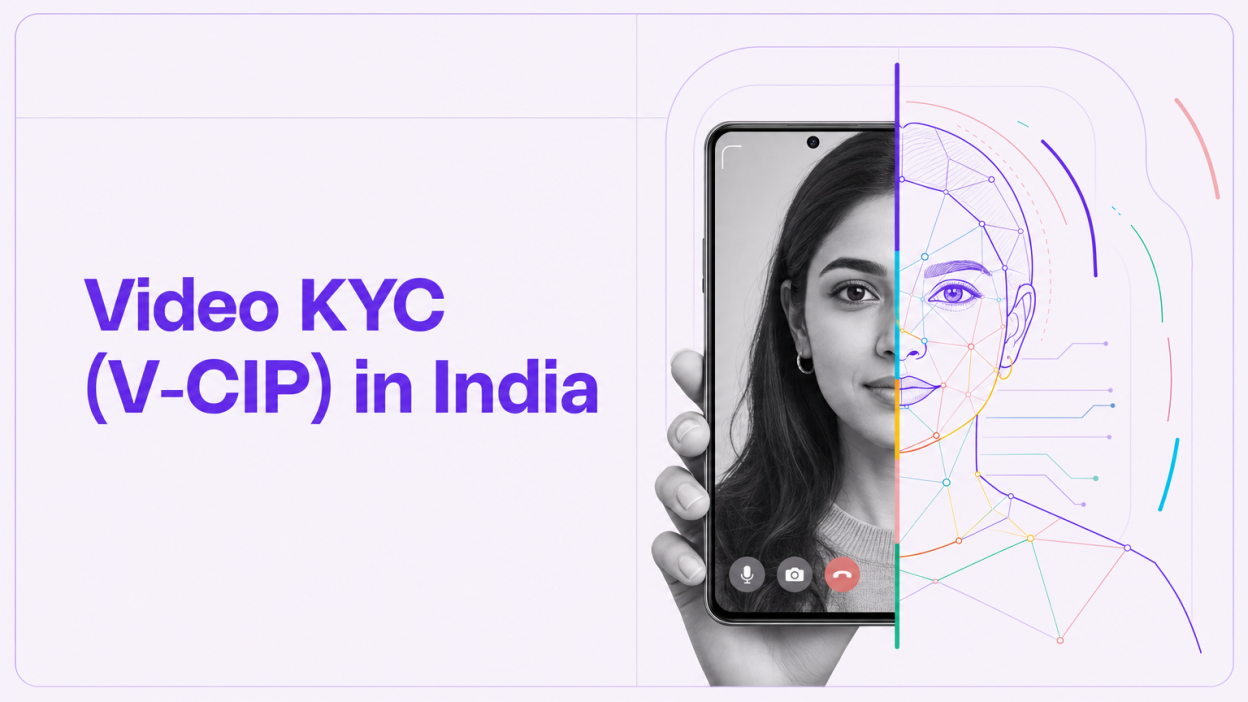
Video KYC made fully remote account opening possible in India. A customer can open a savings account, get a full-KYC wallet or take a loan without visiting a branch, provided a live, recorded video interaction with a trained official meets RBI’s conditions.
The process is now mainstream, but completion rates vary widely. Many sessions fail for reasons that have nothing to do with the customer’s eligibility: a stale Aadhaar file, a weak network, the wrong location or a PAN mismatch discovered only on camera.
This guide explains what V-CIP requires, how a compliant session runs, where sessions fail and how pre-checks lift completion without weakening controls.
What V-CIP Is
V-CIP stands for Video-based Customer Identification Process. RBI defines it as an alternative method of customer identification in which an authorised official of the regulated entity carries out a live, seamless, secure, consent-based audio-visual interaction with the customer to obtain identification information and documents.
For regulatory purposes, a V-CIP carried out in line with the rules is treated as equivalent to face-to-face customer due diligence.
How V-CIP Evolved
- January 2020: RBI introduced V-CIP through an amendment to its KYC framework.
- 2021: The scope was widened, including use for legal-entity representatives in specified cases and for periodic updation, with more detailed infrastructure and procedure requirements.
- 2024-2025: Further amendments refined procedures, including acceptance of digitally signed documents and tighter controls.
- 28 November 2025: The KYC Master Direction of 2016 was replaced by entity-specific KYC Directions; V-CIP requirements continue under the new structure.
SEBI and IRDAI run their own video-based verification frameworks for intermediaries and insurers, with similar principles.
Core RBI Requirements
The requirements fall into four groups.
Infrastructure
- The V-CIP application and infrastructure must be the RE’s own or under its control, with end-to-end encryption and connections initiated from the RE’s domain.
- Systems must undergo vulnerability assessment, penetration testing and security audits before going live and periodically after.
- The technology must detect and prevent spoofing, including liveness checks.
Procedure
- The interaction must be live and conducted by a trained official, not pre-recorded.
- The customer must be physically present in India, confirmed through geo-tagging.
- The official must vary the sequence and type of questions to confirm the interaction is real.
- If the session breaks, it must restart rather than continue from where it stopped.
Documents and data
- Identity is established through Aadhaar-based e-KYC authentication where permitted, or offline verification using Aadhaar XML or Secure QR, which must be generated no more than three days before the V-CIP.
- Equivalent e-documents, including those from DigiLocker, can be used.
- PAN must be verified, including against the issuing database, and the customer’s face matched to the photograph on the identity document.
Records and audit
- The session must be recorded, time-stamped and stored securely.
- Accounts opened through V-CIP are subject to concurrent audit before becoming operational.
The V-CIP Process Step by Step
- Pre-session: The customer fills the application, gives consent, and shares Aadhaar offline data or completes e-KYC and PAN details.
- Queue and connect: The customer joins a video call initiated from the RE’s application or domain. Location permission is captured.
- Liveness and identity: The official confirms liveness, compares the customer’s face with the ID photograph and asks varied questions.
- Document display: The customer shows the original PAN card or presents an e-PAN; the official captures it clearly.
- Verification: Data from Aadhaar, PAN and the application are matched; discrepancies are resolved on the call or the session is closed.
- Closure: The session is recorded and the case moves to concurrent audit before the account is activated.
Why Video KYC Sessions Fail
Failure analysis across lenders and banks typically shows a small number of recurring causes:
| Failure point | Typical cause | Preventable before the call? |
|---|---|---|
| Stale Aadhaar data | XML or QR older than three days | Yes |
| PAN mismatch | Name or date of birth differs between PAN and Aadhaar | Yes |
| Face mismatch | Old Aadhaar photograph, poor lighting | Partly |
| Location outside India or unavailable | GPS off, VPN, travel | Yes |
| Network drop | Low bandwidth | Partly |
| No original PAN at hand | Customer unprepared | Yes |
| Agent wait time | Peak-hour queues | Operational |
Most of these can be detected before the customer ever reaches an official, which is where completion gains come from.
Pre-VKYC Checks That Improve Completion
Pre-checks run silently or with minimal customer effort before the call:
- Aadhaar freshness: Confirm the XML or QR timestamp is within the permitted window.
- PAN verification and name match: Verify PAN status and compare name and date of birth with Aadhaar data using scored matching; flag mismatches before the call.
- Selfie face match: Compare a selfie with the Aadhaar photograph to predict on-call face-match problems.
- Location and device check: Confirm location permission, detect VPNs and check network quality.
- Readiness prompts: Remind the customer to keep the original PAN card and be in a well-lit place.
These checks do not replace the V-CIP requirements. They make sure only ready, likely-eligible customers enter the queue, which reduces official time per successful account.
Fraud Risks, Including Deepfakes
V-CIP is a high-value target. Risks include:
- Deepfake and face-swap video injected through virtual cameras
- Coached mules who pass genuine identity checks but will hand the account to others
- Document display fraud using printed or edited PAN images
Controls include virtual-camera and emulator detection, active liveness, random challenge questions, device and mobile-number risk signals, and post-onboarding monitoring of new accounts.
Use Cases
Digital savings accounts: A bank upgrades minimum-KYC accounts to full KYC through V-CIP, using pre-checks so that only customers with fresh Aadhaar data and matching PAN are queued.
Personal loans: An NBFC uses V-CIP for higher-value loans, with pre-VKYC face match and PAN verification cutting call failures.
Full-KYC PPI wallets: A wallet issuer runs V-CIP to upgrade users, adding device and virtual-camera checks to stop fraud rings.
Periodic updation: A bank uses V-CIP for high-risk customers whose KYC is due, avoiding branch visits.
Key Takeaways
- V-CIP is RBI’s Video-based Customer Identification Process, treated as equivalent to face-to-face CDD when done correctly.
- Core requirements cover owned and secured infrastructure, live interaction, geo-tagging in India, fresh Aadhaar data, PAN verification, recording and concurrent audit.
- Most failures come from stale Aadhaar files, PAN mismatches, location issues and unprepared customers.
- Pre-VKYC checks catch these before the call and improve completion without weakening controls.
- Deepfakes and coached mules require device, liveness and post-onboarding monitoring.
Frequently Asked Questions
Is video KYC recorded?
Yes. Sessions must be recorded, time-stamped and stored securely by the regulated entity.
Why did my video KYC fail?
Common reasons include an Aadhaar file older than three days, PAN and Aadhaar details not matching, poor network, location issues or not having the original PAN card.
Can I complete video KYC from outside India?
No. The customer must be physically present in India, confirmed through geo-tagging.
Is video KYC legally valid in India?
Yes. When carried out according to RBI’s requirements, V-CIP is treated as equivalent to face-to-face KYC.
What is the full form of V-CIP?
Video-based Customer Identification Process.
Conclusion
V-CIP gives Indian institutions a compliant route to fully remote onboarding, but the regulatory requirements are only half the design. The other half is making sure customers arrive at the call ready to pass, and that fraud attempts are stopped before they consume an official’s time.
Institutions that invest in pre-checks and anti-spoofing controls see higher completion, lower cost per account and cleaner audit outcomes.
BeFiSc’s verification APIs support pre-VKYC checks such as PAN verification, name matching, face match and mobile-number risk signals, so more video KYC sessions succeed on the first attempt. Talk to the BeFiSc team to set them up.


[…] characters 3 to 12 give you the PAN, so a GSTIN that does not match the PAN on the borrower’s KYC is an immediate stop. Second, the check character catches most typing errors before you even query […]