The last mile of digital lending used to be a courier. A lender could source, underwrite, and approve a loan online in minutes, yet still wait days for the borrower to sign and return the agreement by post. Aadhaar eSign removed that mile. A borrower now signs a Digital Agreement Execution with an OTP, and the signed document carries stronger evidence of who signed it and when than most wet signatures ever did.
Yet eSign remains widely misunderstood. Teams conflate it with scanned signatures, misjudge where it is legally sufficient, or integrate it without the audit trail that gives it courtroom weight. In this guide, we explain what Aadhaar eSign actually is. Next, we cover the legal framework behind it, the signing workflow, and the integration decisions that ultimately determine whether your signed documents can withstand a dispute.
What Is Aadhaar eSign?
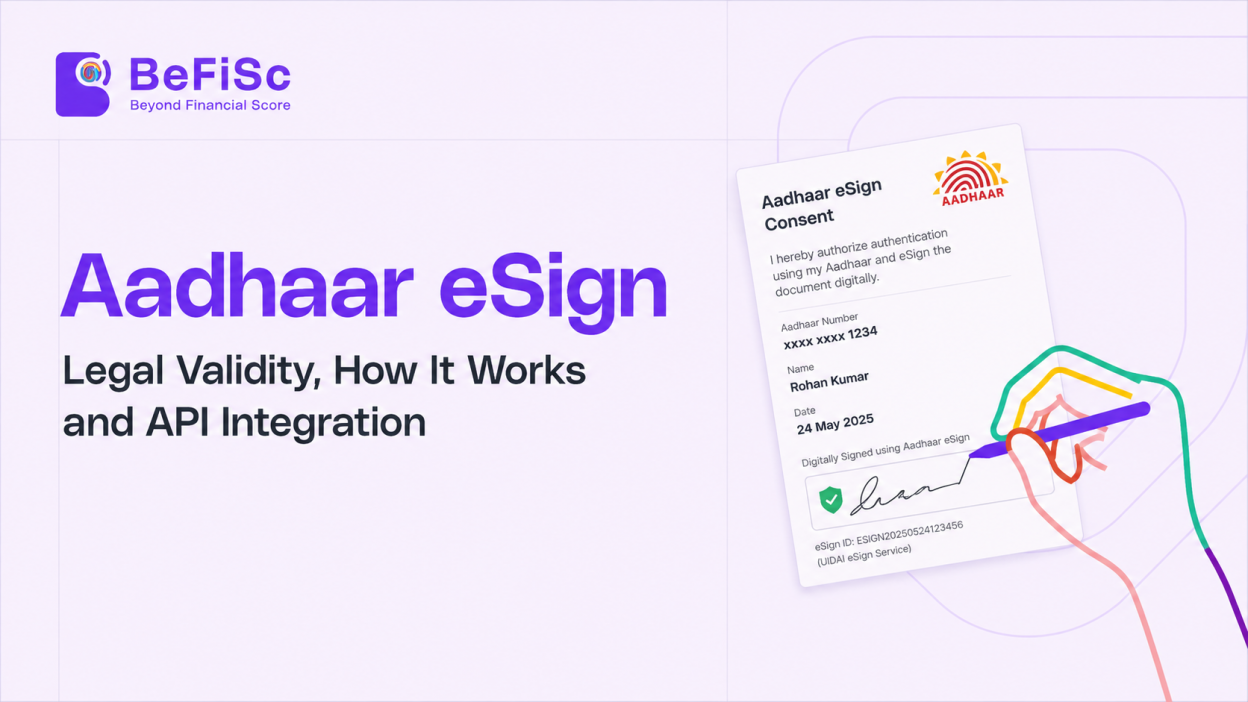
Aadhaar eSign is an online electronic signature service that lets an Aadhaar holder sign documents digitally after authenticating themselves, most commonly with an OTP sent to their Aadhaar-linked mobile number. The service issues a short-lived digital signature certificate in the signer’s name at the moment of signing and applies a cryptographic signature to the document.
Three properties distinguish it from anything resembling a pasted signature image.
Identity-bound. Moreover, the verified Aadhaar identity authenticates the signer at signing time. As a result, it binds the signature to that verified identity rather than to an image that anyone could copy.
Document-bound. The system computes the signature over the document’s hash. Change one character after signing, and validation fails, making tampering self-evident.
Time-bound. Furthermore, the signature embeds a trusted timestamp. As a result, it establishes exactly when the signing act occurred.
Ultimately, the signature answers the three questions every dispute raises: who signed, what exactly they signed, and when they signed it. Moreover, it provides cryptographic evidence rather than relying solely on testimonial evidence.
The Legal Framework: IT Act, CCA, and ESPs
Therefore, Aadhaar eSign’s validity rests on a specific legal chain. For this reason, understanding that chain matters when counterparties or courts scrutinize the signature.
The Information Technology Act, 2000 recognises electronic signatures as legally equivalent to handwritten signatures for most documents. The Act’s Second Schedule specifically recognises the eSign technique, an electronic signature using Aadhaar e-KYC services, as a recognised, reliable method.
The Controller of Certifying Authorities (CCA) licenses the ecosystem: Certifying Authorities issue digital signature certificates, and eSign Service Providers (ESPs) operate the online signing service. When your platform integrates Aadhaar eSign, an ESP performs the Aadhaar-based authentication, obtains the momentary certificate, and applies the signature.
Two boundaries deserve respect. First, the IT Act’s First Schedule excludes certain documents from electronic execution: negotiable instruments (other than cheques), powers of attorney, trusts, wills, and contracts for the sale of immovable property. Second, stamp duty is a separate question from signature validity: an eSigned agreement may still need e-stamping under the relevant state’s stamp law. Signature and stamp are different compliance objects; mature document workflows handle both.
How the Aadhaar eSign Workflow Works
A production Aadhaar eSign journey has five steps, and the details determine its evidentiary strength.
Step 1: Document Preparation
The platform finalises the document, say, a loan agreement, and computes its hash. Only the hash travels to the ESP, not the document, which keeps contract contents out of third parties’ hands.
Step 2: Signer Authentication
The signer is redirected to the ESP’s interface, enters their Aadhaar number (or VID), and authenticates with the OTP delivered to their Aadhaar-linked mobile. Biometric authentication is an alternative in assisted settings.
Step 3: Certificate Issuance and Signing
On successful authentication, a digital signature certificate is issued in the signer’s name for that signing session, and the document hash is signed with it.
Step 4: Signature Embedding
The signed hash returns to the platform and is embedded into the document, producing a signed PDF that any standards-compliant reader can validate.
Step 5: Audit Trail Capture
The platform records the full evidentiary bundle: document hash, signature response, timestamp, authentication mode, and the consent screens the signer saw. This bundle, not the PDF alone, is what wins disputes.
The whole journey takes under a minute, which is why it slots so naturally at the end of digital onboarding flows and directly before, where the same eSign act can authenticate the collection mandate.
Aadhaar eSign vs DSC vs Scanned Signatures
Three things get called “digital signing” in India, and only two of them are.
A scanned or drawn signature image is decoration. It proves nothing about identity, integrity, or time, and it earns essentially no evidentiary weight on its own.
A traditional DSC (dongle-based digital signature certificate) is a long-validity certificate issued after in-person or video verification, held by the signer on a token. It is cryptographically strong, and suits repeat professional signers, directors filing with the MCA, and tax professionals, but issuing and managing dongles for one-time consumer signers is operationally absurd.
Aadhaar eSign delivers DSC-grade cryptographic properties through a temporary certificate created at signing time, with no prior issuance process. For consumer-scale, one-off signing of loan agreements, insurance proposals, and account terms, it is the only model that combines legal strength with zero onboarding overhead.
The selection rule is simple: recurring professional signers → DSC; consumer transaction signing at scale → Aadhaar eSign; signature images → never, for anything that matters.
Where Aadhaar eSign Is Used and Where It Is Not Enough
Adoption concentrates where document execution was the last analogue step in an otherwise digital journey.
Lending. Loan agreements, sanction letters, and key fact statements are eSigned at the end of onboarding, the final control in the digital lending flows we analysed under the [RBI digital lending guidelines].
Recurring payments. Aadhaar eSign is one of the authentication modes for eNACH mandates, binding the auto-debit authorisation to a verified identity.
Securities and insurance. Account-opening forms, policy proposals, and consent documents are executed digitally across SEBI- and IRDAI-regulated workflows.
HR and vendor operations. Offer letters, contractor agreements, and vendor onboarding documents move to eSign for speed and audit uniformity.
Where it is not enough: the IT Act’s excluded documents listed earlier, and any context where your risk policy requires proving the signer’s live presence. eSign proves control of the Aadhaar-linked mobile at signing time; it does not prove the person holding the phone is the Aadhaar holder. The same binding logic we apply throughout the verification stack.
Integration and Evidence Architecture
Four decisions determine whether your eSign integration produces documents that hold.
Hash-only transmission. Send document hashes to the ESP, never documents. It is better for confidentiality and eliminates the data-sharing question.
Evidence bundling. Store the signed document, signature response, timestamps, consent screens, and authentication metadata together, immutably. Under the DPDP Act, this bundle is also subject to personal data retention and access controls, as we detailed in our [DPDP compliance analysis].
Multi-signer orchestration. Agreements often need the borrower, a co-applicant, and an authorised signatory. The workflow engine must sequence signers, track partial states, and produce one final document with all signatures validated.
Fallback design. OTP delivery fails; Aadhaar-mobile linkages lapse. Route failures to retry paths and, where policy allows, alternative execution modes without stranding a completed loan application at its final step.
Key Takeaways
- Aadhaar eSign creates legally valid electronic signatures via OTP-based Aadhaar authentication, recognised under the IT Act’s Second Schedule.
- The signature binds identity, document hash, and time stamp, answering who, what, and when with cryptography rather than testimony.
- Certain documents (wills, immovable property sales, powers of attorney) remain excluded; stamp duty is a separate obligation from signature validity.
- Aadhaar eSign suits consumer-scale one-time signing; dongle DSCs suit repeat professional signers; signature images suit nothing.
- Evidentiary strength comes from the audit bundle hash, response, timestamp, and consent trail, not from the signed PDF alone.
Frequently Asked Questions
Does Aadhaar eSign prove the signer was physically present?
No. Aadhaar eSign proves control of the Aadhaar-linked mobile at signing time. Where presence assurance matters — high-value agreements, vulnerable customers — pair Aadhaar eSign with liveness detection and face match before the signing step.
What is the difference between Aadhaar eSign and a DSC?
A DSC is a long-validity certificate on a physical token, suited to repeat professional signers. Aadhaar eSign issues a one-time certificate at the moment of signing with no prior setup, making it the practical choice for consumer-scale document execution.
Which documents cannot be signed with Aadhaar eSign?
Documents excluded from electronic execution under the IT Act — including wills, powers of attorney, trusts, negotiable instruments other than cheques, and contracts for sale of immovable property — cannot rely on Aadhaar eSign.
How does Aadhaar eSign verify who is signing?
Aadhaar eSign authenticates the signer against their Aadhaar identity — typically via an OTP to the Aadhaar-linked mobile — and issues a momentary digital signature certificate in their name, which signs the document’s hash.
Is Aadhaar eSign legally valid in India?
Yes. Aadhaar eSign is a notified electronic signature technique under the Second Schedule of the IT Act, 2000, making it legally equivalent to a handwritten signature for most documents, subject to the Act’s excluded categories.
Conclusion
Signatures were always evidence technology; ink was simply the best available version for a few centuries. Aadhaar eSign is the upgrade: identity-authenticated, tamper-evident, timestamped, and executable at the speed of the journeys it completes. The institutions that benefit most treat it accordingly as an evidence system with an audit architecture, not a checkbox that produces a PDF.
The trajectory ahead is toward composite execution: eSign fused with liveness, consent records, and e-stamping in a single flow, producing agreements that are simultaneously signed, stamped, and provably consented. Teams that build their document infrastructure on that assumption will find each regulatory tightening a configuration change rather than a redesign.