Reverse penny drop solves a critical gap in traditional bank account verification. A standard penny drop confirms that an account exists and returns the registered holder’s name, but it does not prove that the applicant currently controls that account. A fraudster could submit a relative’s, victim’s, or mule account details and still pass the check.
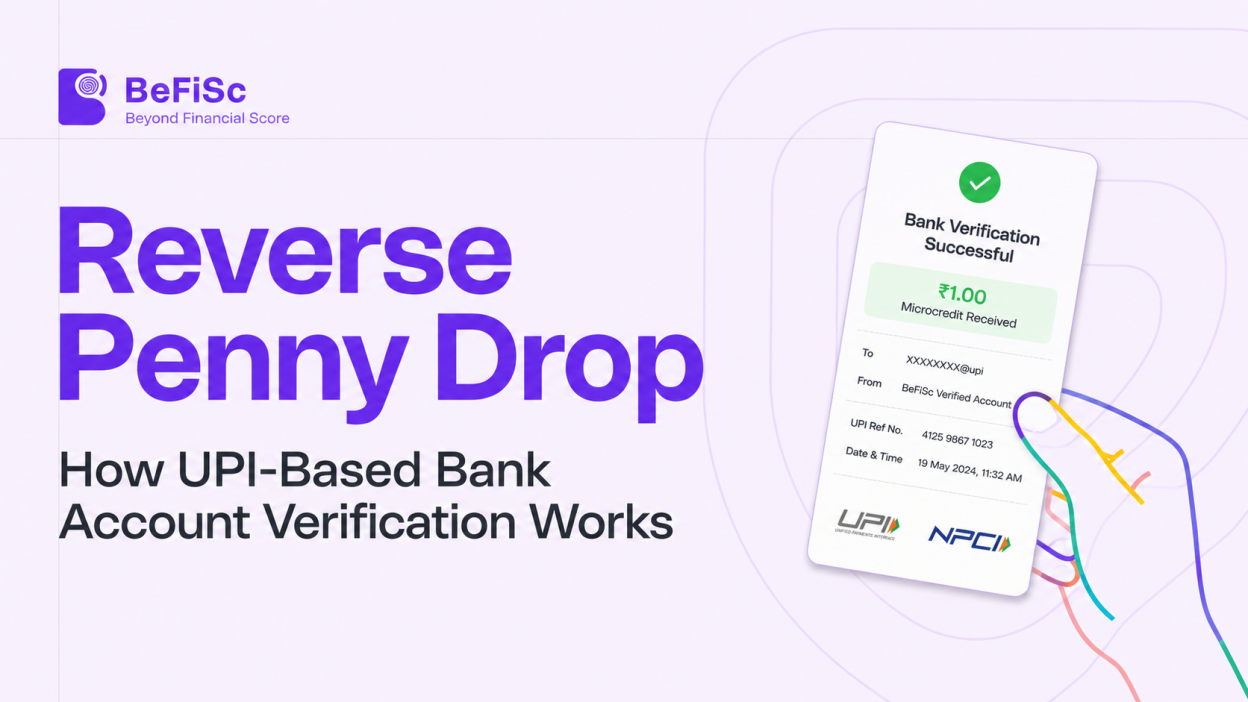
Reverse penny drop closes this gap by reversing the transaction direction. Instead of the business sending ₹1 to the customer, the customer pays ₹1 through UPI from the account being verified. This confirms account existence, retrieves the registered holder’s name, and demonstrates live control of the account.
This guide explains how reverse penny drop works, why lenders are standardising on it, and where it fits against other verification methods.
What Is Reverse Penny Drop?
Reverse penny drop is a bank account verification method in which the customer initiates a small UPI payment, typically ₹1, to the verifying business from the account under verification. The transaction’s response data reveals the account holder’s registered name and confirms the account is active, while the act of payment itself proves the customer controls the account right now.
The method rides on UPI’s architecture. When the customer approves the collect request or scans the QR code and pays, the transaction settles from a specific underlying bank account. The verifier receives the payer’s name as registered with the bank and the account reference, and immediately refunds the rupee.
Three verification outcomes arrive in one step: the account exists and is operational, the registered holder name is captured for matching, and control of the account is demonstrated through the successful, authenticated payment. Traditional methods deliver the first two; only Reverse Penny Drop delivers the third natively.
How Reverse Penny Drop Works, Step by Step
A production reverse penny drop flow has five stages.
Step 1: Initiation
During onboarding or payout setup, the flow presents a UPI intent link, QR code, or collect request for ₹1, addressed to the business’s verification VPA.
Step 2: Customer Payment
The customer completes the payment in their UPI app, authenticating with their UPI PIN. This authentication is the control proof: it requires the registered device, the linked account, and the PIN.
Step 3: Data Capture
The verifier’s system receives the transaction confirmation containing the payer’s bank-registered name and account reference details, sourced from the banking rails rather than from anything the customer typed.
Step 4: Name Match
The captured name is matched against the application name using fuzzy logic that tolerates spelling variants, initials, and ordering differences. The discipline we cover in depth in our [name match API guide] matches scores route to pass, review, or fail.
Step 5: Instant Refund
The ₹1 returns to the customer automatically. The refund is more than courtesy: it keeps the flow’s economics honest and removes any consumer-protection ambiguity about collecting money during verification.
End-to-end, the journey takes seconds, and every element- payment, name, and refund is logged for audit.
Reverse Penny Drop vs Penny Drop: The Control Problem
The two methods answer different questions, and the difference is exactly where modern fraud lives.
Penny drop (forward): the business pushes ₹1 via IMPS to the account number and IFSC provided, and reads the beneficiary name from the response. It verifies existence and name. It cannot verify control because the customer never has to touch the account. We covered its mechanics in our [penny drop verification guide].
Reverse penny drop: the customer pulls money out of the account under their own authentication. Existence, name, and control are verified in a single authenticated act.
The control gap matters because account-detail fraud is cheap. Mule networks circulate valid account credentials precisely so that fraudsters can pass name-agnostic or detail-only check patterns we documented in our work on [money mule detection]. A lender that disburses to an account verified only by forward penny drop may be paying a mule; one that requires reverse penny drop knows the applicant, at minimum, controlled that account at verification time.
Cost and coverage also differ. Forward penny drop needs payout rails and carries per-transaction costs even for failed verifications. Reverse penny drop leverages UPI’s ubiquity, and failed attempts cost nothing because no money moves.
Why Digital Lenders Are Adopting Reverse Penny Drop
Four forces are pushing the reverse penny drop toward default status in lending.
Disbursal integrity. The RBI’s digital lending guidelines require funds to flow directly between the regulated entity and the borrower’s account. Verifying that the borrower controls the disbursal account, not merely that it exists, is the operational substance behind that rule. Our breakdown of the [RBI digital lending guidelines] covers the broader framework.
Mule and APP fraud pressure. With mule account activity under regulatory scrutiny, demonstrating account control at onboarding is becoming an expected line of defence rather than an advanced feature.
Conversion. Counterintuitively, paying ₹1 often converts better than typing an account number and IFSC without error on a phone keyboard. The UPI gesture is familiar; the sixteen-digit account number is not.
Data quality. The name arrives from the bank’s records via the transaction, eliminating the typo-driven mismatches that plague manually entered details.
Limitations and Fraud Scenarios That Remain
Reverse penny drop is strong but not sufficient. Three residual risks deserve attention.
Willing mules. If the account holder is a knowing participant, they can complete the payment themselves. Control is proven; intent is not. Behavioural and network analytics remain necessary.
Coerced or manipulated payments. Social-engineering scripts can walk a victim through “verification payments.” The ₹1 amount limits direct loss, but the pattern underlines why verification context and customer communication matter.
UPI coverage edges. Accounts without UPI linkage some corporate accounts and certain NRE/NRO setups cannot complete the flow. A forward penny drop fallback keeps these journeys alive.
The mature posture treats reverse penny drop as the control-proof layer inside a stack that still includes identity verification, device intelligence, and screening, not as a standalone gate.
Implementation: UX, Refunds, and Fallbacks
Four implementation choices drive results.
Explain the rupee. One line: “Pay ₹1 from the account you want verified; we refund it instantly” prevents the suspicion that otherwise kills conversion.
Automate refunds with monitoring. Refund latency is your most visible quality signal. Track it as an SLA; a delayed rupee generates support tickets far out of proportion to its value.
Route by outcome, not binary. Name-match scores should feed a threshold policy with a manual-review band, since bank-registered names legitimately differ from application names in ordering and transliteration.
Build the fallback waterfall. Reverse penny drop first; forward penny drop for UPI-uncovered accounts; document-based proof as the last resort. Configuration-driven routing keeps journeys alive without engineering changes.
Key Takeaways
- Reverse penny drop verifies a bank account by having the customer pay ₹1 via UPI from that account, proving existence, name, and, critically, live control.
- Forward penny drop verifies details; reverse penny drop verifies the person’s relationship to the account, which is where mule-driven fraud operates.
- The method aligns with RBI digital lending expectations on direct, borrower-controlled disbursal accounts.
- Residual risks, willing mules, and coached payments mean it complements, not replaces, identity verification and behavioural analytics.
- Execution quality lives in refund SLAs, fuzzy name-match thresholds, and a fallback waterfall for non-UPI accounts.
Frequently Asked Questions
What happens if a customer’s account does not support UPI in a reverse penny drop flow?
Well-designed flows fall back automatically: forward penny drop over IMPS for accounts without UPI linkage, and document-based account proof as a final resort. The fallback keeps corporate and edge-case accounts onboardable.
Does reverse penny drop stop all account fraud?
No. Reverse penny drop defeats stolen-detail fraud but not willing mules who control the accounts they submit. It should run alongside identity verification, device intelligence, and mule-pattern detection for full coverage.
Why do lenders prefer reverse penny drop?
Lenders use reverse penny drop because it confirms the borrower controls the disbursal account, supporting RBI digital lending expectations and blocking detail-only mule submissions. It also improves data quality, since the name comes from bank records rather than manual entry.
How is reverse penny drop different from normal penny drop?
In forward penny drop, the business sends ₹1 to the account and reads the beneficiary name, proving existence, not control. In reverse penny drop, the customer initiates the payment under their own UPI authentication, so account control is demonstrated as part of the check.
What is reverse penny drop verification?
Reverse penny drop is a verification method where the customer pays ₹1 via UPI from the bank account being verified. The transaction confirms the account is active, returns the bank-registered holder name, and proves the customer currently controls the account. The rupee is refunded immediately.
Conclusion
Verification methods earn adoption when they answer the question fraud is actually asking. For a decade, the question was “is this account real?” and penny drop answered it. Today the question is “does this person control this account?” and reverse penny drop answers that one, natively, in a single authenticated gesture.
Expect the direction to continue: verification is migrating from checking submitted data to observing authenticated actions. Institutions that rebuild their payout and disbursal flows around action-based proof now will find both their fraud teams and their regulators easier conversations in the years ahead.