Money is changing form again. Cash gave way to bank deposits, deposits gave way to cards and instant transfers, and now central banks worldwide are issuing a new kind of money entirely: the central bank digital currency. India’s version, the Digital Rupee or e₹, is a sovereign digital currency issued directly by the Reserve Bank of India not a payment app, not a bank deposit, not a private cryptocurrency, but the digital equivalent of a banknote, backed by the central bank itself. It sits at the intersection of monetary policy, payments innovation, financial inclusion, and the future of money, and it raises questions that reach well beyond convenience into privacy, surveillance, and the architecture of the financial system.
For a country that already leads the world in digital payments through UPI, the Digital Rupee is a deliberate and distinct addition, one that many observers struggle to place, precisely because India already has such an effective digital money movement. This guide explains what the Digital Rupee is, how it differs from UPI and from cryptocurrency, its retail and wholesale forms, the significance of programmability, its use cases, and the genuine questions it raises around privacy and compliance.
What Is the Digital Rupee?
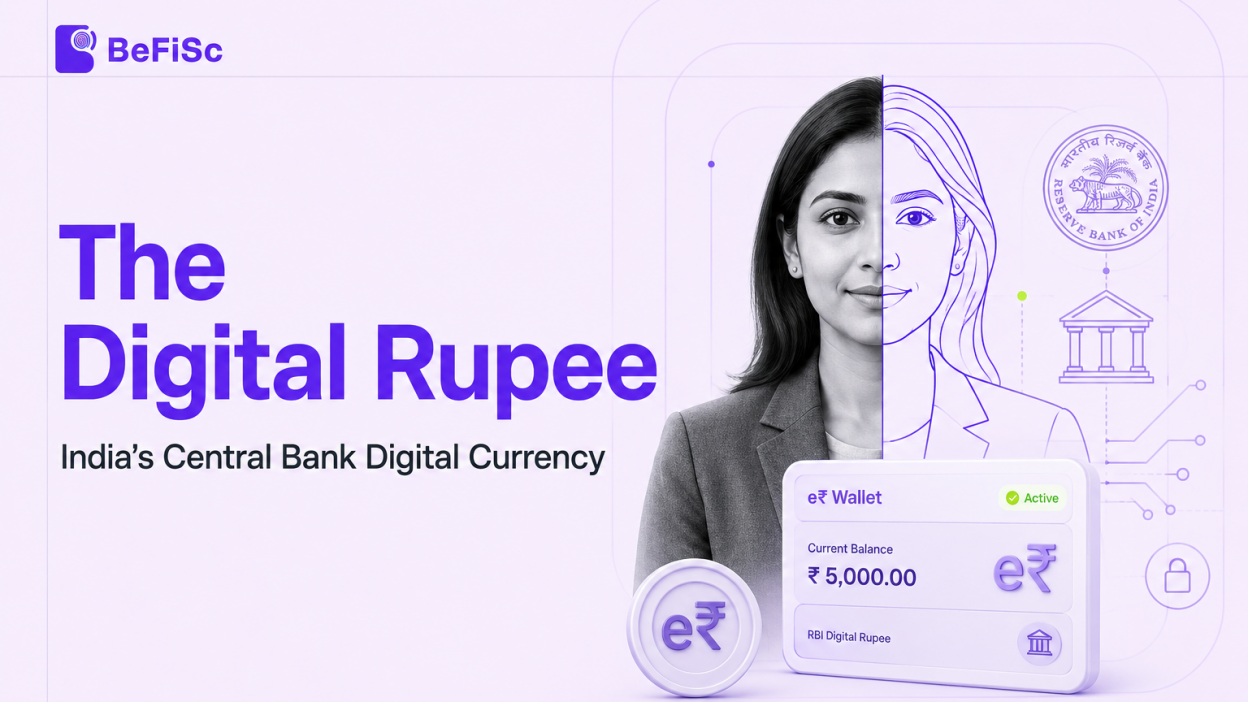
The Digital Rupee (e₹) is a central bank digital currency (CBDC), a digital form of sovereign currency issued directly by the Reserve Bank of India, representing legal tender in electronic form. It is the digital equivalent of physical cash: issued by the central bank, denominated like banknotes and coins, and holding the same legal-tender status, but existing as a digital token rather than a physical note.
The defining characteristic is that the Digital Rupee is central-bank money in digital form. It is a direct liability of the RBI, just as a physical banknote is not a claim on a commercial bank (as a bank deposit is), and not a private digital asset. When you hold e₹, you hold sovereign currency directly, the same as holding cash, but digitally. This direct-central-bank-money quality distinguishes CBDC from every other form of digital money.
The RBI launched the Digital Rupee in pilot form, with the retail version (e₹-R) introduced in December 2022 within a closed user group of participating banks, customers, and merchants. The e- ₹-R is issued as a digital token representing legal tender, in the same denominations as physical currency, distributed through banks, and held in digital wallets offered by participating banks. It supports both person-to-person (P2P) and person-to-merchant (P2M) transactions, offering features of physical cash trust, safety, and settlement finality in digital form.
The RBI has consistently framed the Digital Rupee as complementing, not replacing, existing forms of money. It is an additional option alongside cash, deposits, and digital payments, expanding the forms money can take rather than displacing them. Understanding the Digital Rupee as sovereign, central-bank-issued digital cash legal tender in electronic form, complementing rather than replacing existing money, is the foundation for understanding everything else about it, including why it is distinct from the UPI system India already relies on.
CBDC vs UPI: A Crucial Distinction
The most common confusion about the Digital Rupee is how it differs from UPI, given that India already has instant, ubiquitous digital payments. This distinction is fundamental.
UPI moves existing bank deposits. UPI is a payment system that enables the instant transfer of existing bank deposits between accounts. When you pay via UPI, you are moving money that exists as a commercial-bank deposit; the bank deposit is the money, and UPI is the rails that move it. UPI is a highly efficient way to transfer bank money, but it is not itself a new form of money; it moves existing deposits.
CBDC is a new form of money. The Digital Rupee is not a payment system but a form of money itself: sovereign central-bank money in digital form. It does not move bank deposits; it is money you hold directly, like digital cash. The e₹ is central-bank money; a bank deposit moved by UPI is commercial-bank money. This is the core difference: UPI is a system for moving one kind of money (deposits), while CBDC is a different kind of money entirely (central-bank money).
Why the distinction matters. This difference has real implications. CBDC, as direct central-bank money, carries no commercial-bank credit risk (it is a claim on the RBI, not a bank), offers settlement finality like cash, and can have features (like programmability and offline capability) that deposit-based systems handle differently. It also changes the monetary architecture, introducing direct central-bank money into circulation digitally. UPI, by contrast, is an efficient overlay on the existing deposit-based system.
The adoption challenge this creates. The distinction also explains the Digital Rupee’s central adoption challenge: UPI already provides fast, free, ubiquitous digital payments, so for everyday users, the practical benefit of switching to CBDC is not obvious. As of early 2026, e₹ retail transactions remained a tiny fraction of UPI volumes. UPI serves hundreds of millions of users and billions of monthly transactions, while the Digital Rupee had a modest user base. Convincing users and merchants to adopt a parallel system requires clear benefits beyond what UPI already delivers, which is why the Digital Rupee’s distinctive features (programmability, offline use, direct central-bank money) matter to its case, and why its near-term adoption has been gradual. Understanding that CBDC and UPI are fundamentally different things- a form of money versus a payment system is essential to understanding both the Digital Rupee’s purpose and its challenges.
CBDC vs Cryptocurrency
A second common confusion is between CBDC and cryptocurrency, which are often conflated but are fundamentally different, and clarifying this is important.
The sovereign-versus-private distinction. The Digital Rupee is sovereign currency issued and backed by the RBI, with legal-tender status, representing central-bank money. Private cryptocurrencies are decentralised, privately created digital assets, not issued or backed by any central authority, without legal-tender status. CBDC is central-bank money; cryptocurrency is a private asset. This is the defining difference.
The stability difference. The Digital Rupee, as sovereign currency, is stable and exchangeable at par with existing rupees, backed by the RBI. Cryptocurrencies are typically volatile, their value fluctuating based on market forces without sovereign backing. CBDC has cash-like stability; cryptocurrency has market-driven volatility. This stability difference is fundamental to CBDC’s role as money.
The RBI’s framing. The RBI has explicitly positioned the Digital Rupee as the sovereign alternative to private crypto, a safe, stable, sovereign-backed digital currency in contrast to volatile private cryptocurrencies, which the RBI has viewed as posing risks to monetary and financial stability. The Digital Rupee is framed as offering the benefits of digital money (efficiency, digital form) with the safety and sovereign backing that cryptocurrencies lack. This positioning of CBDC as the sovereign, stable alternative to private crypto reflects the RBI’s cautious stance toward private cryptocurrencies and its preference for sovereign digital money.
The technology overlaps and differs. CBDCs may use some technologies associated with cryptocurrencies (the retail CBDC pilot has blockchain-based components), but the technology does not make them the same; the defining difference is sovereign issuance and backing, not the underlying technology. A CBDC using distributed-ledger technology is still sovereign central-bank money, fundamentally different from a decentralised private cryptocurrency. Understanding that the Digital Rupee is sovereign, stable, central-bank money the opposite of decentralised, volatile private crypto clarifies its nature and the RBI’s rationale for issuing it as a sovereign alternative.
Retail and Wholesale CBDC
The Digital Rupee comes in two forms: retail and wholesale, serving different purposes, and understanding both completes the picture of India’s CBDC.
Retail CBDC (e₹-R). The retail Digital Rupee (e₹-R) is for general public use, held by individuals and businesses in digital wallets, used for everyday P2P and P2M transactions, functioning as digital cash for the public. This is the form most people think of as the Digital Rupee, the sovereign digital currency the public can hold and transact with. The retail pilot, launched in December 2022, tests this public-facing digital cash, with participating banks distributing e₹-R through wallets. Retail CBDC is the public digital currency.
Wholesale CBDC (e₹-W). The wholesale Digital Rupee (e₹-W) is for financial institutions used for interbank settlement, wholesale financial transactions, and settlement between institutions. Wholesale CBDC serves the financial system’s plumbing, providing central-bank money for institutional settlement, potentially improving the efficiency and finality of wholesale transactions. The wholesale pilot tests CBDC in financial-market settlement, including applications in securities settlement. Wholesale CBDC is the institutional settlement currency.
The different purposes. The two forms serve different needs: retail CBDC provides public digital cash (competing with and complementing everyday payment methods), while wholesale CBDC improves institutional settlement (enhancing the financial system’s wholesale operations). Both are the Digital Rupee, but they operate at different levels: retail for the public, wholesale for institutions with different use cases and implications. Much of the practical near-term value of CBDC may come through wholesale applications (settlement efficiency, asset tokenisation) even as retail adoption develops more gradually.
The tokenisation and settlement direction. Wholesale CBDC connects to broader developments in asset tokenisation and settlement. The RBI has explored using wholesale CBDC for settling tokenised financial assets, part of a broader move toward programmable money and tokenised finance. This positions wholesale CBDC within the evolution of financial-market infrastructure, potentially significant for settlement efficiency and the tokenisation of assets. Understanding both retail and wholesale CBDC public digital cash and institutional settlement money gives a complete picture of the Digital Rupee’s forms and their distinct roles.
Programmability: Money That Can Carry Rules
One of the Digital Rupee’s most distinctive and consequential features is programmability, the ability to embed rules or conditions into the money itself. This capability is both promising and, for some, concerning.
What programmability means. Programmable money can carry embedded rules governing how it is used, for example, money that can only be spent on specific things, at specific merchants, within a specific time, or for a specific purpose. The rules travel with the money, so the currency itself enforces conditions on its use. This is a capability that physical cash and ordinary digital deposits do not have; programmable CBDC can be designed to be used only in defined ways.
The use cases. Programmability enables powerful applications, particularly for targeted disbursements. India has piloted programmable CBDC for direct benefit transfers and subsidies, for instance, disbursing food subsidies as programmable digital rupees redeemable only at designated fair-price shops, or welfare payments that can only be used for their intended purpose. Programmability ensures targeted funds (subsidies, welfare, specific-purpose disbursements) are used as intended, reducing leakage and misuse. This is a significant potential benefit for public-fund efficiency and welfare delivery, and an area where CBDC offers genuine value beyond existing payments.
The efficiency and control appeal. For governments and institutions, programmability offers the ability to ensure funds are used for their intended purpose, controlling and directing money’s use in ways that improve efficiency and reduce misuse. Programmable disbursements can make welfare and subsidy delivery more effective, connecting to India’s broader direct-benefit-transfer agenda. This purpose-control is a major driver of interest in programmable CBDC.
The concern. Programmability also raises concerns. Money that can be restricted in its use is money over which the issuer has more control, raising questions about autonomy, freedom, and potential for over-control (money that expires, that can only be spent in approved ways, that carries conditions). The same capability that ensures subsidies are used correctly could, in principle, be used to restrict money’s use more broadly, which is a genuine concern for individual financial autonomy. The programmability that makes CBDC powerful for targeted disbursement is the same feature that raises control and autonomy questions, a tension at the heart of CBDC design.
The design question. How programmability is designed and governed where it is applied (targeted disbursements versus general money), what safeguards protect autonomy, and what limits constrain control is a central question for CBDC. Used for legitimate targeted purposes with appropriate limits, programmability offers real benefits; used expansively, it raises control concerns. The Digital Rupee’s programmability is thus both a distinctive strength and a source of the privacy-and-control questions the technology raises, making its design and governance genuinely important.
Use Cases and the Path to Adoption
The Digital Rupee’s practical value and adoption path depend on genuine use cases, and understanding them clarifies where CBDC is heading.
Targeted disbursements and welfare. As above, programmable CBDC for subsidies, direct benefit transfers, and welfare delivery is a leading use case, ensuring targeted funds are used as intended and improving public-fund efficiency. India’s pilots in this area (food subsidies, DBT schemes) reflect genuine value, and this may be an early area of meaningful CBDC adoption, driven by government use.
Financial inclusion. CBDC could support financial inclusion by providing sovereign digital money access, including potentially offline capability for areas with limited connectivity. Offline CBDC transactions, which the RBI has tested, could extend digital money to contexts where connectivity is limited, supporting inclusion. This inclusion potential, particularly through offline capability, is a use case relevant to India’s inclusion agenda.
Cross-border payments. CBDC offers potential for improving cross-border payments, an area of significant inefficiency in the current system. The RBI has explored cross-border CBDC pilots and arrangements (including with other countries), and cross-border CBDC could reduce the cost and friction of international payments, a meaningful potential benefit. Cross-border applications are an active area of CBDC development, with India exploring bilateral and multilateral pilots.
Wholesale settlement and tokenisation. As discussed, wholesale CBDC for institutional settlement and tokenised-asset settlement is a significant use case, potentially improving financial-market efficiency. Much near-term CBDC value may come through these wholesale applications.
The adoption reality. Despite these use cases, retail CBDC adoption has been gradual; the modest user base and low transaction volumes relative to UPI reflect the challenge of adoption where UPI already serves everyday needs. The path to meaningful retail adoption likely runs through use cases where CBDC offers clear advantages (programmable disbursements, offline capability, specific benefits) rather than competing head-on with UPI for general payments. The Digital Rupee’s adoption will depend on realising genuine value in these areas, developing gradually as pilots expand and use cases mature. Understanding CBDCs’ use cases and the gradual, use-case-driven adoption path gives a realistic picture of where the Digital Rupee is heading, not a rapid replacement of existing payments, but a gradual development driven by the specific value CBDC offers.
Privacy, Surveillance and the Traceability Question
The Digital Rupee raises significant and genuine questions about privacy and surveillance, which are central to the debate about CBDCs and deserve honest consideration.
The traceability concern. Digital, central-bank-issued money is inherently more traceable than physical cash. Where cash transactions are largely anonymous and untraceable, CBDC transactions are digital and potentially visible to the issuing authority, raising concerns that CBDC enables greater visibility into individuals’ financial activity than cash. The traceability of digital central-bank money, in contrast to cash’s anonymity, is the core privacy concern about CBDC. This is a genuine and widely discussed issue.
The surveillance question. If CBDC transactions are visible to the central bank or state, CBDC could, in principle, enable financial surveillance visibility into how individuals spend money, which cash does not permit. Combined with programmability (control over money’s use), this raises concerns about a financial system with greater state visibility into and control over individuals’ money than the cash-based system. These concerns traceability and potential surveillance are central to the CBDC debate and to public wariness of CBDC in some quarters.
The design-dependent reality. Crucially, the degree of traceability and privacy depends on CBDC design. CBDC can be designed with varying privacy protections, from highly traceable to more privacy-preserving (with anonymity for small transactions, privacy safeguards, or other protections). The privacy implications are not inherent to CBDC but depend on how it is designed and governed. How much privacy the Digital Rupee affords, and what safeguards protect it, are design and policy choices, making the privacy debate partly about how CBDC should be designed, not just whether it exists.
The tension with legitimate purposes. There is a genuine tension between privacy and the legitimate purposes that traceability serves in combating money laundering, fraud, and financial crime; traceability benefits financial integrity, while privacy and autonomy argue for protection. CBDC design must balance these, providing enough traceability for legitimate financial-integrity purposes while protecting privacy and autonomy. This balance, and where it is struck, is central to responsible CBDC design and to public acceptance.
The honest assessment. The privacy and surveillance concerns about CBDC are legitimate and important, not to be dismissed; digital central-bank money is more traceable than cash, and its design determines the privacy and control implications. At the same time, these implications depend on design choices that can incorporate privacy protections, and traceability serves legitimate financial-integrity purposes. An honest view acknowledges both the genuine concerns and the design-dependent nature of the outcomes, making CBDC’s privacy design a genuinely important matter that deserves careful attention and public scrutiny, rather than either dismissal or alarmism.
CBDC, AML and Financial Crime
The Digital Rupee has significant implications for AML and financial crime; the traceability that raises privacy concerns also affects money laundering and fraud, which is relevant to this series’ focus.
The traceability-and-AML connection. CBDC’s traceability, while a privacy concern, is an AML advantage. Traceable digital money is harder to launder than anonymous cash, and CBDC transactions leave a digital trail that supports financial-crime detection. Where cash’s anonymity enables laundering (the [placement stage] especially), CBDC’s traceability makes illicit use more visible. CBDC could thus support AML by reducing the anonymity that laundering exploits the flip side of the privacy concern.
The programmability-and-compliance potential. Programmability could embed compliance features into money potentially restricting illicit uses or enabling compliance controls at the currency level. This is speculative but represents a potential AML application of programmable CBDC, embedding financial-integrity controls into the money itself. The compliance potential of programmable money is an area of interest, though it raises the same control concerns as programmability generally.
The reporting integration. CBDC, as regulated digital money, falls within the financial-integrity framework and notably, CBDCs (alongside crypto-assets and specified electronic money) have been brought within the tax-information-reporting framework ([FATCA/CRS]), reflecting how digital currencies are being integrated into financial transparency and reporting regimes. CBDC is subject to the AML and reporting frameworks that govern the financial system, integrated into the compliance architecture rather than sitting outside it.
The fraud dimension. CBDC, like any digital money, faces fraud risks the [social-engineering, phishing, and account-related fraud] that affect digital payments could affect CBDC, requiring the [authentication],[fraud detection], and security measures this series has explored. CBDC does not eliminate fraud; it introduces a new digital-money form that must be secured against the fraud vectors affecting digital finance. The fraud-prevention discipline applies to CBDC as to other digital money.
The balanced view. CBDC’s relationship with financial crime is dual: its traceability supports AML (reducing anonymity-enabled laundering) and it can carry compliance features, but it also faces the fraud risks of digital money and raises the privacy concerns that traceability entails. For financial-crime purposes, CBDC offers AML advantages (traceability, potential compliance features) while requiring fraud protection and raising privacy trade-offs. Understanding CBDC’s financial-crime implications, AML-supportive traceability, compliance potential, fraud exposure, and the privacy trade-off connects the Digital Rupee to the financial-integrity themes central to this series.
Key Takeaways
- The Digital Rupee (e₹) is a central bank digital currency sovereign digital money issued directly by the RBI as legal tender, the digital equivalent of cash, complementing rather than replacing existing money.
- It differs fundamentally from UPI: UPI is a payment system moving existing bank deposits, while CBDC is a new form of money (direct central-bank money) , a distinction that also explains its gradual adoption where UPI already dominates.
- It differs from cryptocurrency by being sovereign, stable, central-bank-backed money positioned by the RBI as the safe, sovereign alternative to volatile private crypto.
- It comes in retail (public digital cash) and wholesale (institutional settlement) forms, and its distinctive programmability enables targeted disbursements (subsidies, welfare) but raises money-control and autonomy concerns.
- It raises genuine privacy and surveillance questions (digital money is more traceable than cash) that depend on design choices with the same traceability offering AML advantages against laundering.
Frequently Asked Questions
Does the Digital Rupee raise privacy concerns?
Yes, digital central-bank money is more traceable than anonymous cash, raising genuine concerns about financial visibility and surveillance. However, the degree of privacy depends on how the CBDC is designed, which can incorporate privacy protections. The same traceability also offers AML advantages against money laundering.
What is programmable money in the Digital Rupee?
Programmable money can carry embedded rules governing its use for example, funds that can only be spent for a specific purpose or at specific merchants. India has piloted programmable CBDC for subsidies and welfare (like food subsidies redeemable only at designated shops), though the capability also raises money-control and autonomy concerns.
Is the Digital Rupee a cryptocurrency?
No, the Digital Rupee is sovereign, central-bank-issued, stable legal tender, backed by the RBI, whereas cryptocurrencies are decentralised, privately-created, volatile digital assets without sovereign backing. The RBI positions the Digital Rupee as the safe, sovereign alternative to private cryptocurrencies.
How is the Digital Rupee different from UPI?
UPI is a payment system that moves existing bank deposits between accounts, while the Digital Rupee is a new form of money itself, direct central-bank money you hold like digital cash. UPI moves commercial-bank money; CBDC is sovereign central-bank money. This is why the Digital Rupee is distinct from, not a replacement for, UPI.
What is the Digital Rupee?
The Digital Rupee (e₹) is India’s central bank digital currency, a digital form of sovereign currency issued directly by the RBI as legal tender. It’s the digital equivalent of physical cash, held in bank-provided wallets, and it complements rather than replaces existing forms of money like cash and bank deposits.
Conclusion
The Digital Rupee represents something more profound than a new way to pay. It is a new form of money, sovereign currency reborn in digital form, and its significance lies less in convenience than in what it changes about the architecture of money itself. In a country that already moves money with extraordinary efficiency through UPI, the Digital Rupee’s purpose is not to make everyday payments faster but to introduce direct central-bank money into the digital age, with capabilities programmability, offline use, sovereign backing that deposit-based systems and payment overlays cannot provide. This is why understanding the distinction between CBDC and UPI, and between CBDC and cryptocurrency, matters so much: the Digital Rupee is neither a better payment app nor a state cryptocurrency, but a genuinely different kind of money.
Its promise is real programmable disbursements that ensure welfare reaches its purpose, potential inclusion through offline capability, more efficient cross-border payments and wholesale settlement, and AML advantages from traceability that anonymous cash cannot offer. But its questions are equally real, and they deserve honest engagement rather than either dismissal or alarm. The traceability that helps combat money laundering also raises legitimate concerns about financial surveillance; the programmability that ensures subsidies are used correctly is the same capability that could restrict money’s use more broadly. These are not flaws to be waved away but design choices to be made carefully, with attention to privacy, autonomy, and the appropriate limits of control. As the Digital Rupee develops gradually through its pilots and use cases, its ultimate character, how private, how programmable, and how much a tool of inclusion versus control will be determined by these choices. The technology of sovereign digital money is here; what it becomes, for India and its citizens, remains genuinely open, and worth watching closely.