Recurring collections are where lending economics live or die. A lender that disburses perfectly but fails to collect effectively, however, is essentially a charity with a license. For years, the collection rail was the paper NACH mandate: a physical form, a wet signature, and a two-to-three-week registration cycle with rejection rates that routinely crossed a quarter of submissions on image and signature-mismatch grounds.
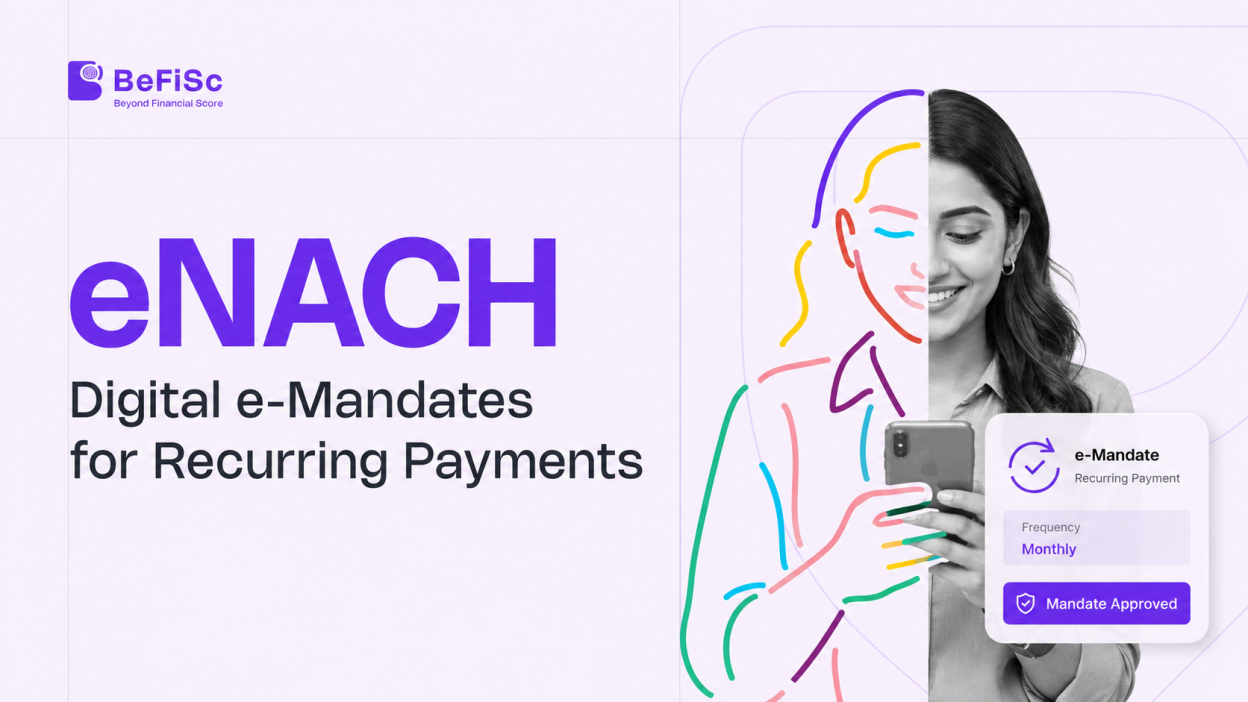
eNACH replaced that cycle with a digital journey the customer completes in minutes. The mandate registers against the bank account electronically, authenticated by the customer through net banking, debit card, or Aadhaar-based eSign, and EMI collection begins on schedule. This guide explains how eNACH works, the authentication modes and their trade-offs, where UPI Autopay fits, and the operational discipline that keeps mandate success rates healthy.
What Is eNACH?
eNACH is the electronic version of the National Automated Clearing House (NACH) mandate system operated by NPCI. A NACH mandate is a standing authorisation from a customer permitting a business to debit their bank account for a defined amount, frequency, and period. eNACH digitises the creation of that authorisation.
The cast of participants: the corporate (the collecting business, a lender, insurer, or subscription provider), its sponsor bank, NPCI as the clearing house, and the destination bank holding the customer’s account. First, the customer authenticates the mandate digitally. Next, the destination bank validates and registers it. From then on, presenting the mandate debits the account according to its terms.
The gains over paper are structural. Registration compresses from weeks to minutes. As a result, rejections caused by illegible forms and signature mismatches disappear because authentication is electronic. Moreover, the mandate’s terms amount, ceiling, frequency, start date, and end date are captured as clean data rather than handwriting. Therefore, lenders can process mandates more accurately and efficiently.
For lenders, eNACH is the default EMI collection rail. For insurers and SaaS businesses, it powers premium and subscription auto-debits at ticket sizes and account types beyond UPI Autopay’s comfort zone.
How eNACH Mandate Registration Works
The registration journey has five stages.
Step 1: Mandate Creation
The business generates a mandate request specifying the debit account, maximum amount, frequency (monthly, quarterly, as-presented), and validity period. However, precision here matters. For example, an amount ceiling set too low can force re-registration when EMIs change. Conversely, setting it too high may alarm customers and reviewers.
Step 2: Customer Authentication
The customer authenticates the mandate through one of the permitted modes: net banking credentials, debit card details, or Aadhaar-based eSign. This step legally binds the authorisation.
Step 3: Destination Bank Validation
First, the customer’s bank verifies the account status and authentication. Then, it either accepts or rejects the mandate. Live account, matching details, supported mode accepted. Dormant account, mismatched data, unsupported mode rejected, with a reason code.
Step 4: Activation
Accepted mandates are registered with NPCI and the destination bank, typically becoming active within a day or two. The business receives the mandate reference (UMRN) that anchors every future debit.
Step 5: Presentation and Collection
On each due date, the business presents a debit against the UMRN through its sponsor bank. Meanwhile, successful presentations settle as expected. However, failed presentations return reason codes such as insufficient funds, mandate cancellation, or account closure. These codes, in turn, feed directly into the collections workflow.
Because a mandate is only as good as the account beneath it, mature flows verify the account first. In turn, a pre-registration account check eliminates one of the largest classes of avoidable rejections: mandates raised against mistyped or wrong-owner accounts. As a result, lenders can reduce failed mandates before registration even begins.
Authentication Modes: Net Banking, Debit Card, and Aadhaar eSign
The three eNACH authentication modes trade coverage against completion.
Net banking authentication offers the strongest bank-grade assurance but assumes the customer has active net banking credentials and remembers them mid-journey, a real constraint outside metros.
Here’s a smoother version with stronger transitions and clearer flow:
Moreover, debit card authentication broadens coverage because cards outnumber active net banking users. However, support varies across banks, and entering card details can add friction to the process.
Aadhaar eSign authentication signs the mandate with an OTP-backed electronic signature tied to Aadhaar. Its coverage is the widest; Aadhaar-linked mobile is near-universal, and its friction is the lowest.
Production systems offer modes in a fallback order tuned to their customer base and monitor completion by mode. A ten-point completion gap between modes, at lending volumes, is a portfolio-level revenue line.
eNACH vs UPI Autopay: Choosing the Recurring Rail
UPI Autopay is the other recurring-payment rail, and the choice between them is a real product decision.
UPI Autopay wins on user experience: mandate approval is a familiar UPI-app gesture, activation is instant, and customer control (pause, modify, revoke in-app) is excellent. Its constraints are that transaction-size norms mean smaller recurring tickets clear without additional authentication, while larger debits face AFA requirements per prevailing RBI limits, and its dependence on UPI-linked accounts.
eNACH wins on ticket size, account coverage (including accounts without UPI linkage), long-tenure stability, and its entrenchment in lending and insurance operations where UMRN-anchored processes, legal familiarity, and bank-side tooling are mature.
The emerging pattern is segmentation, not substitution: UPI Autopay for small-ticket subscriptions and digital-native users; eNACH for EMIs, premiums, and larger or longer commitments. Businesses running both route customers by ticket size and account type.
Why Mandates Fail and What Failure Data Tells You
Mandate operations produce two failure streams, and both carry signal.
Registration failures cluster around account-data errors, dormant or incompatible accounts, and authentication drop-offs. High registration failure for a cohort is an onboarding-quality problem often solved upstream by account verification and better mode routing rather than by collection efforts.
Presentation failures: the debit bounces cluster around insufficient funds, cancelled mandates, and closed accounts. Here, the reason codes are underwriting telemetry. A borrower whose mandate is cancelled days after disbursal looks less like cash-flow stress and more like an intent pattern belonging to the [first-party fraud playbook]. We have documented. Repeated insufficient-funds returns, by contrast, argue for restructuring conversations before default.
Feeding mandate reason codes back into risk models is one of the cheapest underwriting upgrades available, because the data already exists; most institutions simply leave it inside the collections silo.
Compliance and Customer-Protection Context
Three compliance threads run through eNACH operations. Mandate terms must match what the customer agreed to in the loan or service contract. Amount ceilings quietly set above the agreed EMI are an audit and conduct risk. Cancellation rights are real: customers can cancel mandates through their bank, and businesses must handle cancellations in collections logic rather than re-presenting into a dead mandate. And mandate data, account details, UMRNs, and debit histories are personal data under the DPDP Act, inheriting the fiduciary duties we set out in our [DPDP compliance guide].
For NBFC lenders, mandate practices also sit inside the RBI’s broader conduct expectations for digital lending; collection through authorised, transparent instruments is part of the supervisory picture, not merely an operational choice.
Key Takeaways
- eNACH digitises NACH mandate registration, compressing a multi-week paper process into a minutes-long authenticated journey.
- Three authentication modes: net banking, debit card, Aadhaar eSign- offer trade assurance against coverage; offer a fallback order and measure completion by mode.
- Verify the bank account before raising the mandate; it removes the largest class of avoidable registration rejections.
- eNACH and UPI Autopay are complements: Autopay for small-ticket, UPI-native use; eNACH for EMIs, premiums, and broad account coverage.
- Presentation failure codes are underwriting telemetry; route them into risk models, not just collections queues.
Frequently Asked Questions
Why do eNACH mandates fail?
Registration failures stem from wrong or dormant account details and authentication drop-offs; presentation failures stem from insufficient funds, cancelled mandates, and closed accounts. Verifying accounts before registration and analysing failure reason codes sharply reduce both.
What is the difference between eNACH and UPI Autopay?
Both create recurring debit authorisations. UPI Autopay offers the smoothest approval and in-app control for smaller tickets on UPI-linked accounts, while eNACH covers larger amounts, non-UPI accounts, and long-tenure EMI and premium collection with mature bank-side processes.
How long does eNACH mandate registration take?
The customer journey completes in minutes, and accepted eNACH mandates typically activate within a day or two of destination-bank validation, compared to two to three weeks for paper NACH mandates.
What authentication modes does eNACH support?
eNACH mandates can be authenticated through net banking credentials, debit card details, or Aadhaar-based eSign. Coverage and completion rates differ by mode, so production flows offer them in a fallback sequence suited to the customer base.
What is eNACH and how does it work?
eNACH is NPCI’s electronic mandate system for recurring debits. The customer digitally authorises a mandate specifying amount, frequency, and validity; the destination bank validates and registers it; and the business then debits the account on schedule against the mandate reference.
Conclusion
Collections infrastructure rarely gets the strategic attention of origination, yet it is where credit models meet reality. eNACH turned the mandate from a paperwork bottleneck into a data-rich, minutes-fast rail, and the institutions extracting the most from it are those treating mandate telemetry as a risk asset rather than an operations by-product.
The rail itself will keep evolving: authentication modes will shift with regulatory guidance, and the boundary with UPI Autopay will keep moving as limits change. What will not change is the underlying discipline: verified accounts, honest mandate terms, and failure data flowing back into decisions. Build for that, and the rail changes become configuration.