
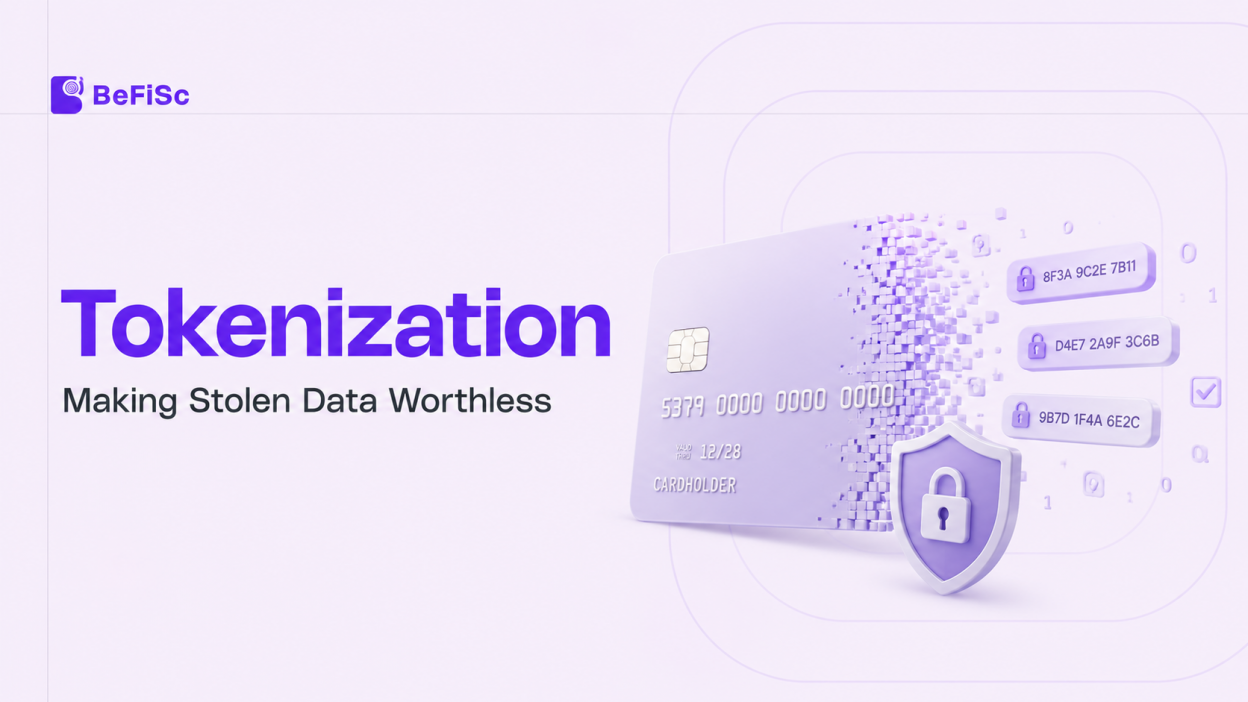
The logic of most payment fraud is simple: steal the card data, then use it. [E-skimming], [breaches], and [phishing] all aim at the same prize: the card number, expiry, and security code that make [card-not-present fraud] possible. Tokenisation attacks this logic at its root, not by making data harder to steal, but by making the stolen data worthless. It replaces sensitive card details with a meaningless substitute, a “token” that stands in for the real data wherever it is stored or transmitted, so that even if the token is compromised, it cannot be used to commit fraud. If the data a criminal steals is not the real card data but a useless token, the theft yields nothing.
Tokenisation has become a foundational payment-security technology, mandated by the RBI for card-on-file storage and embedded across the payments ecosystem. It is a quiet but powerful shift in the philosophy of data protection from guarding sensitive data everywhere to removing it from where it does not need to be. This guide explains what tokenisation is, how it works, why it is so effective, its relationship to encryption, the RBI’s card-on-file tokenisation mandate, its applications, and its role in the broader security landscape.
What Is Tokenisation?
Tokenisation is a data-security technique that replaces sensitive data such as a payment card number with a non-sensitive substitute called a token, which has no meaningful value or exploitable relationship to the original data, so that the sensitive data itself is not stored or transmitted where the token is used.
The defining idea is substitution with a valueless stand-in. The token represents the original sensitive data in systems and transactions, but it is itself meaningless; it cannot be reverse-engineered to reveal the original data, and it has no value if stolen. The real sensitive data is held securely elsewhere (in a protected token vault or by the tokenisation provider), and only the token flows through the systems that would otherwise handle the sensitive data. Wherever the sensitive data would have been stored or transmitted, the token takes its place.
The security consequence is fundamental: systems that use tokens do not hold the actual sensitive data, so a breach of those systems exposes only tokens, not usable sensitive data. The value of stealing data from a tokenised system is eliminated; the tokens are useless outside their specific, controlled context. This is the essence of tokenization’s protection: by removing the real sensitive data from most systems and replacing it with valueless tokens, it removes the prize that data theft aims for.
For payments, this means card data, the target of so much fraud, can be replaced by tokens throughout most of the payment ecosystem, so that merchants, apps, and systems store and handle tokens rather than actual card numbers. A breach of a merchant storing tokens exposes tokens, not card data usable for fraud. Tokenisation thus directly attacks the data availability that fuels [card fraud], by ensuring the data available in most systems is valueless. This shift from protecting sensitive data everywhere to removing it and using valueless tokens is tokenisation’s core contribution to security.
How Tokenization Works
The mechanics of tokenisation, while implemented in various ways, follow a general pattern that clarifies how it provides protection.
Token generation. When sensitive data (a card number) enters a tokenised system, the tokenisation system generates a token to represent it as a substitute value that maps to the original data but reveals nothing about it. The token is designed to be usable in place of the sensitive data within the system while being meaningless outside it. Tokens are often generated so that they cannot be mathematically reversed to the original data (unlike encryption, as discussed below); the mapping exists only in the secure token vault.
The token vault. The mapping between tokens and the original sensitive data is held in a secure, protected token vault (or by the tokenisation provider). This vault is the one place where the real data and its token relationship exist, and it is heavily protected. Systems using tokens do not have access to the original data; only the vault can map a token back to the sensitive data, and only under controlled conditions. Centralising the sensitive data in the protected vault, and removing it from everywhere else, is the architectural heart of tokenisation.
Token use. The token is then used throughout the systems and transactions that would otherwise use the sensitive data stored by merchants, transmitted in transactions, and held in databases, standing in for the real data. These systems operate on tokens, never touching the actual sensitive data. When the real data is genuinely needed (for example, to process a payment through the network), the token is mapped back to the data only within the secure, controlled process, not exposed to the systems using the token.
De-tokenization. When the original data is required, the token is exchanged for the real data through the secure vault, a controlled process (“de-tokenisation”) available only to authorised systems under controlled conditions. Most systems never de-tokenise; they operate purely on tokens. De-tokenisation occurs only where and when the real data is genuinely necessary, minimising the sensitive data’s exposure.
The scope reduction. The net effect is that the sensitive data is confined to the secure vault and the minimal, controlled processes that genuinely need it, while tokens flow everywhere else. This dramatically reduces the “attack surface” for the sensitive data, the number of systems holding it, concentrating protection on the vault and removing the data from the many systems that now hold only tokens. This scope reduction is a key security and compliance benefit (reducing, for example, [PCI DSS] scope for merchants who store tokens rather than card data).
Why Tokenization Is So Effective
Tokenization’s effectiveness stems from a fundamental strategic advantage: it removes the value from stolen data rather than merely trying to prevent theft.
Attacking the incentive. Most security tries to prevent data theft by guarding data against breach and compromise. Tokenisation takes a different, complementary approach: it removes the value of the data in most systems, so that even successful theft yields nothing useful. A criminal who breaches a tokenised system steals tokens, which are valueless outside their controlled context. This attacks the incentive for and payoff from data theft, rather than only trying to prevent it. Even if prevention fails, tokenisation ensures the failure does not expose usable data.
Reducing the attack surface. By removing sensitive data from most systems and confining it to the secure vault, tokenisation dramatically reduces the number of places the sensitive data exists, shrinking the attack surface. Fewer systems hold the real data, so there are fewer places to breach it. Protection concentrates on the vault, while the many systems using tokens are no longer targets for the sensitive data. This scope reduction makes protecting the sensitive data more tractable and reduces overall exposure.
Limiting breach impact. Because tokenized systems hold only tokens, breaches of those systems expose tokens, not usable sensitive data, limiting the impact of the many breaches that will inevitably occur. In a world where breaches are common, tokenization ensures that a breach of a token-holding system does not translate into usable stolen data, containing the damage. This resilience to inevitable breaches is a major practical benefit.
Complementing other defences. Tokenisation complements rather than replaces other security (encryption, access controls, [authentication]); it is a layer that specifically addresses the value and exposure of sensitive data, working alongside the defences that prevent breaches. The combination prevents breaches where possible (other security) and ensures stolen data is valueless (tokenisation), and is stronger than either alone. Tokenisation adds the “make the data worthless” layer to the “prevent the breach” layers.
The strategic elegance. Tokenisation’s effectiveness lies in its strategic elegance: rather than winning the unwinnable battle of preventing all data theft, it makes the theft pointless by removing the data’s value where it is held. This is a profound shift in data-protection philosophy from “protect the data everywhere” to “remove the data and use valueless tokens”, and it addresses the reality that breaches happen, ensuring they do not yield usable data. This is why tokenisation has become foundational to payment security and why it is mandated for card data storage.
Tokenization vs Encryption
Tokenization is often confused with encryption, and clarifying the distinction is important to understanding tokenization’s specific value.
Encryption. Encryption transforms sensitive data into an unreadable form using a cryptographic algorithm and key, such that the data can be decrypted back to its original form with the key. Encrypted data is the original data mathematically transformed; it retains a mathematical relationship to the original, and anyone with the key (or who breaks the encryption) can recover the original data. Encryption protects data by making it unreadable without the key, but the encrypted data is still, in essence, the sensitive data in transformed form.
Tokenization. Tokenization replaces the sensitive data with a token that has no mathematical relationship to the original data; the token is not the data transformed, but a substitute that maps to the data only through the secure vault. The token cannot be reversed to the original data by any algorithm or key; the mapping exists only in the vault. So a stolen token is genuinely useless (no key can decrypt it, because it is not encrypted data), whereas stolen encrypted data could potentially be decrypted if the key is compromised or the encryption broken.
The key difference. Encryption transforms the data (recoverable with the key); tokenisation substitutes the data (recoverable only through the vault mapping). This means a compromised token is valueless regardless of any key, while compromised encrypted data is at risk if the key is compromised. Tokenisation removes the sensitive data entirely from the tokenized systems (they hold only meaningless tokens), while encryption keeps the data present but unreadable. For reducing the exposure and value of sensitive data in systems, tokenisation has advantages: there is no data and no key to compromise in the tokenised systems, only valueless tokens.
The complementary use. Encryption and tokenisation are complementary, used together in comprehensive security: encryption protects data in transit and at rest (including protecting the token vault), while tokenisation removes sensitive data from systems that do not need it. They address different aspects: encryption makes data unreadable, tokenisation makes it absent and valueless, and combining them provides layered protection. Understanding that tokenisation is not encryption, but a substitution technique with distinct advantages for reducing data exposure, clarifies its specific role in the security stack.
Payment Tokenization and Network Tokens
In payments specifically, tokenization takes particular forms that are important to understand, especially network tokenization.
Payment tokenisation broadly. Payment tokenisation replaces card data (the primary account number and details) with tokens throughout the payment ecosystem so that merchants, apps, wallets, and systems store and handle tokens rather than actual card numbers. This protects card data across the many systems that would otherwise store it, reducing exposure and [PCI DSS] scope, and ensuring breaches expose tokens rather than usable card data.
Network tokens. A significant form is network tokenisation, provided by the card networks. Here, the card networks generate tokens that replace the card number, and these network tokens are used in transactions in place of the real card number. Network tokens carry advantages: they are recognised across the payment ecosystem, can be domain-restricted (limited to specific merchants or uses, so a token stolen from one merchant is useless elsewhere), and can be automatically updated when the underlying card is reissued (improving continuity for stored-card payments). Network tokenisation is increasingly central to secure card-on-file and digital payments.
Device and wallet tokenisation. Mobile wallets and device-based payments use tokenisation extensively; the wallet stores a token, not the actual card number, so the device holds no usable card data. This is why wallet payments are secure even if the device is compromised: there is no card number to steal, only a device-specific token. Tokenisation underpins the security of mobile and wallet payments.
Domain restriction. A powerful tokenisation feature is domain restriction, limiting a token to a specific merchant, channel, or user, so that a token is useless outside its designated context. A token stolen from one merchant cannot be used at another, dramatically limiting the value of any stolen token. Domain restriction is part of what makes payment tokens so much safer than raw card data, even if a compromised token has minimal usability.
The ecosystem shifts. Payment tokenisation: network tokens, wallet tokens, and domain-restricted tokens represent an ecosystem-wide shift toward handling tokens rather than raw card data, dramatically reducing the card data available to steal and use. This shift is central to modern payment security and directly addresses the [card-fraud] and [skimming] that depend on stealing usable card data. As tokenisation spreads, the raw card data that fraud requires becomes scarcer, confined to fewer systems and replaced by valueless, restricted tokens.
RBI Card-on-File Tokenization (CoFT)
India’s most significant tokenisation development is the RBI’s card-on-file tokenisation mandate, which is important to understand for the Indian context.
The card-on-file problem. “Card-on-file” refers to merchants and platforms storing customers’ card details to enable future payments (saved cards for repeat purchases, subscriptions). This stored card data, held across many merchants, was a significant vulnerability: a large attack surface of stored card data, exposed to breaches and misuse. The widespread storage of actual card data by merchants created substantial [card-fraud] risk.
The RBI mandate. The RBI mandated card-on-file tokenisation (CoFT), requiring that merchants and platforms not store actual card data, but instead use tokens for stored-card functionality. Under the mandate, saved-card details are replaced with tokens, so merchants store tokens rather than real card numbers, and the actual card data is not held across the merchant ecosystem. This removed the stored card data from merchants, dramatically reducing the card data exposed to breach and misuse.
The effect. The CoFT mandate substantially improved card-data security in India by removing actual card data from merchant storage and replacing it with tokens. A breach of a merchant now exposes tokens, not usable card data, and the vast pool of stored card data that previously existed across merchants is replaced by valueless tokens. This directly reduces the card data available for fraud, addressing a major vulnerability. The mandate is a significant, concrete example of tokenisation deployed at scale by regulation to protect payment data.
The implementation. The mandate required the payment ecosystem merchants, payment aggregators, and card networks to implement tokenisation for card-on-file, transitioning from stored card data to tokens. This was a substantial ecosystem-wide change, moving India’s saved-card payments onto a tokenised basis. The transition made India a notable example of large-scale, regulation-driven payment tokenisation.
The broader significance. RBI CoFT reflects the regulatory recognition that stored card data is a major risk, and that tokenisation is the solution, removing the data and using tokens. It aligns India with the global tokenisation direction and demonstrates tokenisation’s value at scale. For Indian merchants, platforms, and users, CoFT means saved-card payments now operate on tokens, with the actual card data protected a concrete, mandated application of tokenisation improving payment security across the country. It exemplifies how tokenisation moves from a technical option to a regulatory requirement for protecting payment data.
Applications Beyond Payments
While payment card data is tokenisation’s most prominent application, the technique protects other sensitive data too, and understanding this breadth completes the picture.
Personal and identity data. Tokenisation can protect sensitive personal data, identity numbers, Aadhaar, and other [PII] by replacing them with tokens in systems that do not need the actual data, reducing exposure. This connects tokenisation to [data protection] and the [DPDP Act’s] data-minimisation and security principles: holding tokens instead of actual sensitive personal data reduces the data at risk. Aadhaar-related tokenisation mechanisms (like [reference/virtual IDs]) reflect similar logic using references rather than the actual number.
Healthcare and other sensitive data. Sensitive data in healthcare and other domains handling personal or confidential information can be tokenised to reduce exposure, applying the same principle: remove the sensitive data from systems that do not need it and use valueless tokens.
Compliance and data-minimisation. Tokenisation supports compliance with data-protection requirements by minimising the sensitive data held by a system holding tokens rather than actual sensitive data, reducing its data-protection risk and obligations. This aligns tokenisation with the data-minimisation principle central to modern data protection, making it a data-protection tool as well as a fraud-prevention one.
The general principle. Wherever sensitive data is stored or transmitted more widely than necessary, tokenisation can reduce exposure by substituting valueless tokens, concentrating the actual sensitive data in a secure vault and removing it from the many systems that only need a reference. This general applicability makes tokenisation a broadly useful data-protection technique, though payment card data remains its most prominent and mandated application. The core logic removes the sensitive data; using valueless tokens applies wherever sensitive data’s exposure should be minimised.
Tokenization in the Security Landscape
Placing tokenisation within the broader security landscape clarifies its role and its relationship to the other defences this series has examined.
Part of layered defence. Tokenisation is one layer in the defence-in-depth approach to protecting data and preventing fraud, working alongside [encryption], [access controls], [authentication], [monitoring], and other measures. It specifically addresses the value and exposure of sensitive data, complementing the defences that prevent breaches and detect fraud. No single layer is complete; tokenisation adds the “make stolen data valueless” dimension.
Addressing the data-availability root of fraud. Much fraud [card-not-present], [skimming], [identity theft] depends on stealing usable sensitive data. Tokenisation attacks this root by reducing the usable data available: if the data in systems is tokens rather than real data, the fraud that depends on stealing usable data is starved of its raw material. This makes tokenisation a strategic anti-fraud measure, reducing the data supply that fuels fraud, complementing the detection measures that catch fraud when it occurs.
The PCI DSS and compliance connection. Tokenisation reduces [PCI DSS] compliance scope for merchants (by removing card data from their systems) and supports data-protection compliance (by minimising sensitive data held). It is both a security and a compliance tool, easing the burden of protecting and complying with sensitive data by reducing where that data exists. This dual benefit security and reduced compliance scope drives its adoption.
The complementary relationship with authentication. Tokenisation (protecting the data) and [authentication] (verifying identity) address different aspects; one reduces the value of stolen data, the other ensures only legitimate users transact. Together with [additional-factor authentication], tokenisation forms part of the layered payment security that makes both stealing data (tokenisation renders it valueless) and using stolen data (authentication requires more than the data) hard. The combination is powerful.
The strategic role. Tokenization exemplifies a mature security philosophy: rather than only trying to prevent the inevitable (breaches), also ensure that when prevention fails, the stolen data is worthless. This resilience-oriented, value-removing approach is increasingly central to protecting sensitive data in a world of frequent breaches. Tokenization is a foundational technology for this approach, quietly making much of the data that fraud targets valueless, and thereby striking at fraud’s essential foundation. As it spreads across payments and beyond, driven by mandates like RBI CoFT and the broader recognition of its value, tokenization is steadily reducing the usable sensitive data available to steal, a fundamental and durable contribution to security.
Key Takeaways
- Tokenisation replaces sensitive data (like a card number) with a meaningless token that has no exploitable relationship to the original, so the real data isn’t stored or transmitted where the token is used.
- It’s effective because it removes the value of stolen data rather than only preventing theft; a breach of a tokenised system exposes valueless tokens, not usable sensitive data, containing the inevitable breach.
- Tokenisation differs from encryption: encryption transforms data recoverably with a key, while tokenisation substitutes data recoverable only through a secure vault, so a stolen token is valueless regardless of any key.
- Payment tokenization (network tokens, wallet tokens, domain-restricted tokens) removes card data from the ecosystem; RBI’s card-on-file tokenization (CoFT) mandate removed stored card data from Indian merchants.
- Tokenisation is a layered-defence measure that attacks the data-availability root of fraud, reduces PCI DSS and data-protection scope, and complements authentication, making stolen data worthless while authentication makes it insufficient.
Frequently Asked Questions
Is tokenization only used for payments?
While payment card data is its most prominent application, tokenization also protects other sensitive data, including personal and identity information (like Aadhaar-related references) and healthcare data. The principle applies wherever sensitive data’s exposure should be minimised by substituting valueless tokens.
What is RBI card-on-file tokenization (CoFT)?
RBI card-on-file tokenization is a mandate requiring merchants and platforms not to store actual card data, but to use tokens for saved-card functionality instead. It removed stored card data from the merchant ecosystem, so breaches expose tokens rather than usable card data, significantly improving payment security in India.
What is the difference between tokenization and encryption?
Encryption transforms data into an unreadable form recoverable with a key, so it retains a mathematical relationship to the original. Tokenization substitutes data with a token that maps to the original only through a secure vault, with no mathematical relationship. A stolen token is valueless regardless of any key; encrypted data is at risk if the key is compromised.
How does tokenization protect payment data?
Tokenization protects payment data by ensuring merchants and systems store tokens instead of actual card numbers. If those systems are breached, only valueless tokens are exposed, not usable card data, so the theft yields nothing. It removes the value from stolen data rather than only trying to prevent theft.
What is tokenization?
Tokenization is a data-security technique that replaces sensitive data such as a card number with a non-sensitive substitute called a token, which has no meaningful value or exploitable relationship to the original. The real data is held securely in a vault, while only valueless tokens flow through most systems.
Conclusion
Tokenisation embodies one of the most elegant ideas in data security: if you cannot prevent every theft, make what is stolen worthless. Rather than fighting the endless, ultimately unwinnable battle of guarding sensitive data everywhere it is held, tokenisation removes the data from where it does not need to be and replaces it with meaningless tokens so that the breaches that will inevitably occur expose valueless substitutes rather than the real data that fraud requires. It is a shift from prevention alone to resilience, from protecting the data to removing its value, and it strikes directly at the data availability that fuels so much of the [payment fraud] this series has examined.
The RBI’s card-on-file tokenisation mandate demonstrates this power at scale: by removing stored card data from India’s merchant ecosystem and replacing it with tokens, it eliminated a vast pool of vulnerable card data in one stroke, ensuring that the breaches that target merchants now yield tokens rather than usable cards. Combined with network tokens, domain restriction, and wallet tokenisation, this represents an ecosystem-wide reduction in the raw card data available to steal, starving fraud of its essential raw material. And the logic extends beyond payments to any sensitive data whose exposure should be minimised, aligning tokenisation with the data-minimisation principles at the heart of modern data protection. As a layer in defence-in-depth, making stolen data worthless while authentication makes it insufficient and monitoring catches the fraud that remains, tokenisation is a quiet but foundational contributor to security. In a world where data theft is a constant, the technology that renders the stolen data useless is not a luxury but a necessity, and tokenisation is how, increasingly, that is done.

[…] The tokenisation and settlement direction. Wholesale CBDC connects to broader developments in asset tokenisation and settlement. The RBI has explored using wholesale CBDC for settling tokenised financial assets, part of a broader move toward programmable money and tokenised finance. This positions wholesale CBDC within the evolution of financial-market infrastructure, potentially significant for settlement efficiency and the tokenisation of assets. Understanding both retail and wholesale CBDC public digital cash and institutional settlement money gives a complete picture of the Digital Rupee’s forms and their distinct roles. […]
[…] users, and protection against breach are essential. The data-security dimension, connecting to [tokenisation] and data protection, is central to open banking’s trustworthiness. A breach or misuse of […]
[…] DSS underpins much of the payment security this series has explored, from [tokenisation] to protection against [card fraud] and [e-skimming]. This guide explains what PCI DSS is, who must […]