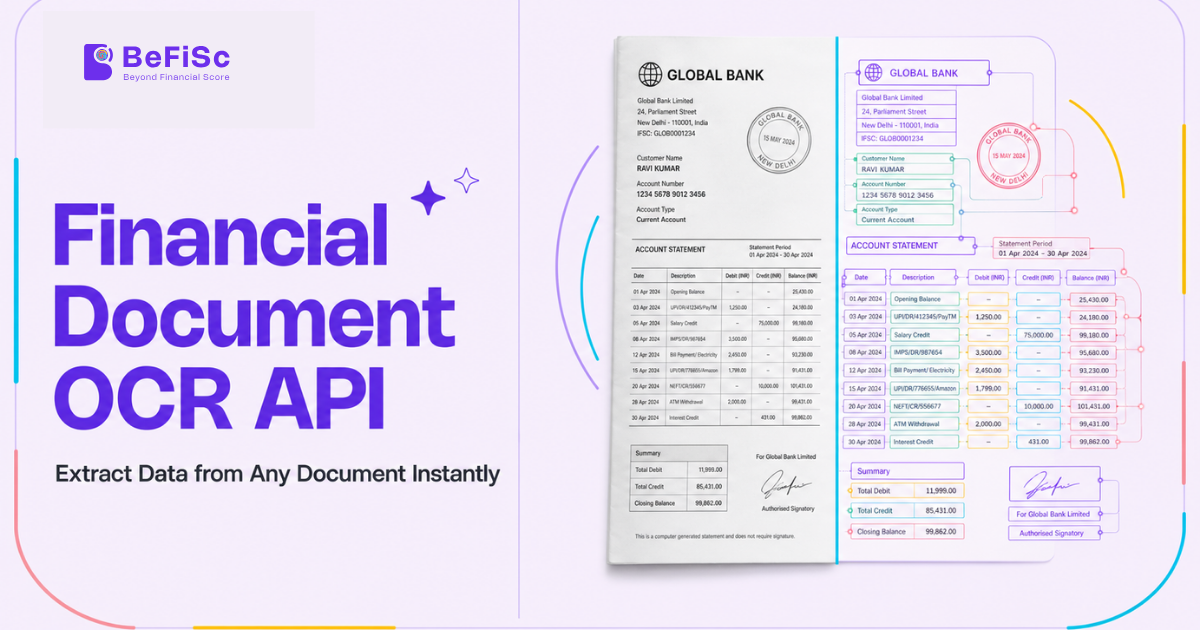
Every digital onboarding and lending flow begins with the same unglamorous, high-stakes task: turning documents into data. IDs, bank statements, salary slips, GST filings, cheques all have to become clean, structured fields before anything else in your stack can act on them. The OCR API you choose sets the ceiling for everything downstream: if extraction is slow, inaccurate, or breaks on real-world Indian documents, your onboarding drops off, your underwriting stalls, and your fraud checks run on bad data. Get extraction right and the rest of the flow moves.
This guide is for product, risk, and engineering teams evaluating an OCR / document-extraction API in India. It covers why extraction quality quietly determines your funnel, what to evaluate beyond a headline accuracy number, how the market looks in 2026, and where BeFiSc’s OCRProof fits. If documents enter your product, this is the foundation the whole flow is built on.
Why Extraction Quality Sets Your Funnel’s Ceiling
OCR looks like a solved commodity until you run it on production traffic. Then the differences become expensive. Extraction sits at the very start of onboarding and lending, so its quality caps everything after it:
- Conversion. If extraction fails or forces manual correction on real documents, genuine users drop off at the first step. Every extraction failure on a legitimate document is acquisition waste.
- Speed. Manual data entry and correction are slow and don’t scale. High-accuracy automated extraction is what lets you process thousands of applications without a proportional army of reviewers.
- Downstream accuracy. [Identity verification], [statement analysis], and [fraud checks] all run on the extracted data. Garbage in, garbage out: weak extraction quietly degrades every decision downstream.
So while OCR feels like plumbing, it’s plumbing that determines pressure across the whole system. The right extraction API raises the ceiling; the wrong one caps your funnel no matter how good the rest of your stack is.
Real Documents Break Naive OCR
The gap between a demo and production is where OCR providers separate. Demos use clean, well-lit, standard documents. Production is messy, and India’s document reality is especially demanding:
- Scanned and camera-clicked images: skewed, shadowed, low-resolution captures from a phone.
- Degraded and older documents: faded, worn, or poor-quality originals.
- Password-protected and complex PDFs: especially for bank statements and financial documents.
- Regional languages and scripts: India’s linguistic diversity, including regional-language names and text.
- Hundreds of formats: every bank, every document type, every layout variant.
Naive OCR that scores well on clean documents can fall apart in this reality, and it fails in the worst way, by wrongly rejecting genuine users whose documents happen to be degraded or regional. That’s a chronic India problem, and it’s why real-document accuracy, not clean-document benchmarks, is the metric that actually matters. Evaluate any OCR API on your own messy, representative documents, not the vendor’s polished samples.
Extraction, Authentication and the Full Picture
A point worth being clear about: extraction is necessary but not sufficient. OCR tells you what a document says; it does not tell you whether the document is genuine. An extraction API will happily pull clean data off a [forged or tampered document]and pass it downstream as truth.
That’s why extraction works best paired with [tamper and forgery detection], the “is this real?” layer that complements the “what does it say?” layer. A modern document pipeline both reads the document (OCR) and verifies it (tamper detection), so downstream decisions rest on data that is accurate and authentic. When evaluating an OCR API, it’s worth choosing one that integrates cleanly with authentication and identity checks, so you’re building a complete document pipeline rather than an isolated extractor.
How to Evaluate an OCR / Document-Extraction API
Look past the headline accuracy figure and evaluate on:
- Real-document accuracy: performance on scanned, camera-clicked, degraded, and regional-language documents, not clean samples.
- Ingestion breadth: images, ePDFs, scanned and password-protected PDFs, across India-native formats.
- Document-type coverage: IDs (Aadhaar, PAN, DL, voter ID, passport), bank statements, salary slips, GST and business documents, cheques.
- Structured output quality: clean, reliable, well-typed fields, not just raw text.
- Speed and scalability: throughput for high-volume onboarding without latency spikes.
- Integration and documentation: sandbox-to-production time and API clarity.
- Stack fit: does it pair with [tamper detection], [identity], and [statement analysis] in one flow?
- Pricing transparency: published, volume-flexible pricing versus opaque enterprise-only contracts.
The Landscape in India (2026)
Document extraction in India is offered by dedicated OCR/IDP providers and as a module within broader verification platforms:
| Provider | Positioning |
|---|---|
| BeFiSc (OCRProof) | Dedicated document extraction within the API-first Be Suite; transparent pricing |
| Surepass (Sureparser) | Document parsing/extraction within a broad API catalogue |
| HyperVerge | OCR within an identity-verification and onboarding platform |
| Signzy | Document data extraction within an onboarding suite |
| Perfios | Extraction feeding a full-stack financial-data platform |
| Ocrolus | Document understanding/extraction with fraud detection, lending-focused |
Some providers offer extraction as one feature in a large platform; others, like BeFiSc’s OCRProof, offer it as a dedicated, API-first capability you can drop precisely where you need it and pair with tamper detection for a complete pipeline. The right choice depends on your document mix, volume, and whether you want a raw extraction API you control or a bundled module.
Where OCRProof Fits
BeFiSc’s OCRProof is a document data-extraction API built to turn the messy reality of Indian documents into clean, structured data the reliable foundation your onboarding, underwriting, and fraud checks depend on. It sits within the Be Suite, alongside TamperProof (tamper/forgery detection), IDProof (identity verification), and BizCheck (business verification), so extraction pairs naturally with authentication and identity in one integrated stack.
What makes OCRProof a strong fit:
- Built for real Indian documents: designed for scanned, camera-clicked, degraded, and regional-language documents, not just clean samples.
- Broad document coverage: IDs, bank statements, financial and business documents, and the formats Indian onboarding actually sees.
- Pairs with TamperProof: read the document and verify it’s genuine, so downstream decisions rest on accurate, authentic data.
- API-first and transparently priced: sandbox access and clear pricing, so you can test on your own documents before committing.
- Be Suite integration: one stack for extraction, tamper detection, identity, and business verification.
If extraction quality is capping your funnel or forcing manual correction, OCRProof is built to raise that ceiling. Book an OCRProof demo, or get API access and benchmark it against your own real-world documents.
Integration and Time-to-Live
The practical questions that decide most evaluations:
- Benchmark on real documents. Test on your own messy, representative production documents,,nts including regional and degraded ones, not the vendor’s clean samples.
- Pair read with verify. Choose extraction that integrates with [tamper detection], so your pipeline reads and authenticates.
- Time-to-live. API-first providers with sandbox access and clear docs get you to production in days.
- Transparent pricing. Volume-flexible pricing lets you prove value and scale on your terms.
Frequently Asked Questions
How fast can I integrate an OCR API?
With an API-first provider offering sandbox access and clear documentation, integration typically takes days. Benchmark on your own real-world documents during the trial, and prefer a provider whose extraction integrates with tamper detection and identity checks so you build a complete document pipeline, not an isolated extractor.
Should OCR be paired with tamper detection?
Yes. OCR reads what a document says but doesn’t verify it’s genuine; it will extract clean data from a forged document. Pairing extraction with tamper/forgery detection creates a complete pipeline that both reads and authenticates documents, so downstream decisions rest on data that is accurate and real.
Why does real-document accuracy matter more than benchmark accuracy?
Because production documents are messy, scanned, camera-clicked, degraded, password-protected, and in regional languages, and naive OCR that scores well on clean samples often fails in this reality, wrongly rejecting genuine users. Real-document accuracy determines your actual onboarding conversion, so benchmark on your own representative documents.
Which is the best OCR API for financial documents in India?
The best choice depends on your document mix and whether you want dedicated extraction or a bundled module. Options include BeFiSc (OCRProof), Surepass (Sureparser), HyperVerge, Signzy, Perfios, and Ocrolus. Evaluate on real-document accuracy performance on scanned, degraded, and regional-language documents, not clean-sample benchmarks.
What is an OCR / document-extraction API?
An OCR (optical character recognition) or document-extraction API automatically converts documents, IDs, bank statements, salary slips, and business documents into clean, structured data. It’s the first step in most onboarding and lending flows, turning documents into the fields that identity verification, underwriting, and fraud checks act on.
Conclusion
OCR is the least glamorous and most foundational decision in your document stack. It sits at the very start of onboarding and lending, so its quality sets the ceiling for everything after its conversion, speed, and the accuracy of every downstream decision. The trap is evaluating it on clean-sample benchmarks; the reality is production traffic full of scanned, degraded, regional-language, and password-protected documents that naive OCR fails, wrongly rejecting genuine users at the very first step. And extraction alone isn’t enough; ugh, reading a document is not the same as verifying it’s real.
BeFiSc’s OCRProof is built for that reality:ality real-document accuracy across the messy Indian document mix, broad coverage, transparent API-first pricing, and native pairing with TamperProof so your pipeline both reads and authenticates. If extraction is capping your funnel or forcing manual correction, it’s worth benchmarking on your own documents. Book an OCRProof demo, or get API access and run it against your real production documents; the accuracy gap on messy inputs is usually where the decision gets made.