
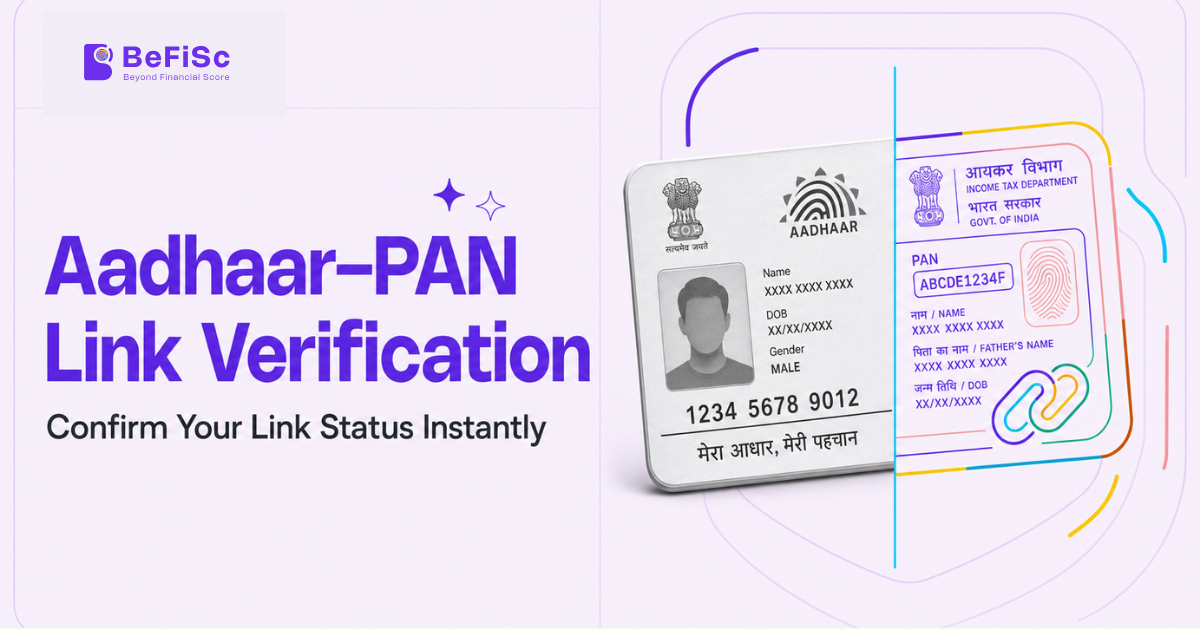
An unlinked PAN is no longer a minor paperwork issue; it is a blocked financial identity. Under Income Tax rules, the government makes a PAN inoperative when the holder does not link it to Aadhaar. An inoperative PAN cannot support the transactions required for lending, investing, and onboarding. For an individual, that means blocked ITR filing and higher TDS. For a lender, fintech, or platform onboarding that individual, it means a customer whose PAN silently fails compliance unless you check the linkage before you proceed.
This guide explains Aadhaar–PAN link verification from both sides: how any individual can check and fix their PAN–Aadhaar link status, and how businesses verify PAN operative Aadhaar-linked status at scale through an API. If you onboard customers in India, PAN-Aadhaar linkage is a status you need to confirm, not assume.
Why Aadhaar–PAN Link Status Matters
Section 139AA of the Income Tax Act requires eligible PAN holders to link their PAN with Aadhaar. The consequence of not linking is not a warning; it is the PAN becoming inoperative, which restricts the holder from a wide range of tax and financial activities.
For individuals, an inoperative PAN blocks ITR filing, triggers higher TDS deduction, and can cause banks, mutual funds, and institutions to reject PAN-based transactions.Businesses that onboard, lend to, or transact with these individuals face a compliance and operational problem when a PAN becomes inoperative. KYC teams that rely on an inoperative PAN weaken their compliance position, while financial institutions may block or reject downstream transactions.
That is why Aadhaar–PAN linkage has become a verification checkpoint, not just a personal tax formality. Confirming that a customer’s PAN is operative (i.e., Aadhaar-linked) is part of confirming that their financial identity actually works.
What “Inoperative PAN” Actually Means
An inoperative PAN remains valid but loses its functionality for financial and tax purposes because the holder did not link it to Aadhaar as required. The PAN still exists, but the holder cannot use it.
The practical consequences of an inoperative PAN include:
- ITR filing blocked: the Income Tax e-filing portal does not accept returns from an inoperative PAN.
- Higher TDS/TCS: tax is deducted or collected at higher rates.
- Blocked financial transactions: opening bank accounts, investing in mutual funds and equities, and high-value transactions if they require a valid, operative PAN.
- Failed onboarding: KYC and onboarding flows that depend on a working PAN can fail.
Reactivation is possible: linking the PAN with Aadhaar (and paying the applicable fee) makes it operative again, typically after a short processing period. But until then, the inoperative PAN effectively blocks the transactions that matter.
How to Check Aadhaar–PAN Link Status (Individuals)
Any individual can check their PAN–Aadhaar link status without logging in:
- Income Tax portal: go to incometax.gov.in and use the “Link Aadhaar Status” option (no login required). Enter your PAN and Aadhaar to see whether they are linked.
- SMS: send an SMS in the format UIDPAN<12-digit Aadhaar><10-digit PAN> to 567678 or 56161, and you’ll receive a reply confirming whether the link is active.
If the status shows linked, the PAN is operative. If it shows not linked or inoperative, linking is required to restore full functionality. A common reason linking fails is a mismatch in name, date of birth, or gender between the PAN and Aadhaar records. The portal rejects mismatched requests instead of partially processing them, so users must correct the mismatched detail through NSDL/Protean or UTIITSL for PAN, or UIDAI for Aadhaar, before retrying.
How to Link PAN with Aadhaar (and the ₹1,000 Fee)
For those who need to link a delayed PAN:
- Pay the fee. A ₹1,000 fee applies for delayed linking (a fee for delayed linking, payable via e-Pay Tax under the applicable minor head).
- Submit the link request. On the Income Tax portal’s “Link Aadhaar” page, enter your PAN and Aadhaar, your name as per Aadhaar, and mobile number; consent; and validate via OTP.
- Wait for validation. The request goes to UIDAI for validation, and linking typically completes after a short processing period.
If names or details don’t match, correct the erroneous record first, then retry. Offline linking is also possible at NSDL/Protean or UTIITSL centres.
The 2026 Rules You Need to Know
A few current specifics matter, especially for onboarding teams:
- Deadlines have passed. The general linking deadline (originally May 31, 2024, with the ₹1,000 fee thereafter) has passed. A special extension to December 31, 2025, applied only to a specific category: those who obtained PAN using an Aadhaar Enrolment ID before October 1, 2024, and for that category, an unlinked PAN becomes inoperative from January 1, 2026.
- New PANs are auto-linked. From April 2026, new PAN applications require the Aadhaar number on the application form (Form 93), and PAN and Aadhaar are automatically linked at issuance for these new applicants, so newer PANs won’t have this problem, but this does not retroactively fix older unlinked PANs.
- Instant e-PAN exists. Individuals without a PAN can obtain a free Instant e-PAN via the Income Tax portal if their Aadhaar has a linked mobile number.
The takeaway for businesses: a meaningful share of existing PANs in your onboarding funnel may be inoperative, and you cannot tell from the PAN number alone. You have to check linkage status.
Why Businesses Must Verify PAN-Aadhaar Linkage
For lenders, fintechs, NBFCs, and platforms, PAN verification is standard KYC, but PAN verification that ignores Aadhaar linkage status is incomplete. A PAN can be genuine and correctly matched to the applicant, yet still be inoperative because it isn’t Aadhaar-linked. Onboard that customer, and downstream financial transactions may be blocked or rejected, disbursals may fail, and your KYC rests on a technically inoperative identity.
Checking Aadhaar–PAN linkage at onboarding lets you:
- Flag inoperative PANs early before disbursal or account opening and request the customer complete linkage.
- Avoid downstream failures, blocked transactions, failed disbursals, and rejected payments tied to inoperative PANs.
- Strengthen KYC: confirm the customer’s PAN is not just genuine but operative and functional.
- Reduce fraud exposure: combine PAN validity, name match, and linkage status for a stronger identity check.
Doing this manually, asking every applicant to check and prove linkage adds friction and drop-off. At scale, it needs to be automated.
Verifying PAN + Aadhaar Linkage via API
A PAN Verification API automates this check: it validates a PAN against the Income Tax Department’s database and returns the associated details, including PAN status and, critically, Aadhaar linkage status, as a machine-readable response, so your onboarding flow can confirm operative status instantly.
BeFiSc’s PAN Verification API part of the IDProof / Be Suite identity stack connects to the NSDL database with live, non-cached connectivity and returns PAN status, name, entity type, date of birth, and Aadhaar linkage status all the fields required for compliant KYC. It supports both individual and bulk verification, with sandbox access for development. Paired with name-match and Aadhaar eKYC, it turns PAN-Aadhaar verification from a manual, drop-off-prone step into an instant, automated onboarding check.
What a strong PAN + linkage verification flow returns:
- PAN status: active, inoperative, invalid, or fake the key compliance flag.
- Aadhaar linkage status: whether the PAN is operative (linked) or inoperative (unlinked).
- Name on PAN: for name-match against application data.
- Entity type: individual or business, enabling director-level checks for business KYC.
If your onboarding verifies PAN but doesn’t check linkage status, you have a gap exactly where inoperative PANs slip through. Get sandbox access to the PAN Verification API and add operative-status checking to your onboarding flow.
Frequently Asked Questions
Can I verify PAN and Aadhaar linkage through an API?
Yes, a PAN Verification API validates the PAN against the Income Tax database and returns PAN status plus Aadhaar linkage (operative/inoperative) status as a machine-readable response. BeFiSc’s PAN Verification API returns these fields with live NSDL connectivity, supporting individual and bulk checks so onboarding can confirm operative status instantly.
Why do lenders need to verify Aadhaar–PAN linkage?
Because a PAN can be genuine but inoperative if it isn’t Aadhaar-linked, and an inoperative PAN blocks financial transactions. Verifying linkage status at onboarding lets lenders flag inoperative PANs before disbursal, avoid blocked downstream transactions, and ensure KYC rests on an operative, functional identity, not just a valid PAN number.
What is the fee to link PAN with Aadhaar now?
A ₹1,000 fee applies for delayed PAN-Aadhaar linking, payable via e-Pay Tax on the Income Tax portal before submitting the link request. This is a fee for delayed linking. New PAN applications from April 2026 include Aadhaar on the form and are auto-linked at issuance, so they don’t require separate linking.
What happens if my PAN is not linked to Aadhaar?
An unlinked PAN becomes inoperative; it cannot be used for financial and tax transactions. ITR filing is blocked, TDS is deducted at higher rates, and banks, mutual funds, and institutions may block or reject PAN-based transactions. Linking the PAN (with the applicable ₹1,000 fee) restores operative status after processing.
How do I check my Aadhaar–PAN link status?
Go to the Income Tax portal (incometax.gov.in) and use “Link Aadhaar Status” — no login needed — by entering your PAN and Aadhaar. Alternatively, SMS UIDPAN<12-digit Aadhaar><10-digit PAN> to 567678 or 56161. The response tells you whether your PAN is linked (operative) or not linked (inoperative).
The Bottom Line
Aadhaar–PAN linkage has quietly become one of the most consequential status checks in Indian onboarding. A PAN that isn’t linked is inoperative, and an inoperative PAN is a financial identity that doesn’t work blocked returns and increases TDS for the individual, and blocked transactions, causes failed disbursals, and creates shaky KYC for any business that onboards them without checking. In 2026, with deadlines passed and a real share of existing PANs likely inoperative, you cannot tell operative status from the PAN number alone. You have to verify it.
For individuals, that’s a quick portal or SMS check and, if needed, a ₹1,000 linking step. For businesses, it’s a verification checkpoint best automated: a PAN Verification API that returns Aadhaar linkage status alongside PAN validity, so inoperative PANs are flagged before they cause downstream failures. BeFiSc’s PAN Verification API does exactly that, with live NSDL connectivity and Be Suite integration.