Every KYC process in India comes back to a short, legally defined list. When a bank asks for “an OVD,” it is not asking for any identity proof you happen to have. It is asking for one of a handful of documents that the law recognises for both identity and address.
The terms cause real confusion. “OVD full form in banking” gets about 2,500 searches a month, and “KYC documents” nearly 9,000. Behind those searches are customers unsure what to submit and operations teams unsure what they can accept.
This guide sets out the OVD list, the deemed OVDs, the separate PAN requirement, and how regulated entities should verify each document rather than simply collect it.
What OVD Means
OVD stands for Officially Valid Document. The term comes from the Prevention of Money-Laundering (Maintenance of Records) Rules, 2005, and is carried over into RBI’s KYC Directions, which were reissued on 28 November 2025 as separate directions for each category of regulated entity.
An OVD serves as proof of identity and, where it carries an address, proof of address. Customers choose which OVD to submit; a regulated entity cannot insist on one specific OVD, including Aadhaar.
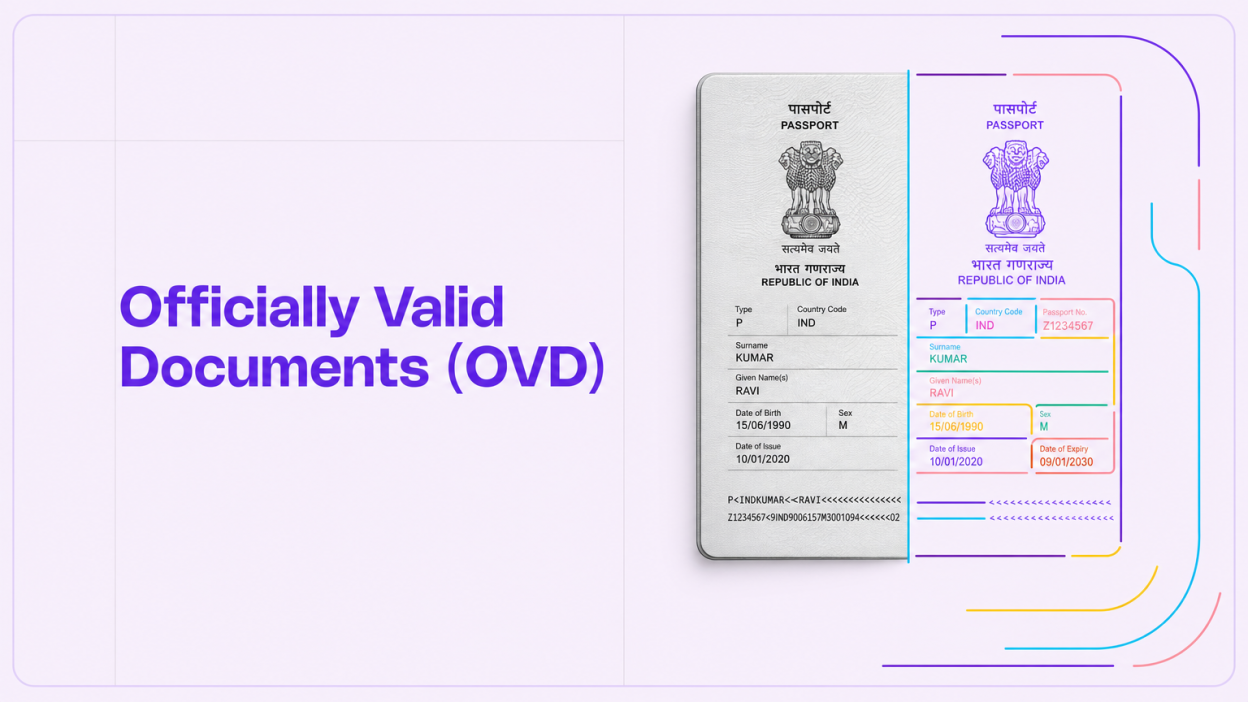
The Six Officially Valid Documents
| OVD | Notes |
|---|---|
| Passport | Valid for identity and address; primary document for non-residents and foreign nationals |
| Driving licence | Must be valid on the date of submission |
| Proof of possession of Aadhaar number | Aadhaar letter, e-Aadhaar, or offline verification data; first eight digits must be masked if a copy is kept |
| Voter identity card (EPIC) | Issued by the Election Commission of India |
| NREGA job card | Signed by an officer of the State Government |
| Letter issued by the National Population Register | Must contain name and address |
An OVD submitted in a name that has changed, for example after marriage, is acceptable with a marriage certificate or gazette notification showing the change.
Deemed OVDs for Address
When the OVD a customer submits does not carry the current address, a limited set of documents is deemed to be an OVD for address:
- Utility bill for any service, such as electricity, telephone, post-paid mobile, piped gas or water, not more than two months old
- Property or municipal tax receipt
- Pension or family pension payment orders issued by government departments or public sector undertakings, if they contain the address
- Letter of allotment of accommodation from specified employers (such as government departments, statutory bodies, public sector undertakings, scheduled commercial banks, financial institutions and listed companies), and leave-and-licence agreements with such employers
The customer must then submit an OVD with the current address within three months. Deemed OVDs are a bridge, not a permanent substitute.
PAN and Form 60: The Separate Requirement
PAN is not an OVD because it does not carry an address. It is a separate, mandatory requirement: the customer must provide a PAN (or its equivalent e-document) or Form 60 if they do not have one.
In practice, most individual onboarding requires three things: PAN or Form 60, one OVD for identity and address, and a recent photograph. Operations teams sometimes treat PAN as the identity proof and skip the OVD. That is a compliance gap.
Documents That Are Not OVDs
These are frequently offered and frequently accepted in error:
- PAN card (required, but not an OVD)
- Bank passbooks and statements
- Ration cards
- Employer identity cards
- Rent agreements with private landlords
- Birth certificates and school certificates
Some may support other checks, but none satisfies the OVD requirement on its own.
OVDs for Legal Entities
For companies, partnerships, trusts and other legal entities, the concept extends to constitutional and registration documents. For a company, this typically includes the certificate of incorporation, memorandum and articles of association, PAN of the company, a board resolution and power of attorney for the person acting on its behalf, and the names and addresses of senior management and beneficial owners. Each authorised signatory and beneficial owner is then identified with individual OVDs.
How to Verify Each OVD
Collecting a document is not verifying it. The difference matters most in digital journeys.
| Document | Stronger verification route |
|---|---|
| Passport | Passport data check against the issuing database where available; MRZ validation; face match with photo |
| Driving licence | Check licence number and validity against the transport database; face match |
| Aadhaar | Offline XML, Secure QR or DigiLocker signature validation; e-KYC where permitted |
| Voter ID | EPIC number check against the electoral database; name and address match |
| NREGA job card and NPR letter | Physical verification or original-seen-and-verified; issuer confirmation where feasible |
| Deemed OVDs (utility bills) | Bill number and consumer details checked with the utility where an interface exists; date within two months |
When documents are obtained as equivalent e-documents, such as through DigiLocker, the digital signature confirms issuance, which is stronger than a scanned image.
Common Operational Errors
- Accepting PAN as the only document. PAN does not replace an OVD.
- Insisting on Aadhaar. Customers can choose any OVD; refusing other OVDs breaches the rules and excludes customers.
- Keeping unmasked Aadhaar copies. The first eight digits must be masked.
- Letting deemed OVDs run past three months without collecting a proper OVD with the current address.
- Relying on images without validation. Edited images of genuine document templates are a major source of identity fraud.
Use Cases
Digital savings account: A small finance bank accepts DigiLocker-issued Aadhaar or driving licence as OVD, verifies PAN separately, and runs a face match against the OVD photo.
Gold loan branch: Staff accept voter ID for a customer without Aadhaar, check the EPIC number against the electoral database, and capture a live photo.
Relocated customer: A salaried customer’s OVD shows an old address. The NBFC accepts a recent electricity bill as deemed OVD and sets a three-month task to collect an OVD with the new address.
NRI onboarding: A bank uses the passport as the OVD, with overseas address evidence as permitted, and verifies the passport data before activation.
Key Takeaways
- OVD means Officially Valid Document: passport, driving licence, proof of Aadhaar possession, voter ID, NREGA job card, and NPR letter.
- Deemed OVDs, such as recent utility bills, can cover the address temporarily, with a proper OVD due within three months.
- PAN or Form 60 is a separate, mandatory requirement; PAN is not an OVD.
- Customers choose their OVD; regulated entities cannot insist on Aadhaar.
- Verify documents against issuing sources or signed e-documents, not just images.
Frequently Asked Questions
What documents are needed for KYC of a company?
Constitutional documents such as the certificate of incorporation and memorandum and articles of association, the company’s PAN, a board resolution and OVDs for authorised signatories and beneficial owners.
Can a utility bill be used as address proof?
Yes, as a deemed OVD, if it is not more than two months old. A regular OVD with the current address must follow within three months.
Is Aadhaar mandatory for KYC?
No. Aadhaar is one of the OVDs. Customers can submit any other OVD.
Is PAN card an OVD?
No. PAN is mandatory for KYC, but it is not an OVD because it does not prove address.
What is the full form of OVD in banking?
Officially Valid Document, as defined under the PML Rules and RBI’s KYC Directions.
Conclusion
- The OVD list is short and stable, but mistakes around it are common and expensive: accepting documents that do not qualify, insisting on the wrong ones, storing Aadhaar incorrectly, and treating images as proof. Each is visible in an audit.
- The better model is to collect OVDs as signed e-documents where possible, verify them against issuing sources, and link the document to the person through face match and liveness.
- BeFiSc’s document and identity verification APIs cover PAN, driving licence, voter ID, passport, and Aadhaar-based checks, so OVDs are verified at source rather than just collected. Talk to the BeFiSc team to add them to your KYC flow.