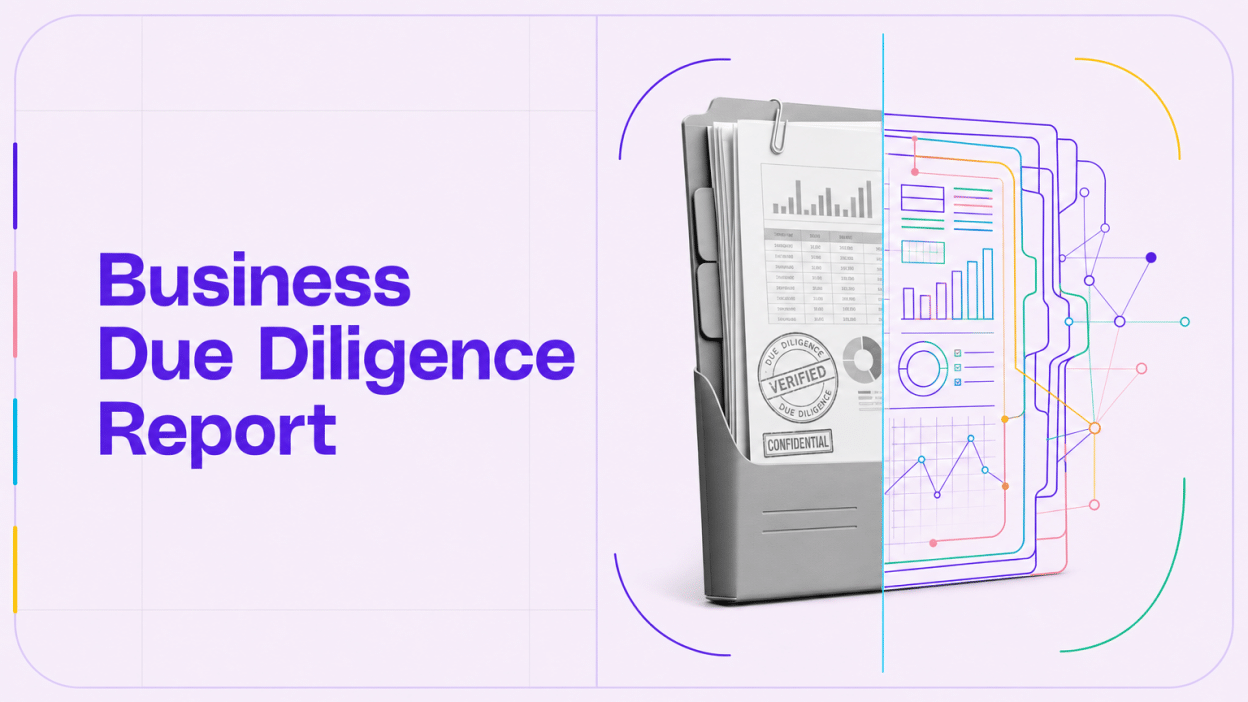
A business due diligence report for onboarding should let a reviewer approve, refer, or decline without further research. It needs identity and registrations, legal status, people and directorships, compliance behaviour such as GST filing, digital footprint, and a clear list of red flags and inconsistencies, delivered fast enough to fit the onboarding flow.
Ask five teams what a due diligence report is, and you will get five answers. To an M&A lawyer, it is a hundred-page data room review. To a credit analyst, it is a bureau pull plus financials. To a marketplace onboarding team, it is often a screenshot of the GST portal.
For onboarding decisions (a merchant loan, a seller, a logistics partner, a new vendor), none of those fit. You need something narrower than transaction diligence and much deeper than a single registry check. This guide sets out the sections of a decision-ready report, an illustrative anatomy, a turnaround comparison, how to turn a report into approve, refer, and decline rules, and how to run a POC.
What onboarding due diligence is (and is not)
Onboarding due diligence answers three questions about a counterparty: does the business exist as claimed, is it in good standing with the registries that govern it, and does anything about it or the people behind it warrant caution?
It is not a credit assessment. A business can be genuine and still be a poor credit risk; that is what bureau data, bank statements, and financials are for. It is also not KYC. Regulated entities still need to collect and verify entity documents and identify beneficial owners under the RBI’s KYC Directions 2025 (for commercial banks, legal-entity requirements sit in paras 30 to 38; NBFC and co-operative bank Directions number them differently).
The right position for a company due diligence report in onboarding is first: a pre-screen that tells you which applicants deserve the cost of KYC, document review and credit analysis.
What a slow or shallow report costs
Shallow reports let bad counterparties in. The RBI Annual Report 2025-26, as reported by Outlook Business on 29 May 2026, recorded 10,114 fraud cases involving Rs 48,021 crore in FY26, with advances accounting for 8,640 cases and Rs 40,774 crore. Separately, the Ministry of Finance reported on 7 January 2024 that its drive against fake GST registrations had detected 29,273 bogus firms since mid-May 2023. A report that stops at “GSTIN active” would have passed many of them.
For banks, the RBI’s Fraud Risk Management Directions of 31 July 2026 set out an early warning signal and red-flagging framework for accounts. Signals visible at onboarding but never recorded make that framework harder to apply later.
Slow reports cost differently. Illustrative: an in-house analyst assembling a report from GST, MCA, Udyam and web searches might spend 30 to 45 minutes per counterparty. At 2,000 new counterparties a month, that is 1,000 to 1,500 analyst hours, and a backlog that pushes good applicants towards faster competitors.
Six sections of a decision-ready business due diligence report
1. Identity and registrations
Which registrations does the business hold, and do they describe the same entity? GSTIN, CIN or LLPIN for incorporated entities, Udyam registration where declared, and the PAN embedded in the GSTIN. Each source answers a different question.
2. Legal status
Is the entity active on each registry? GST status (active, suspended, cancelled), company status on MCA, and registration or incorporation dates. A business claiming ten years of trading with a GSTIN issued last month needs explaining.
3. People and directorships
Who controls the business? For private limited companies, the directors and the other companies they are linked to. Directors associated with many recently formed or struck-off companies are a recognised shell signal .
4. Compliance behaviour
Does the business behave like an operating entity? Regular GST return filing is the most useful public signal. A registration that is active but has stopped filing tells you more than one that is merely active.
5. Digital footprint
Is there evidence of the business outside government records: a website, marketplace listings, map presence, reviews, a phone number associated with the trade name? Absence is not proof of fraud for small businesses, but it should be weighed against the size of the exposure.
6. Red flags and inconsistencies
The section that makes a report decision-ready. Name mismatches across sources, addresses in different states, dates that contradict each other, people linked to adverse entities. If a report lists data without stating conflicts, the analyst is still doing the real work. Our overview shows how these inconsistencies tend to cluster.
Sample report anatomy (illustrative)
The table shows a generic structure for an onboarding report. It is illustrative and is not the field list of any specific product.
| Section | Typical contents | Example red flag | Typical decision impact |
|---|---|---|---|
| Summary | Entity name, inputs used, overall view, flags count | Multiple high-severity flags | Routes case to approve, refer, or decline |
| Identity and registrations | GSTIN, CIN/LLPIN, Udyam, embedded PAN | Udyam name differs from GST legal name | Refer if unexplained |
| Legal status | Status and dates per registry | GSTIN cancelled or suspended | Decline or hold |
| People | Directors and linked entities | Director linked to many struck-off companies | Refer, enhanced checks |
| Compliance behaviour | Filing regularity, taxpayer type | No returns for recent periods | Refer; lower limits |
| Digital footprint | Website, listings, contact consistency | No footprint for a claimed large trader | Refer for high exposure |
| Inconsistencies | Cross-source conflicts | Registered address in one state, operations claimed in another | Refer |
Turnaround: manual analyst vs automated report
| Dimension | Manual analyst report | External agency report | Automated business risk report |
|---|---|---|---|
| Turnaround | 30–45 minutes per case (illustrative), longer with backlog | Days | Under a minute for automated reports such as BizCheck |
| Consistency | Varies by analyst | Varies by agency template | Same structure every time |
| Cross-source conflicts | Found if the analyst looks | Usually covered | Surfaced automatically, depth varies by vendor |
| Scale | Linear with headcount | Linear with spend | Scales with volume |
| Depth on edge cases | High when time allows | High | Needs human review for referrals |
| Best use | Referrals and large exposures | Large or complex counterparties | First-line screening of every applicant |
The practical model combines them: an automated report on every counterparty, analysts on referrals, and specialist diligence only for large or unusual exposures.
Buyer’s checklist for a business risk report
| Criterion | Why it matters | What to ask the vendor |
|---|---|---|
| Inputs accepted | Applicants share different identifiers | Can I start from a GSTIN or a mobile number? |
| Source coverage | Gaps leave blind spots | Which of GST, MCA, Udyam and footprint data are covered? |
| People coverage | Shells hide behind directors | Are directors of private limited companies profiled, with linked entities? |
| Conflict detection | The value is in inconsistencies | Which cross-source conflicts are flagged? |
| Speed | Must fit onboarding | What is time to a complete report? |
| Explainability | Referrals need a reason | Does every flag show the underlying data? |
| Evidence | Auditors and regulators ask later | Can reports be stored per case with a timestamp? |
| Data protection | Director data is personal data under the DPDP Act 2023 | Processor agreement, storage location, retention? |
Setting decision rules: approve, refer, decline
A report only speeds onboarding if it maps to rules. Start simple and tune with outcomes.
- Decline: cancelled or suspended GST registration for a business that should be registered; company struck off or under strike-off; identity data that cannot be reconciled to one entity.
- Refer: name or address conflicts across sources; recent registration combined with a large requested exposure; stopped GST filing; directors linked to adverse entities; no footprint for a large claimed business.
- Approve to KYC: consistent identity across sources, active status, regular filing, and no material flags.
Set thresholds by exposure. A Rs 50,000 seller payout limit and a Rs 50 lakh working-capital line should not share a referral rule. Record the rule that fired on every case, so you can audit decisions and tune rules. For the wider KYB process, these rules sit within.
Running a POC
- Choose 20–50 past counterparties (week 0, risk owner): approvals, declines, referrals and, ideally, cases that later went bad.
- Record the baseline (week 0, operations): your decision, reason, turnaround, and analyst minutes per case.
- Generate reports (days 1–5): submit the GSTINs or mobile numbers and collect one report per case.
- Compare side by side (days 5–7, risk): where did the report agree, catch something you missed, or flag something benign?
- Draft rules and decide (week 2, steering group): convert findings into approve, refer, and decline rules and agree rollout scope.
Success metrics: agreement with past declines and referrals, warnings visible on cases that later went bad, false flags on clean cases, time to report and analyst minutes per decision.
Where BeFiSc fits: BizCheck generates a business risk report in under 60 seconds from a GSTIN or a mobile number, built on GST, MCA, Udyam, and digital-footprint data, and profiles the people behind Private Limited entities. The use cases it lists are lenders screening merchant loans, marketplaces screening sellers and vendors, and logistics teams screening supply-chain partners. It sits before KYC rather than replacing it, which is exactly where an onboarding due diligence report belongs. The free POC covers 20–50 of your own cases over 5–7 working days: a full BizCheck report per case, a side-by-side with your current screening, and a debrief call, with no setup fee.
What to bring to the POC: 20–50 GSTINs or mobile numbers, your decision and reason for each, current turnaround, and outcomes for any cases that later went bad.
Key Takeaways
- An onboarding business due diligence report is a pre-screen: narrower than transaction diligence, deeper than a single registry check, and separate from KYC and credit assessment.
- Six sections make it decision-ready: identity and registrations, legal status, people, compliance behaviour, digital footprint, and red flags and inconsistencies.
- The inconsistencies section carries the most value; a report that only lists data leaves the real work to analysts.
- Combine automated reports on every counterparty with analyst review of referrals and specialist diligence on large exposures.
- Translate the report into explicit approve, refer, and decline rules, scaled to exposure, and record which rule fired.
Frequently Asked Questions
What does a business due diligence report cost compared with an analyst?
Compare cost per decision: analyst minutes, backlog, and missed risk on one side, per-report pricing on the other. A free POC on 20–50 cases gives you the time-saving and accuracy data to make that comparison with your own numbers.
How do we meet DPDP Act obligations when profiling directors?
Director and proprietor details are personal data. Define the purpose (onboarding risk assessment), collect only what the decision needs, sign processor agreements with vendors, and set retention periods aligned with your regulatory record-keeping.
How much integration is needed to start?
None for a POC: you share identifiers and receive reports. For production, confirm with the vendor which delivery modes are available today and how reports attach to your case or loan files.
Does a business risk report replace KYC or credit underwriting?
No. It decides who proceeds to KYC and underwriting. Regulated entities must still verify entity documents and beneficial owners under the KYC Directions, and credit decisions still need bureau, banking, and financial data.
Is an automated business due diligence report accurate enough to act on?
Accuracy depends on source freshness and on how well the report matches records to one entity. Test it on your own past cases with known outcomes, and count both missed warnings and false flags before you set rules.
Conclusion
A due diligence report earns its place in onboarding only if it changes decisions. That means covering the six sections that matter, putting inconsistencies up front, arriving fast enough to sit before KYC, and mapping cleanly to approve, refer, and decline rules.
The shift underway is from reports as documents that analysts read to reports as inputs that rules act on, with humans reserved for the cases that genuinely need judgement. Organisations that make this shift onboard good counterparties faster and see bad ones earlier.
The most reliable way to judge any report is against decisions you have already made.
Request a free BizCheck POC on 20–50 of your past counterparties, a full report per case and debrief call.