
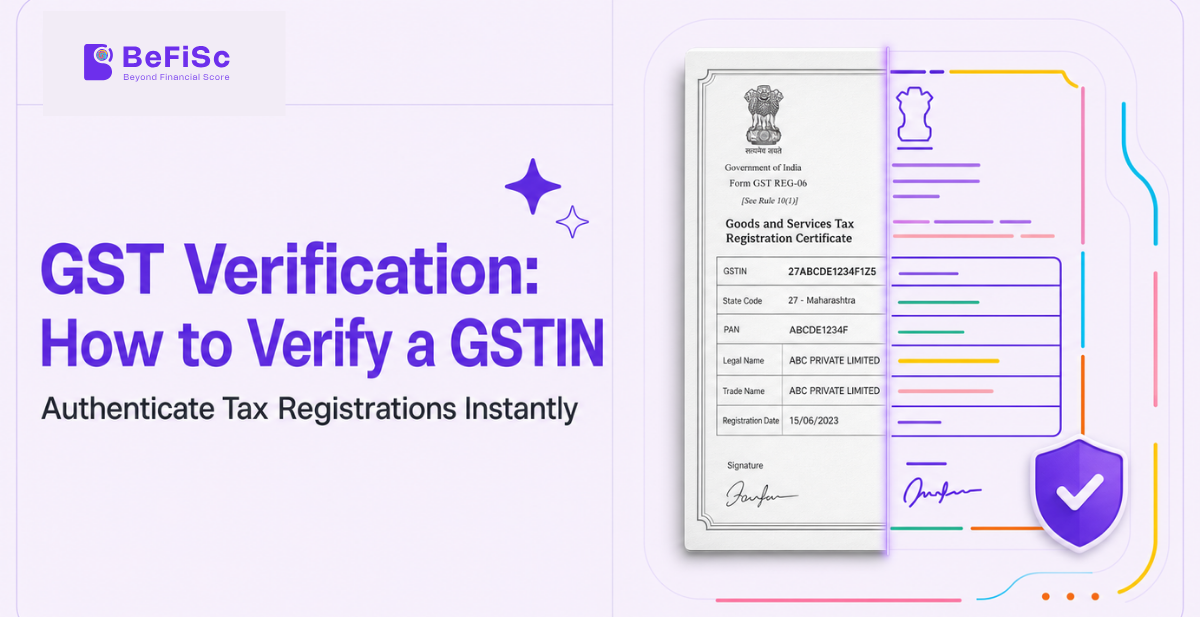
Every registered business in India carries a GSTIN, a 15-character GST identification number that ties the business to its tax identity. For anyone onboarding, lending to, or transacting with businesses, that GSTIN is one of the most useful verification signals available: it confirms the business exists, is registered, is active, and matches who it claims to be. But a GSTIN printed on an invoice or an application form proves nothing on its own; it has to be verified against the GST system. And with fake GST registrations and fake input tax credit being a major fraud in India, GST verification has become a front-line check, not a formality.
This guide explains how to verify a GSTIN, what verification actually confirms, why it matters for onboarding and lending, and how businesses automate GST verification at scale through an API. If you deal with business customers, verifying their GSTIN is one of the highest-value checks you can run.
What Is a GSTIN and What It Reveals
A GSTIN (Goods and Services Tax Identification Number) is the 15-character alphanumeric identifier assigned to every business registered under GST. Its structure is meaningful: the first two digits are the state code, the next ten are the business’s PAN, and the remaining characters encode entity and check information. That structure links the GSTIN directly to the business’s PAN and state, which is why GST verification is so useful for business identity.
Verifying a GSTIN reveals the registered business’s legal name, its registration status (active, cancelled, suspended), its registration type and date, its state jurisdiction, and its taxpayer type. In effect, the GSTIN is a window into whether a business is genuinely registered, active, and, as claimed, the foundation of business verification (KYB).
Why GST Verification Matters
GST verification matters because the GSTIN is a high-signal proof of business legitimacy, and because fake GST registrations are a real and costly problem.
For onboarding and KYB, verifying the GSTIN confirms the business exists, is registered, and is active a core check before extending services, credit, or a merchant account. For lending, GST data (including returns supports underwriting, so verifying the GSTIN is the entry point to using GST-based signals. For payments and marketplaces, verifying merchant GSTINs helps ensure merchants are genuine registered businesses, reducing transaction-laundering and merchant-fraud exposure.
And critically, GST verification is a fraud check. Fake GST registrations obtained using stolen or fabricated identities to issue fake invoices and claim fraudulent input tax credit are a dominant GST fraud in India. Verifying a GSTIN against the GST system, and checking that it is active and matches the claimed business, is a front-line defence against dealing with fake or fraudulent firms.
How to Verify a GST Number (Manually)
Any GSTIN can be verified manually through the official GST portal:
- GST portal search: go to the GST portal (gst.gov.in) and use the “Search Taxpayer” → “Search by GSTIN/UIN” option.
- Enter the GSTIN: input the 15-character GSTIN.
- Review the details: the portal returns the registered legal name, status (active/cancelled/suspended), registration date, state jurisdiction, taxpayer type, and constitution of business.
You can also search by PAN to find GSTINs associated with a PAN. Manual verification confirms whether a single GSTIN is genuine and active, useful for a one-off check, but slow and unscalable for onboarding businesses at volume.
What GST Verification Confirms
A complete GST verification confirms several things about a business:
- Existence and registration: the business is genuinely registered under GST.
- Legal name: the registered name, for name-matching against the application or invoice.
- Status: active, cancelled, or suspended (a cancelled or suspended GSTIN is a major red flag).
- PAN linkage: the PAN embedded in the GSTIN, connecting the business to its PAN identity.
- State and jurisdiction: where the business is registered.
- Registration date and type: how long it’s been registered and its taxpayer category.
Together, these establish whether the business is genuine, active, and consistent with what it claims, the core of business identity verification.
GST Verification and Fraud Prevention
GST verification is a direct fraud-prevention control, particularly against the fake-firm problem at the heart of GST fraud.
Fake GST registrations created using stolen or fabricated identities to issue fake invoices and pass fraudulent input tax credit rely on the GSTIN appearing legitimate. Verifying the GSTIN against the GST system, checking that it is active (not cancelled or suspended), confirming the registered name matches the claimed business, and cross-checking the embedded PAN helps detect:
- Non-existent or invalid GSTINs: numbers that don’t verify.
- Cancelled or suspended registrations: firms no longer legitimately registered.
- Name mismatches: a GSTIN whose registered name doesn’t match the claimed business.
- PAN inconsistencies: a GSTIN whose embedded PAN doesn’t align with the business’s claimed PAN identity.
Combined with broader KYB and beneficial-ownership checks, GST verification is a key layer in confirming a business is genuine and in filtering out the fake firms that fuel GST and invoice fraud.
Why Manual GST Verification Doesn’t Scale
Manual GST verification through the portal works for a single check, but it breaks down at onboarding scale:
- Volume: onboarding hundreds or thousands of business customers manually is slow and impractical.
- Friction and drop-off: manual verification adds delay to business onboarding, causing genuine businesses to abandon the flow.
- Consistency: manual checks are inconsistent and error-prone.
- Integration: manual results don’t flow into your onboarding, KYB, or underwriting systems.
- Ongoing monitoring: a GSTIN active at onboarding can be cancelled later; manual checks can’t re-verify continuously.
For any business onboarding companies at scale, GST verification needs to be automated and integrated, which is what a GSTIN verification API provides.
GST Verification via API (GSTIN Verification API)
A GST Verification API automates GSTIN verification: it validates a GSTIN against the GST system and returns the registered business details legal name, status, registration date, state, taxpayer type, and PAN linkage as a machine-readable response, integrated directly into your onboarding, KYB, and underwriting flows.
BeFiSc’s BizCheck business-verification suite includes GST verification, returning the GSTIN’s registered details and status so you can confirm a business is genuine and active in real time. Because it’s part of the API-first Be Suite, GST verification runs alongside company (CIN) and director (DIN), Udyam/MSME, and PAN checks, building a complete business-identity picture from one integrated stack, with transparent, self-serve pricing and sandbox access.
What a GSTIN verification API enables:
- Instant onboarding checks: verify GSTINs in real time, without manual portal lookups.
- Bulk verification: verify many GSTINs at once (for portfolios, marketplaces, or vendor bases).
- Name-match and consistency: check the registered name against application data automatically.
- Fraud filtering: flag invalid, cancelled, or inconsistent GSTINs before onboarding.
- Ongoing monitoring: re-verify GSTINs to catch registrations cancelled after onboarding.
If you onboard or lend to businesses, GSTIN verification is one of the highest-value automated checks you can run. Get BizCheck API access and verify GSTINs at scale with name-match and status checks built in.
Frequently Asked Questions
Is there a GST verification API?
Yes, a GST verification API validates a GSTIN against the GST system and returns the registered business details and status as a machine-readable response, integrated into onboarding and KYB flows. BeFiSc’s BizCheck includes GST verification with name-match and status checks, supporting instant and bulk verification with transparent, API-first pricing.
Can I verify a GST number by PAN?
Yes, because a GSTIN embeds the business’s PAN, you can search for GSTINs associated with a PAN and cross-check the two. This linkage lets you confirm that a business’s GST and PAN identities align, strengthening business verification and helping detect inconsistencies that indicate fabricated firms.
Why is GST verification important for onboarding?
Because the GSTIN is a high-signal proof of business legitimacy, and fake GST registrations are a major fraud in India. Verifying the GSTIN confirms the business exists, is active, and matches the claimed business, filtering out non-existent, cancelled, or fake firms before you extend services, credit, or a merchant account.
What does GST verification confirm?
GST verification confirms that a business is genuinely registered under GST and reveals its registered legal name, registration status (active, cancelled, or suspended), registration date, state jurisdiction, taxpayer type, and the PAN embedded in the GSTIN, establishing whether the business is genuine, active, and consistent with what it claims.
How do I verify a GST number (GSTIN)?
Verify a GSTIN through the official GST portal (gst.gov.in) using “Search Taxpayer” → “Search by GSTIN/UIN,” entering the 15-character GSTIN. The portal returns the registered legal name, status (active/cancelled/suspended), registration date, state, and taxpayer type. For onboarding at scale, businesses use a GST verification API instead of manual lookups.
Conclusion
A GSTIN is one of the most useful business-identity signals in India, but only once it’s verified. On its own, a GST number on an invoice or application proves nothing; verified against the GST system, it confirms a business exists, is registered, is active, and matches who it claims to be. In a market where fake GST registrations drive some of the country’s largest fraud, that verification is a front-line defence, not a formality the difference between onboarding a genuine business and onboarding a fabricated firm built to defraud.
Manual portal checks work for a one-off, but onboarding businesses at scale demands automation: a GST verification API that confirms GSTIN validity, status, and name-match instantly, and re-verifies over time. BeFiSc’s BizCheck brings GST verification into an integrated, API-first business-verification stack alongside company, director, Udyam, and PAN checks, with transparent pricing and sandbox access. If you onboard or lend to businesses, it’s worth running against your own pipeline.
Get BizCheck API access and verify GSTINs and the businesses behind them at scale.

[…] relying on a legal-entity CKYC record should re-check current company data from MCA filings and GST registration before relying on […]