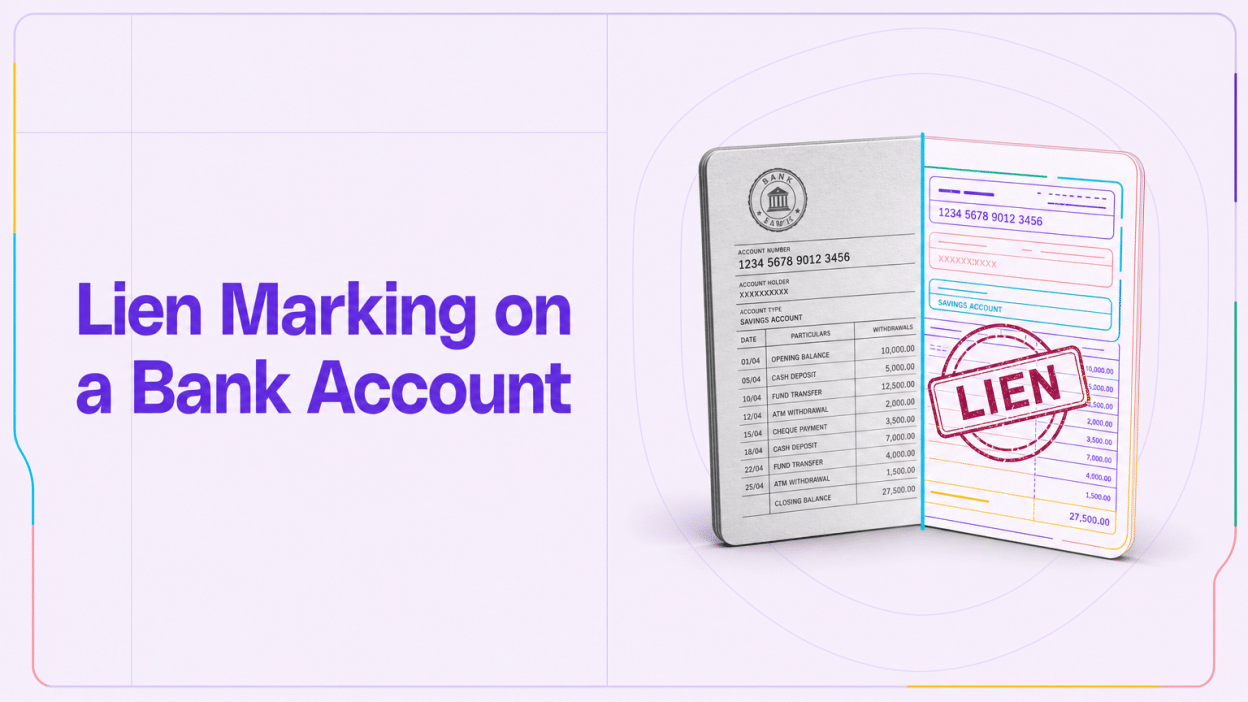
Lien marking means your bank has blocked a specific amount in your account, usually after a cyber fraud complaint on the 1930 helpline or cybercrime.gov.in traced stolen money to it. You can still use the balance above the lien. To resolve it, contact your bank, then the investigating police unit, and if needed, the court.
Most people discover lien marking when a UPI payment fails or a withdrawal is refused. Often they have done nothing wrong: they sold something online or accepted a payment that turned out to be someone else’s stolen money.
This guide explains how liens are placed, what account holders can do, what courts said in 2026, and how banks and fintechs can stop mule accounts at the door.
What lien marking on a bank account means
Lien marking places a hold on a defined amount. If your account shows a lien of Rs 36,000, that sum cannot be withdrawn or transferred, but the rest of your balance remains usable until a release instruction arrives from the police, a court or the bank’s process.
In cyber fraud cases, a lien usually follows the money trail. When a victim reports fraud, the stolen amount is traced through the accounts it passed through. Every account in that chain may receive a lien for the amount it received, whether the holder knew about the fraud or not.
Accounts used deliberately to move stolen funds are called mule accounts. Some are opened with borrowed identities; others are rented out by real people. Innocent recipients get caught in the same chain, which is why lien marking often feels arbitrary.
How a 1930 complaint becomes a lien
The Citizen Financial Cyber Fraud Reporting and Management System (CFCFRMS), launched in 2021 and run by the Indian Cyber Crime Coordination Centre (I4C) under the Ministry of Home Affairs, connects victims, police and financial institutions. The flow works roughly like this:
- The victim reports the fraud on the 1930 helpline or the National Cyber Crime Reporting Portal (cybercrime.gov.in).
- The complaint reaches the victim’s bank and the receiving institutions through CFCFRMS.
- Each receiving bank checks whether funds are still in the account and places a hold or lien on the traced amount.
- If the money has moved on, the trail continues to the next account.
- State or UT police handle FIR conversion, investigation and orders to release money to the victim.
A Standard Operating Procedure for handling complaints through NCRP and CFCFRMS was issued on 2 January 2026, according to an MHA reply in the Lok Sabha on 17 March 2026.
PIB reported on 28 July 2026 that, as of 30 June 2026, CFCFRMS had handled more than 32.80 lakh complaints and saved more than Rs 11,158 crore. By then 1,586 entities were onboarded, and I4C’s Suspect Registry had shared 32.08 lakh Layer 1 mule accounts with participating institutions.
Lien, debit freeze and attachment compared
| Action | What is blocked | Typical trigger | How it ends |
|---|---|---|---|
| Lien on amount | Only the specified sum | CFCFRMS complaint or police notice naming an amount | Release instruction from police or court, or refund to victim |
| Debit freeze | All outgoing transactions | Police notice, or bank’s own KYC/AML action | Police or court instruction, or bank review |
| Total freeze | Debits and credits | Rare; serious suspicion of complicity | Court order or agency release |
| Attachment of proceeds of crime | Property linked to the offence | Court order under BNSS on application by police | Court decision after hearing |
The distinction matters: lien marking affects one amount, while a full debit freeze can stop salary withdrawals, EMIs and business payments.
What to do if your account is lien-marked
The steps below are general information, not legal advice.
- Ask your bank for details in writing. Request the complaint or acknowledgement number, the amount under lien, the date, and the police unit or state that requested it.
- Gather your evidence, such as invoices, chats or delivery proof showing why you received the money.
- Submit a grievance through your bank. The MHA mechanism allows the account holder to approach the bank, which, after due diligence, submits the grievance through the NCRP-CFCFRMS Grievance Redressal Module. PIB states this module has handled freeze and lien grievances since April 2026.
- Contact the investigating officer. Write to the cyber police station named by the bank with your documents and request release of the lien or limitation to the disputed amount.
- Escalate if there is no response. The Allahabad High Court described escalation from the investigating officer to the District Grievance Officer, with appeal to the State Grievance Officer.
- Approach the court. If the hold is excessive or indefinite, a lawyer can seek relief before the jurisdictional magistrate or file a writ petition in the High Court.
Do not pay anyone who offers to “remove” a lien for a fee.
What courts have said in 2026
Several High Courts have questioned blanket freezes in cyber fraud cases.
In Ritesh Yadav v. Reserve Bank of India (reported by LiveLaw on 14 August 2026), the Allahabad High Court dealt with accounts frozen over a disputed credit of Rs 36,000. It directed that the freeze be lifted and lien marking be limited to Rs 36,000. It held that under Section 106 of the Bharatiya Nagarik Suraksha Sanhita (BNSS), police may seek a lien on a specific amount but cannot require a bank to block the whole account. It also directed banks to publicise the grievance mechanism, noting: “An undisclosed remedy is, for all practical purposes, incapable of being effectively availed of.”
In Shree Balaji Enterprises v. RBI (2026:RJ-JP:33344, reported by Verdictum on 21 August 2026), the Rajasthan High Court held that where the disputed amount is identifiable, the default is a lien on that amount. Full freezes are for exceptional cases, such as deliberate mule accounts, with recorded reasons. The court observed that “a bank cannot be used as a substitute for the statutory judicial process.”
Both rulings point the same way: lien marking on specific amounts, proportionate holds and a working grievance route.
RBI’s draft temporary debit hold framework
On 11 September 2026, RBI released draft amendments to its KYC Directions, 2025, proposing a standard operating procedure on suspected money mule accounts. As reported by MediaNama, the draft proposes:
- A temporary debit hold of up to 60 days on flagged transactions of Rs 1,000 or more, unless law enforcement instructs otherwise
- Account-level holds only as a last resort
- Notice to the customer with reasons, and 20 days to respond
- Referral to police through NCRP if unresolved, with the hold lifting if no statutory instruction arrives within 30 days
Comments closed on 2 October 2026, and the proposed effective date is 1 April 2027. This is still a draft and may change before it is finalised.
Reducing mule accounts at onboarding
For banks, payment aggregators, wallets and lenders, lien marking is a downstream symptom. The cheaper intervention is to stop mule accounts from being opened.
On 12 May 2026, I4C and the Reserve Bank Innovation Hub signed an MoU under which I4C will share Suspect Registry intelligence to strengthen AI fraud-risk models, including MuleHunter.AI, which PIB described as implemented across banks. Transaction models catch mules after they move money; onboarding controls reduce how many get that far.
| Mule pattern | Onboarding control | What it catches |
|---|---|---|
| Borrowed or bought identity documents | Face match between selfie and ID photo | Applicant is not the document holder |
| Photo of a photo, screen replay, mask | Liveness detection | Someone presenting another person’s face |
| Account in a different name than the applicant | Name match across PAN, ID and bank account | Third-party accounts used for payouts |
| Dormant or rented accounts used as payout destinations | Bank account verification before first payout | Account does not exist or holder differs |
| Same person opening many accounts | Your own repeat-applicant rules on device, phone and face data | Account farming |
Where BeFiSc fits: IDProof provides identity checks used at onboarding, including PAN verification, Aadhaar routes, DigiLocker, face match, liveness, name match and bank account verification. These help confirm that the person opening an account is real, present and the rightful owner of the documents and payout account. IDProof does not place liens, freeze accounts or monitor transactions; those remain with the bank, its transaction monitoring systems and law enforcement.
Key Takeaways
- Lien marking blocks a specific amount, not the whole account, and usually follows a 1930 or NCRP complaint traced through CFCFRMS.
- CFCFRMS had saved more than Rs 11,158 crore across more than 32.80 lakh complaints as of 30 June 2026 (PIB).
- Account holders should get details in writing, use the grievance module and escalate if needed.
- The Allahabad and Rajasthan High Courts in 2026 favoured liens on the disputed amount over blanket freezes.
- RBI’s 60-day temporary debit hold framework is a draft, proposed to take effect from 1 April 2027.
- Banks and fintechs can reduce mule accounts with face match, liveness, name match and bank account verification at onboarding.
Frequently Asked Questions
Can police freeze my entire account for a small disputed amount?
In 2026, the Allahabad and Rajasthan High Courts held that, where the disputed amount is identifiable, the default should be a lien on that amount rather than a full freeze. Exceptions apply where there is evidence of deliberate mule activity. Seek legal advice for your specific case.
How do I remove a lien placed after a 1930 complaint?
Ask your bank for the complaint details, submit documents through the bank’s grievance route to the NCRP-CFCFRMS Grievance Redressal Module, and write to the investigating cyber police station. If the hold is disproportionate or indefinite, consult a lawyer about court remedies.
How long does a lien on a bank account last?
There is no single fixed period today; a lien continues until the police, a court or the bank’s process releases it. RBI’s September 2026 draft proposes a 60-day limit for bank-initiated holds, but it is not in force and excludes holds placed on police instruction.
What does lien marking mean in a bank account?
It means the bank has blocked a specific amount, which cannot be withdrawn or transferred until the lien is released. The rest of the balance is usually available. In cyber fraud cases, it typically follows a complaint that traced stolen funds to the account.
Conclusion
Lien marking exists to stop stolen money from disappearing, and it works at scale. The cost falls on account holders caught in a fraud trail without being part of it, and 2026’s court rulings and RBI’s draft are pushing towards specific amounts, defined timelines and reachable grievance routes.
For institutions, the durable answer sits earlier in the chain: every mule account never opened is one fewer lien and one fewer customer caught in someone else’s fraud.
Talk to BeFiSc about mule-resistant onboarding with IDProof