The customers with the most money to move are often the hardest to onboard. An NRI opening an NRE account, a returning professional applying for credit, a foreign national investing through Indian rails none of them fit the Aadhaar-first onboarding flows that domestic stacks optimise for. What they all carry is a passport.
The passport is simultaneously the world’s most standardised identity document and, in many Indian KYC stacks, the least automated. A passport verification API changes that: combining machine-readable zone (MRZ) validation, document authenticity checks, and, for Indian passports, verification against Passport Seva issuance records. This guide covers how passport verification works technically, where it anchors NRI and cross-border journeys, and the design choices that separate real verification from image inspection.
What Is a Passport Verification API?
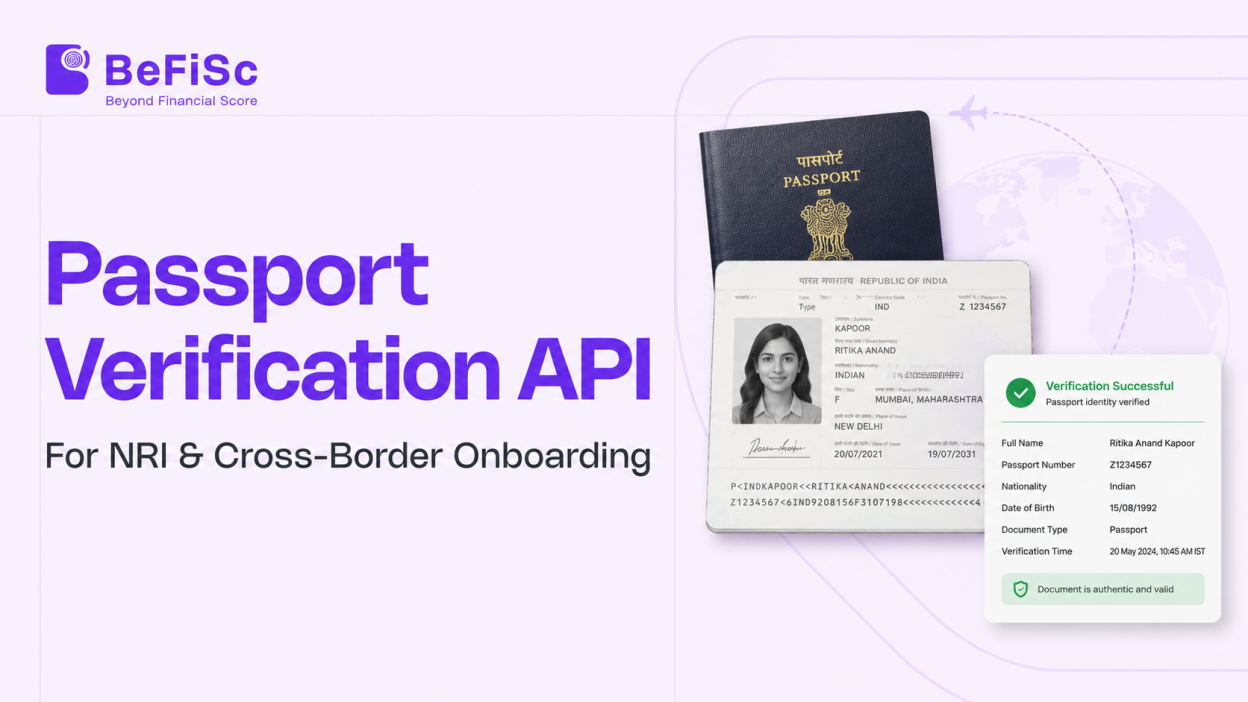
A passport verification API validates a passport’s authenticity and its holder’s details for identity verification. Depending on the passport’s origin and the integration depth, it operates across three layers: structural validation of the machine-readable zone, forensic analysis of the document image, and, where available, as with Indian passports verification against the issuing authority’s records, as with Indian passport verification.
The passport’s special property among identity documents is standardisation. Under ICAO Doc 9303, every passport carries an MRZ: the two lines of characters at the bottom of the data page encoding name, nationality, passport number, date of birth, sex, and expiry, each protected by check digits. That structure gives automated verification a foothold no purely domestic document offers.
For Indian KYC purposes, the passport is also an officially valid document under the PMLA/RBI framework, which makes the API a compliance instrument, not merely a fraud control.
The Three Layers: MRZ, Document Forensics, Source Records
Robust passport verification stacks three checks, each catching what the previous cannot.
Layer 1: MRZ Validation
OCR reads the MRZ; the API validates its check digits and internal consistency, then cross-checks MRZ data against the visually printed fields. Amateur forgeries fail here: editing the printed name without recomputing MRZ check digits is the most common forgery error. MRZ validation is fast, deterministic, and catches a surprising share of fraud on its own.
Layer 2: Document Forensics
For the image itself: template conformity for the claimed issuing country and series, font and layout analysis, photo-tampering detection, and screenshot/re-capture detection. This is the same forensic discipline we detailed in our [document forgery detection guide], applied to a document family with unusually well-defined templates.
Layer 3: Source Verification
Where issuance records are accessible, the Indian passport’s file number check is the key case; covered next, the API validates details against the authority’s records, converting document trust into registry truth. For foreign passports, source access is generally unavailable, so layers one and two, plus biometric binding, provide assurance.
The layering logic mirrors the rest of the verification stack: structure catches the careless, forensics catches the skilled, and source catches the document that never existed.
Indian Passport Verification: The File Number Check
For Indian passports, verification can go beyond the document. The Passport Seva ecosystem allows validation of a passport’s details against issuance records using the file number and holder details, confirming that the passport number, name, and issuance particulars correspond to a genuinely issued document.
This closes the gap that pure document analysis leaves: a physically perfect counterfeit of a passport that was never issued, or a genuine-looking document whose details were never in the registry. Registry-anchored verification defeats both structurally.
The operational notes: capture the file number where flows allow (it appears on the passport), treat registry mismatches as review events rather than auto-fraud (data-entry variance exists in older issuances), and log the registry response in the evidence bundle alongside MRZ and forensic results. The composite MRZ valid, forensics clean, registry matched, face bound is as strong as Indian document verification gets outside Aadhaar’s cryptographic rails.
NRI and Cross-Border Use Cases
Five journeys lean on passport verification as their identity anchor.
NRI banking. NRE/NRO account opening runs on passport-plus-visa/status evidence. A passport verification API moves these journeys from days of document review toward the same-session onboarding domestic customers get, within the RBI’s KYC framework for non-residents.
Investments and securities. NRI participation in mutual funds, PIS accounts, and demat onboarding requires passport-anchored KYC; automating this process directly shortens funding timelines.
Cross-border fintech. Remittance platforms, international payroll, and multi-currency accounts verify passports from many issuing countries, which is where MRZ standardisation and template libraries earn their keep.
Foreign nationals in India. Employment, banking, and rental/utility flows for expatriates are anchored on passports, where no Indian registry document exists yet.
High-value domestic KYC. Even for residents, the passport serves as a premium OVD in wealth, private banking, and [enhanced due diligence] contexts, where multi-document corroboration is policy.
Across all five, the passport pairs with a live selfie and [face match with liveness] against the data-page photo, the binding without which any document verification, however deep, verifies paper rather than people.
Passport Verification in the OVD and FATF Context
Two regulatory frames shape passport verification design.
Domestically, the passport’s OVD status under PMLA rules and the RBI KYC Master Directions makes it complete identity-and-address evidence for KYC (address per the passport, with policy handling where the current address differs). Institutions running OVD waterfalls as discussed in our [voter ID verification] should treat the passport rail with the same automation dignity as the Aadhaar rail.
Internationally, FATF’s risk-based standards drive the cross-border angle: non-resident customers are commonly higher-risk classifications, which means stronger identification, sanctions and PEP screening against travel-document names, with all the fuzzy-matching complexity covering and often enhanced due diligence. The passport verification API is the identification backbone of that stack, not the whole of it; screening and EDD layers complete the picture, as our [PEP screening guide] details.
Implementation: Capture Quality, Expiry, and Binding
Four implementation realities decide field performance.
Capture quality dominates. Glare on the laminate, cropped MRZ lines, and low-light captures cause most failures. Invest in guided capture UX frame overlays, glare detection, and automatic recapture before tuning anything downstream.
Expiry is policy, not just data. The API returns expiry; your policy decides validity windows (some products require months of remaining validity). Feed expiry into re-verification calendars for long-lived relationships, the same lifecycle logic we prescribed.
Handle name structure generously. Passports split names into surname and given names; applications often do not. Matching logic must handle the structural difference plus diacritics and transliteration in foreign passports.
Data handling is high-stakes. Passport data is sensitive personal data with cross-border transfer implications for international platforms. Minimise retention, control access, and align storage with DPDP obligations and fiduciary duties in our [DPDP analysis].
Key Takeaways
- A passport verification API layers MRZ validation, document forensics, and, for Indian passports, Passport Seva registry checks into one identity verification rail.
- MRZ check digits under ICAO 9303 catch the common forgeries; forensics catch skilled ones; registry checks catch never-issued documents.
- The passport anchors NRI banking, cross-border fintech, foreign-national onboarding, and premium/EDD domestic KYC as a full OVD.
- Cross-border use pulls FATF-driven screening and EDD around the verification core; the API is the backbone, not the whole stack.
- Field performance turns on capture UX, expiry policy, name-structure-aware matching, and DPDP-grade data handling.
Frequently Asked Questions
Does a passport verification API work for foreign passports?
Yes, through the ICAO-standardised MRZ and country-specific template forensics, plus biometric binding. Source-record verification is generally available only for Indian passports, so foreign-passport assurance rests on structural, forensic, and face-match layers.
Why is a passport verification API important for NRI onboarding?
NRI customers typically cannot use Aadhaar-first rails, making the passport their anchor document. A passport verification API automates NRE/NRO account opening, investment KYC, and remittance onboarding while meeting the enhanced scrutiny that non-resident flows attract.
Is a passport valid for KYC in India, and does a passport verification API cover it?
Yes. The passport is an officially valid document under PMLA and RBI KYC norms, serving as identity and address evidence. A passport verification API satisfies the verification step at digital speed instead of manual document review.
How does a passport verification API detect fake passports?
A passport verification API first validates MRZ check digits and MRZ-to-visual consistency, which fails most amateur forgeries; then applies template and tamper forensics for skilled fakes; and, for Indian passports, confirms details against Passport Seva issuance records.
What is a passport verification API?
A passport verification API validates a passport’s authenticity and holder details through MRZ validation, document image forensics, and, where issuance records are accessible, as with Indian passports verification against the issuing authority’s records.
Conclusion
Passport verification is where Indian KYC meets the global identity system and where stacks built exclusively around domestic rails show their edges. The customers arriving through this rail are disproportionately valuable: NRIs, cross-border businesses, global professionals. Serving them at domestic-onboarding speed is a competitive statement, not a compliance chore.
The technical future is already visible: chip-based (eMRTD) reading, where the passport’s embedded chip yields cryptographically signed data and a photo, will do for passports what signed XML did for Aadhaar: replace forensics with mathematics. Institutions building layered passport verification now will find that an upgrade, not a rebuild.