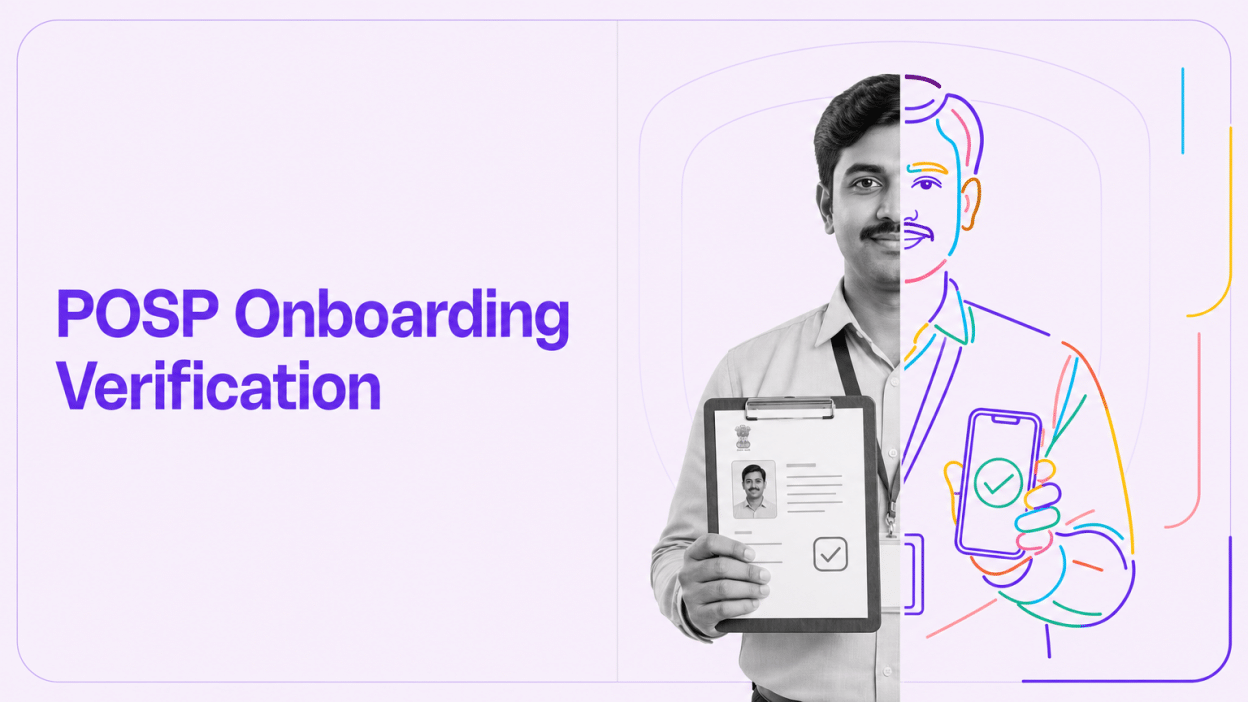
For insurers and brokers, POSP onboarding should verify identity at source (PAN, Aadhaar through DigiLocker or offline XML), confirm the person is live and matches the ID, check names across documents, and verify the payout bank account before the POS code issues. Automate these checks, and keep IRDAI training and exam steps separate.
A POSP (Point of Sales Person) can sell simple, pre-underwritten insurance products after a short training course and an examination. That low barrier is the point of the channel: it lets insurers, brokers and insurtech platforms reach customers through shopkeepers, motor dealers, loan agents and part-time sellers.
It also makes onboarding a high-volume identity problem. The sections below start with a short answer for anyone who wants to become a POSP, then move to what insurers and intermediaries need: the rules, the risks, a verification checklist, an automated flow and the metrics that show it works.
POSP full form and how to become one
POSP stands for Point of Sales Person. Under IRDAI’s framework, a POSP is engaged by an insurer or an insurance intermediary (such as a broker or corporate agent) to solicit and sell specific simple products.
For an individual, POSP registration generally works like this:
- Choose an insurer or intermediary that recruits point of sales persons and apply through its portal or app.
- Meet the basic eligibility: IRDAI’s life master circular sets a minimum age of 18 and a 10th standard pass.
- Submit identity and other details; insurers typically ask for PAN, Aadhaar, an education certificate, photograph and bank details for commission.
- Complete 15 hours of training conducted by the insurer or intermediary.
- Pass the examination; a certificate follows, and the life circular requires the appointment letter, with your POS code, within 15 days of passing.
A point of sales person can sell only products categorised as POS products, and commission is paid by the entity that engaged them. The rest of this guide is for that entity.
What IRDAI requires
Two sets of IRDAI instructions apply. Both should be checked against IRDAI’s current consolidated master circulars, since the regulator restructured many instruments in 2024.
Life insurance
The Master Circular on Point of Sales Products and Persons – Life Insurance (2 December 2019) provides that:
- The applicant must be at least 18 years old and have passed the 10th standard (para 17.2).
- Identity proof is PAN or Aadhaar (para 17.1).
- 15 hours of in-house training, an examination and a certificate are required (para 17.3).
- Each person receives a POS Code, which must be recorded on proposals and policies (paras 17.3(e), 20).
- Training and examination records are kept for at least five years (para 17.3(f)), and records are maintained electronically and reported half-yearly (paras 24, 25).
Non-life and health
The Guidelines on POSP for non-life and health insurers (26 October 2015), as modified on 16 March 2017, also require 15 hours of training and an examination conducted by the insurer or intermediary. The 2017 modification adds two points that matter for verification:
- The applicant must not be engaged with any other insurer or intermediary, checked against the Insurance Information Bureau (IIB) database.
- Details of onboarded persons are uploaded to the IIB database.
Read together, IRDAI sets the eligibility, training and registration steps. It does not prescribe how to verify identity. That is the insurer’s or intermediary’s control, and where most failures happen.
The scale problem for insurers and brokers
A broker or insurtech running a point of sales network can register thousands of people a month, most of them onboarded remotely through an app. Each one becomes a seller under your licence, with access to customer data and a commission stream.
The failure modes repeat:
- Fake or borrowed identities: a seller registered on someone else’s PAN and Aadhaar, often to hide a person who was terminated elsewhere.
- Duplicate registrations: one person holding codes with several entities, against the IIB-based single-engagement check.
- Proxy sellers: a registered person lends their code to unlicensed sellers who never took the training.
- Commission leakage: payouts routed to accounts that do not belong to the seller, or to one account serving many codes.
- Mis-selling: when the seller is not the person who was trained and certified, accountability for what was said to the customer disappears.
The cost of weak onboarding
Mis-selling is the regulator’s stated concern. According to IRDAI’s Annual Report 2024-25, as reported by Free Press Journal on 5 January 2026, grievances under unfair business practices against life insurers rose from 23,335 in 2023-24 to 26,667 in 2024-25, and their share of total life grievances rose from 19.33% to 22.14%. Business Standard (30 December 2025) reported that IRDAI described mis-selling as a significant concern and asked insurers to carry out root-cause analysis.
Distribution channels where the seller’s identity is uncertain make root-cause analysis harder. When the person who sold the policy cannot be identified with confidence, neither can the fix.
The costs land in three places:
- Regulatory: seller conduct is a factor in an intermediary’s registration renewal (life master circular, para 20.4).
- Financial: commission paid on business sold by proxies, clawbacks that cannot be recovered, and free-look cancellations.
- Operational: manual document checks that do not scale and cannot detect a borrowed identity.
Illustrative: a broker onboards 3,000 sellers a month. If 2% are borrowed or duplicate identities, that is 60 sellers a month operating under your licence whom you cannot hold accountable, and whose commission goes to accounts you have not verified.
POSP verification checklist
Use this checklist to evaluate your current onboarding, or a vendor’s flow.
| Check | Why it matters | What to ask the vendor or team |
|---|---|---|
| PAN verification at source | Confirms the PAN exists and is active; needed for commission TDS | Is the result from source, with status and name returned? |
| Aadhaar via DigiLocker or offline XML | Issuer-signed identity and photo without storing the full Aadhaar number | Is the digital signature verified? How is the number masked? |
| Face match to ID photo | Confirms the applicant is the person on the ID | What is the match threshold and the reference image source? |
| Liveness | Stops photos, replays and borrowed phones held up to the camera | Passive, active or both? How are failures handled? |
| Name match across PAN, Aadhaar and bank | Catches borrowed IDs and payout to third parties | Scored or exact? Transliteration handling? |
| Bank account verification | Commission goes to the seller’s own account | Does it return the account holder name for matching? |
| Duplicate check | Single-engagement rule and repeat applicants | Same PAN, phone, account or face across your seller base? |
| IIB engagement check | IRDAI requirement for non-life and health | Who performs it, and is the evidence stored? |
| Audit trail | Records retained for at least five years | Can you export the evidence per POS code? |
For partner networks more broadly, our guide to covers related patterns.
Manual vs automated onboarding
| Factor (Illustrative) | Manual document review | Automated verification |
|---|---|---|
| Time to verify identity | Hours to days per applicant | Minutes, mostly waiting on the applicant |
| Borrowed identity detection | Weak: documents look genuine | Face match and liveness tie the person to the ID |
| Payout account check | Cancelled cheque image | Account verified with holder name matched |
| Duplicate detection | Spreadsheet lookups, if any | Systematic on PAN, account, phone and face |
| Evidence | Scanned files | Request ID, timestamp and result per check |
| Cost driver | Ops headcount | Per-check fees plus review of exceptions |
An automated POSP onboarding flow
- Applicant enters PAN; the system verifies it at source and pre-fills the name.
- Applicant shares Aadhaar through DigiLocker or uploads offline XML; the signature is verified and the photo extracted.
- Applicant takes a selfie; liveness runs, then the selfie is matched to the Aadhaar photo. Our guide explains thresholds.
- Names from PAN, Aadhaar and the declared name are scored against each other.
- Applicant enters payout account details; the account is verified and the returned holder name is matched.
- Duplicate checks run across your existing seller base: PAN, account, mobile and, where you run it,
- Clean applicants move to IIB check, training and examination; exceptions go to a review queue.
- POS code issues only after the exam, with every verification result stored against it.
Running identity checks before training saves money: you stop paying for training seats and exam slots for applicants who were never going to qualify.
Metrics that show the flow works
- Auto-approval rate at identity stage, and manual review rate.
- Liveness and face match failure rates, with the share confirmed as fraud.
- Name mismatch rate between PAN and payout account.
- Duplicate hits per thousand applicants.
- Time from application to POS code.
- Complaint and mis-selling rates per thousand policies, by seller cohort, compared before and after rollout.
What to bring to the demo: your current onboarding steps, monthly registration volume, and a handful of anonymised cases you rejected or later terminated.
Where BeFiSc fits: IDProof verifies PAN, Aadhaar through DigiLocker, face match, liveness, name match and payout bank accounts through one API, so insurers, brokers and insurtechs can verify every POSP before training and before the first commission. IRDAI training, examination and IIB steps stay in your process. Book a demo of the flow.
Key Takeaways
- POSP stands for Point of Sales Person; IRDAI sets age, education, 15-hour training, examination and POS code rules.
- IRDAI does not prescribe identity verification methods; borrowed, duplicate and proxy POSPs are a control gap for the engaging entity.
- Mis-selling grievances against life insurers rose to 22.14% of the total in 2024-25, making seller accountability a regulatory issue.
- Verify PAN, Aadhaar via DigiLocker, face match with liveness, name match and payout account before training and before the POS code issues.
- Track auto-approval, duplicate hits, name mismatches and complaints per seller cohort.
Frequently Asked Questions
Will automated checks reduce our POSP sign-ups?
Genuine applicants usually complete PAN, DigiLocker and selfie steps in minutes. The applicants you lose are mostly the ones you would want to lose: borrowed and duplicate identities.
How is seller data protected under the DPDP Act?
The insurer or intermediary is the data fiduciary, and the verification provider is its processor. Use a data processing agreement, mask Aadhaar numbers, limit retention, and keep the IRDAI-required records separately.
Does automated verification replace IRDAI’s training and exam?
No. Training, examination, certification and IIB steps remain IRDAI requirements. Automated checks confirm who the applicant is and that payouts go to them.
How long does automated POSP verification take to integrate?
Integration effort depends on your onboarding app, but identity checks are API calls that sit before your existing training and exam steps. Most of the work is designing exception handling, not wiring the calls.
What is the POSP full form?
POSP stands for Point of Sales Person. Such a person is engaged by an insurer or intermediary to sell simple, pre-defined POS insurance products after training and an examination.
Conclusion
The POSP channel works because onboarding is light. That should mean light for genuine applicants, not light on identity. IRDAI sets who may sell; the insurer or intermediary has to prove that the person who trained, passed and sells is the person on the record.
Put identity verification before training, tie payouts to verified accounts, and measure complaints by cohort. That gives distribution heads growth they can defend when the regulator asks who sold the policy.
Book a 30-minute IDProof demo and test it on your onboarding flow