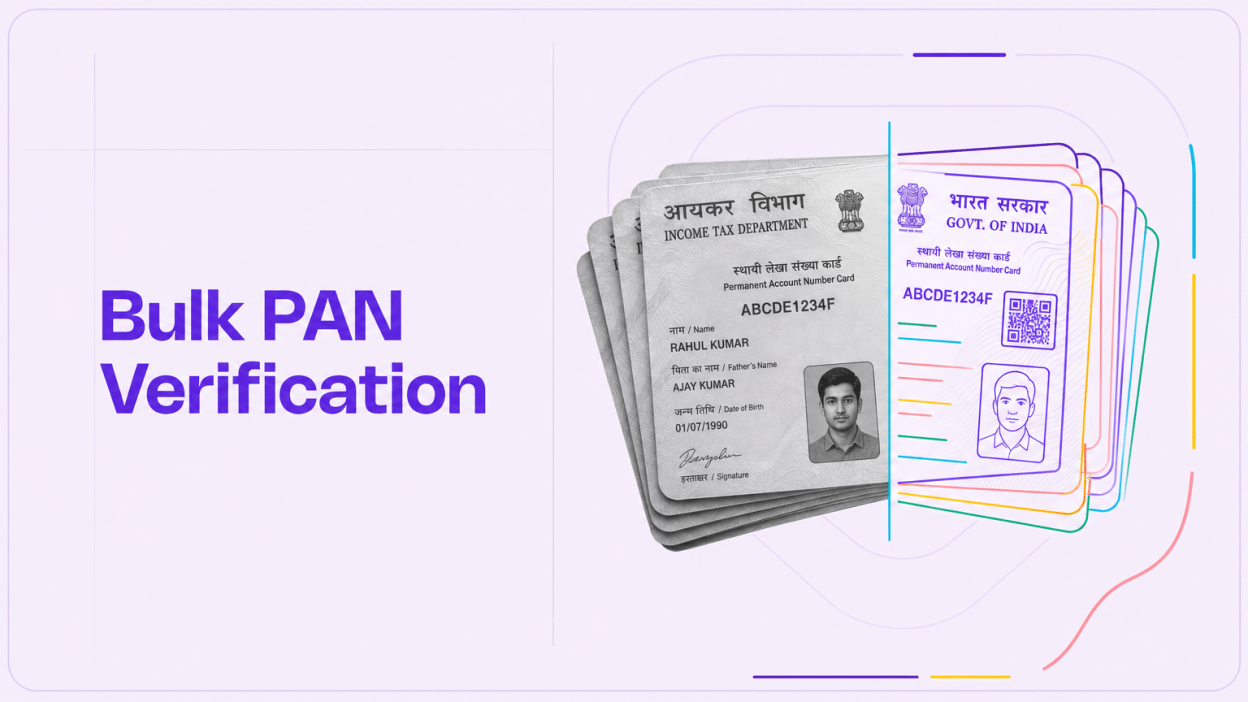
Bulk PAN verification runs a file of PANs against the source through API calls in batches and returns, for each record, whether the PAN is valid, its status (including inoperative), and how well the name matches your record. It turns weeks of portal lookups into a run measured in hours, with an audit trail.
Every Indian lender, broker and large corporate carries a PAN file it does not fully trust. Records captured years ago by branches, DSAs or vendors contain typos, deleted PANs, names that no longer match, and PANs that became inoperative when they were never linked to Aadhaar.
That file only becomes urgent when something depends on it: a co-lending partner’s due diligence, a securitisation pool cut, a TDS demand or a re-KYC deadline. This guide covers when bulk PAN verification is worth running, how it works, what each result means, how to handle exceptions, DPDP obligations, and a rollout plan.
When ops teams need bulk PAN verification
Single PAN checks at onboarding are routine; our guide covers them. Bulk runs answer a different question: how clean is the PAN data we already hold?
- Re-KYC backlogs: periodic updation is due on thousands of accounts. Verifying PAN first separates records that need only a confirmation from those that need fresh documents.
- Portfolio clean-up before co-lending or securitisation: partners and investors test the pool. Invalid or mismatched PANs in a loan tape delay the deal or get loans excluded.
- Vendor and TDS master clean-up: an inoperative PAN on a payee can trigger tax deduction at the higher rate, and short deduction surfaces later as a demand on the deductor.
- Dealer, DSA and agent onboarding: partner networks of thousands are often onboarded on paper. Commission payouts depend on a correct PAN.
- KYC remediation after an audit finding: inspection points to data quality; the fix starts with a full-file check. Our guide covers the programme around it.
What an unverified PAN file costs
The inoperative PAN problem is large. According to a CBDT reply to an RTI query, reported by Deccan Herald on 9 November 2023, 11.5 crore PANs had been made inoperative for not being linked with Aadhaar, out of 70.24 crore PAN holders. No more recent official count was located, but the deadline extensions since then show the backlog has not disappeared.
The consequences flow through Rule 114AAA of the Income-tax Rules 1962 and CBDT Circular 3/2023: with an inoperative PAN, refunds are withheld, no interest is paid on them for that period, and TDS or TCS applies at higher rates. Restoring the PAN requires linking with Aadhaar on payment of a Rs 1,000 fee (Business Today, 7 July 2026). The Income-tax Act 2025, in force from 1 April 2026, carried the PAN regime into the new law; confirm current section references with your tax team.
For a deductor, the risk is concrete. CBDT Circular 9/2025 relieved deductors from the higher rate for payments made on or after 1 August 2025 only where the PAN becomes operative within two months from the end of the month of payment. Outside that window, the deductor carries the short-deduction exposure.
In securities markets, the same flag affects onboarding. SEBI’s circular of 14 May 2024 requires KRAs to verify PAN-Aadhaar linkage before a record is treated as fully validated.
Illustrative: an NBFC with a 4 lakh account re-KYC backlog verifies PANs manually at 3 minutes a record. That is 20,000 analyst hours, or roughly 10 full-time staff for a year, before any exception work.
How bulk PAN verification works
Most bulk PAN verification is not a magic upload. It is the same PAN verification API, called at scale by a job you control.
- Extract: export PAN, name as per your record, date of birth if held, and your internal ID. Strip everything else.
- Normalise: uppercase, trim spaces, and run a format check (five letters, four digits, one letter; the fourth character indicates holder type, such as P for individuals and C for companies). Format failures never need an API call.
- Deduplicate: one PAN can appear on many accounts. Verify each unique PAN once and map results back.
- Batch and throttle: send API calls in batches within the provider’s rate limits, with retries on timeouts.
- Store responses: keep the raw response, timestamp and request ID alongside the derived result.
- Score and bucket: compute the name match score against your record and assign each row to an outcome bucket.
The format check matters more than it looks. The fourth character also catches category errors, such as a company PAN captured against an individual borrower.
Reading the results
Exact labels vary by provider, but bulk PAN verification output usually falls into these categories:
| Result | What it means | Typical action |
|---|---|---|
| Valid, name match high | PAN exists, is active, and the name matches your record | Mark verified; no customer contact |
| Valid, name match partial | PAN is valid; name differs (initials, order, spelling, marriage) | Rule-based acceptance or review |
| Valid, name match low | PAN valid but belongs to someone else, or record is wrong | Treat as high risk; contact customer |
| Inoperative | PAN not linked with Aadhaar as required | Notify customer; tax team applies rules for payees |
| Invalid or not found | No such PAN at source | Recapture PAN from customer |
| Deleted, deactivated or other non-active status | PAN surrendered, duplicate or otherwise inactive | Recapture; check for duplicate PAN holding |
| Format error | Fails structure check | Data entry correction |
Name matching deserves care. A raw string comparison will fail “R. Kumar” against “Ramesh Kumar” and pass two different people with common names. Use a scored match with transliteration and initial handling, set thresholds per use case, and keep the score with the result.
For inoperative results, the customer’s remedy is linking and paying the fee; the explainer is a useful link to send them.
Handling exceptions
Exceptions are where bulk PAN verification earns or loses its value. Design the buckets before you run the file.
- Auto-close: valid with a high name match. No human touches these.
- Rules review: partial matches resolved by rules, such as accepting a match where surname and first initial agree and date of birth matches.
- Analyst review: low matches and conflicting data. Analysts see your record, the source name and the score side by side.
- Customer outreach: inoperative, invalid and deleted PANs. Use templated messages with a clear fix and a deadline.
- Escalation: one PAN on unrelated customers, or a PAN whose source name matches a different customer in your book. These can indicate fraud, not typos.
Track ageing on every bucket. A clean file with 8,000 unresolved exceptions three months later is not clean.
DPDP and data handling
PAN with name and date of birth is personal data. Under the DPDP Act 2023, your verification provider is a data processor and you remain accountable for its processing. Section 8(3) requires reasonable efforts to keep personal data accurate and complete where it is used to make decisions about the person, which is a direct argument for verification.
Practical controls:
- Send only the fields the check needs. Never send account balances, addresses or loan data.
- Agree retention: the provider should not keep your file beyond what the contract allows.
- Encrypt files at rest and in transit; restrict who can trigger and download a run.
- Keep your own copy of results as part of the KYC record; RBI’s KYC Directions (para 50 for commercial banks) require records for at least five years after the relationship ends.
Manual vs automated: time and cost
| Factor (Illustrative, 1 lakh unique PANs) | Manual portal checks | Automated via API in batches |
|---|---|---|
| Effort per record | 2 to 4 minutes | Seconds of compute; review only exceptions |
| Elapsed time | Months for a small team | Hours to days, depending on rate limits |
| Name match | Subjective, inconsistent | Scored, threshold-based, repeatable |
| Audit trail | Screenshots or notes, if any | Request ID, timestamp and response per record |
| Error rate | Rises with fatigue | Consistent; errors concentrate in exceptions |
| Cost driver | Analyst hours | Per-call fees plus exception review |
The manual route also fails quietly: there is no record of what was checked, so the same file gets re-checked at the next audit.
Rollout steps
- Week 1: scope and legal (compliance, legal). Define the file, fields, purpose and data processing terms.
- Week 1: bucket design (operations, risk). Agree name match thresholds and actions for each result.
- Week 2: pilot on 1,000 records (operations, engineering). Measure result mix, latency and false review rate.
- Week 2 to 3: full run in batches (engineering). Monitor throttling and retries.
- Week 3 onwards: exception workflow (operations). Work buckets with ageing targets and customer outreach.
- Ongoing: verify PAN at onboarding and re-check payees on a fixed cycle, so the backlog does not rebuild.
Success metrics: share auto-closed, exception ageing, outreach resolution rate, and cost per verified record.
What to bring to the demo: a 200-row anonymised sample, your current name format conventions, and the use case driving the clean-up.
Where BeFiSc fits: IDProof provides PAN verification alongside name match, Aadhaar routes, DigiLocker, face match, liveness and bank account verification through one API, which ops teams can call in batches from their own job. Book a demo to see the result fields on your sample and how exceptions would bucket.
Key Takeaways
- Bulk PAN verification is the PAN verification API called at scale, with normalisation, deduplication and stored responses.
- Inoperative PANs carry tax consequences under Rule 114AAA; deductors get relief only if the PAN becomes operative within the CBDT window.
- Results need buckets: valid, partial and low name match, inoperative, invalid, deleted and format errors, each with a defined action.
- Exceptions decide the value of the exercise; design review and outreach before the run.
- Send minimum fields, agree retention with the provider, and keep results as part of the KYC record.
Frequently Asked Questions
Can we reuse the results for re-KYC?
A verified PAN with a strong name match supports re-KYC, but it is one element. Periodic updation still follows your entity’s KYC Directions and risk category.
How accurate is automated name matching?
It is more consistent than manual review, but thresholds matter. Calibrate on a sample with known outcomes, route partial matches to review, and keep the score so decisions can be explained.
What should we do with inoperative PANs in our vendor master?
Notify the payee to link PAN with Aadhaar and ask your tax team to apply the higher-rate rules where required. Track the date the PAN becomes operative, since CBDT relief depends on that timing.
Is it legal to verify customer PANs in bulk with a third-party provider?
Yes, for a legitimate purpose such as KYC or tax compliance, with the provider acting as your data processor under a contract. Send only the fields needed and agree retention and deletion terms.
How long does bulk PAN verification take for one lakh records?
With automation, the run itself usually takes hours to a few days, depending on provider rate limits. Exception handling takes longer, which is why buckets and owners should be set before the run starts.
Conclusion
A PAN file is only as good as its last verification. Most institutions discover the gap when a partner, auditor or tax notice forces the issue, and then try to fix years of drift in weeks.
Bulk PAN verification makes that a planned exercise: a scoped file, defined buckets, a run with an audit trail, and an exception queue with owners. Run it once properly, then verify at every onboarding and payee change, and the next deadline becomes routine.
Book a 30-minute IDProof demo and bring a sample of your PAN file