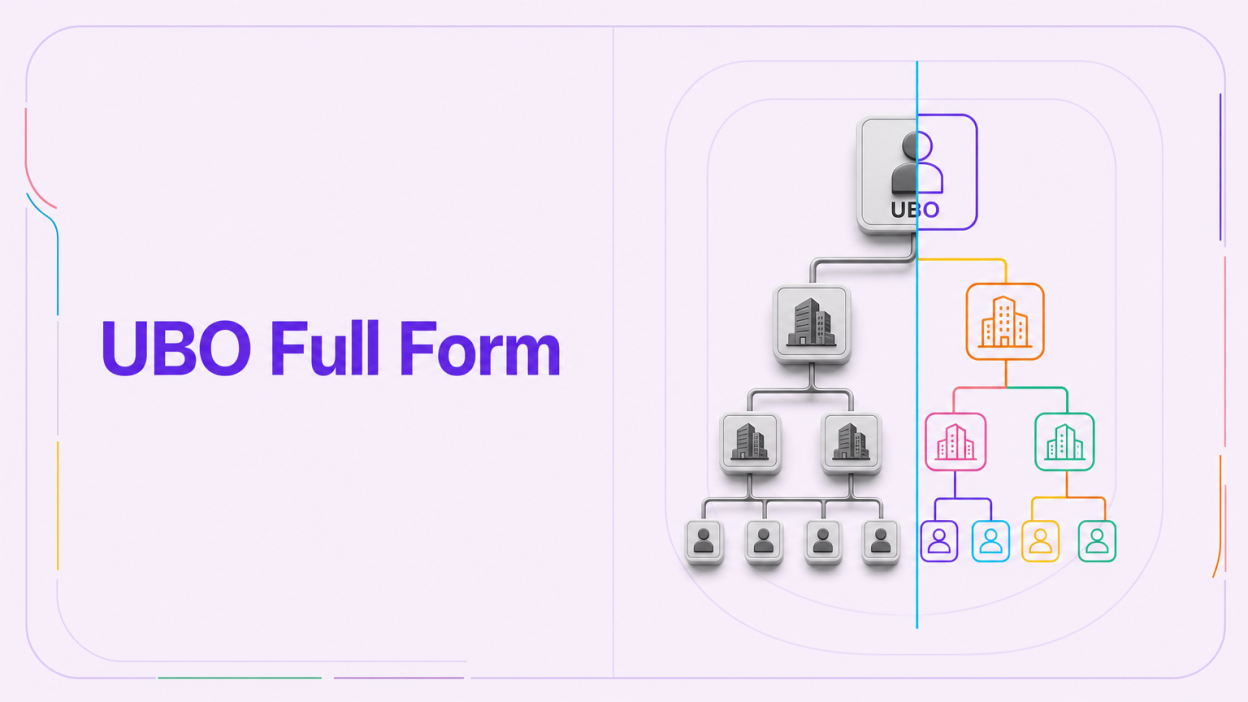
The UBO full form is Ultimate Beneficial Owner: the natural person who ultimately owns or controls a customer, or on whose behalf a transaction is carried out. In India, banks, NBFCs, and payment firms must identify UBOs of legal entities, generally anyone holding more than 10% of a company or partnership.
A company’s name on an account application tells you very little about who benefits from it. Behind a private limited company there may be another company, an LLP, a trust, or a nominee holding shares for someone who never appears on any form.
Beneficial ownership rules exist to close that gap. Beyond the UBO full form itself, this guide explains the thresholds that apply in India, how the PMLA framework differs from the Companies Act regime, and a step-by-step method that lenders and payment aggregators can use to identify the person who actually stands behind a business.
UBO full form and meaning
The UBO full form is Ultimate Beneficial Owner. The word “ultimate” matters: the obligation is to reach a natural person, not to stop at the first corporate shareholder.
Indian regulation rarely uses the UBO full form; it mostly says “beneficial owner”. RBI’s KYC framework requires regulated entities (REs) to identify the beneficial owner of every non-individual customer and take reasonable measures to verify that person’s identity, as part of
Beneficial ownership can arise in two ways. One is ownership, through shares, capital or profits. The other is control, through the right to appoint a majority of directors, shareholder agreements, voting arrangements or other means of directing management and policy decisions.
Beneficial owner thresholds under Indian law
Once the UBO full form is clear, the next question is where the ownership line sits. The thresholds for REs come from Rule 9(3) of the Prevention of Money-Laundering (Maintenance of Records) Rules, 2005, which RBI’s KYC Directions mirror.
| Customer type | Beneficial owner is a natural person who | Threshold |
|---|---|---|
| Company | Owns or is entitled to shares, capital or profits, or exercises control | More than 10% |
| Partnership firm | Owns or is entitled to capital or profits | More than 10% |
| Unincorporated association or body of individuals | Owns or is entitled to property, capital or profits | More than 15% |
| Trust | Author, trustee, beneficiaries with the specified interest, or any person exercising ultimate effective control | 10% or more interest for beneficiaries |
The company threshold was reduced from 25% to 10% through an amendment notified on 7 March 2023, which also lowered the trust beneficiary threshold to 10%. The partnership threshold now also stands at 10%, following the 2023 amendments.
Where no natural person meets these thresholds, and no one exercises control through other means, the relevant natural person who holds the position of senior managing official is treated as the beneficial owner.
Where the customer, or the owner of its controlling interest, is a company listed on a stock exchange in India, or a majority-owned subsidiary of one, the KYC framework does not require identification of individual shareholders.
PMLA beneficial owner vs Companies Act significant beneficial owner
India runs two parallel regimes. They use similar numbers but serve different purposes.
The Companies (Significant Beneficial Owners) Rules, 2018, amended in 2019 and made under Section 90 of the Companies Act, 2013, place the disclosure duty on the company and the individual. A significant beneficial owner (SBO) is an individual who holds, directly or indirectly, at least 10% of shares, voting rights, or distributable dividends, or exercises significant influence or control.
The mechanics run through MCA forms:
- BEN-1: declaration by the SBO to the company
- BEN-2: return filed by the company with the Registrar of Companies, within 30 days of receiving BEN-1
- BEN-3: the company’s register of SBOs
- BEN-4: notice by the company to a person it believes to be an SBO
| Point | PML Rules (REs) | SBO Rules (companies) |
|---|---|---|
| Who acts | Bank, NBFC, PA or other RE | The company and the individual |
| Company threshold | More than 10% | At least 10% |
| Purpose | Customer due diligence | Public corporate disclosure |
| Output | RE’s KYC record | BEN-2 filed with MCA |
The practical point: a BEN-2 on file is a useful starting input, but an RE cannot outsource its own identification duty to the customer’s MCA filings. Non-filing is common among small private companies, and filings can lag changes in shareholding.
Why UBO identification fails in practice
India’s 2024 FATF Mutual Evaluation, published on 19 September 2024, rated the country Largely Compliant on both Recommendation 24 and Recommendation 25, which cover beneficial ownership of legal persons and arrangements. The legal framework is in place, and most compliance teams know the full form of UBO and the thresholds. Failures happen in execution.
The recurring problems:
- Layered structures: a borrower is owned 60% by a holding company, which is owned by an LLP, which is owned by two individuals. Stopping at the first layer produces a corporate “UBO”, which is not one.
- Nominee shareholders: relatives or employees holding shares on behalf of the real controller. Shareholding looks dispersed below 10% each.
- Control without ownership: a person who appoints the board through a shareholder agreement but holds a small stake.
- Common directors across shell entities: the same individuals sitting on many recently incorporated companies with the same registered address, a pattern often seen in
- Stale data: ownership captured at onboarding and never refreshed after a share transfer.
Identifying beneficial owners at scale for your business
A defensible process combines customer declarations, independent records, and documented judgement.
Step-by-step UBO identification
- Classify the customer: company, LLP, partnership, trust, or unincorporated association, since the threshold depends on type.
- Collect the shareholding pattern or partnership deed and a beneficial ownership declaration signed by an authorised signatory.
- Pull MCA master data, directors, and filing history through and check for a BEN-2 filing where applicable.
- For every corporate shareholder above the threshold, repeat steps 2 and 3 until a natural person is reached.
- Control test: board appointment rights, voting agreements, and directors who appear across related entities.
- If no one crosses the threshold, identify and record the senior managing official.
- Verify each identified beneficial owner’s identity with the same rigour as an individual customer.
- Screen beneficial owners for PEP status and adverse media, escalating to where warranted.
- Record the ownership chain, sources used and rationale, and set a trigger for refresh on share transfers or director changes.
Where BeFiSc fits: BizCheck returns a business risk report in about 60 seconds using GST, MCA, Udyam, and digital footprint data. For companies and LLPs, it surfaces MCA master data and director information, which gives your team the starting points for steps 3 and 5. Ownership chain mapping across layers remains your analyst’s work. Book a demo to see the report on your own sample cases.
Use case: a lender onboarding a layered borrower
Consider an illustrative case. An NBFC receives a ₹2 crore term loan application from a private limited manufacturer.
The shareholding pattern shows two corporate shareholders at 55% and 35%, and an individual at 10%. Under the PML Rules, the individual at exactly 10% does not cross the “more than 10%” test on direct holding alone.
The credit team traces the 55% holder through MCA records. It is owned equally by two individuals, each therefore holding about 27.5% indirectly. Both are beneficial owners.
The 35% holder is an LLP incorporated eight months earlier, sharing a registered address with three other recently formed entities. Its designated partners also sit on the board of the borrower. The lender treats them as exercising control, runs enhanced checks, and documents why.
Without the second layer, the file would have recorded a single 10% individual and two companies. With it, the lender knows who it is actually lending to. The same discipline underpins broader programmes.
Key Takeaways
- UBO full form is Ultimate Beneficial Owner, always a natural person, never a company.
- Under the PML Rules, the threshold is more than 10% for companies and partnerships and more than 15% for unincorporated associations; trusts have specific rules.
- The Companies Act SBO regime uses “at least 10%” and BEN forms; it supports but does not replace RE due diligence.
- Most failures come from stopping at the first layer, missing control rights, or not refreshing ownership data.
- Document the chain, sources, and rationale for every non-individual customer.
Frequently Asked Questions
Is the UBO full form the same in banking and in the Companies Act?
The UBO full form, Ultimate Beneficial Owner, is standard in banking and AML usage. The Companies Act uses its own term, significant beneficial owner, with a related but separately defined 10% test.
Who is the beneficial owner if no one owns more than 10%?
If no natural person meets the ownership threshold or exercises control by other means, the senior managing official is identified as the beneficial owner.
What is the difference between a beneficial owner and a significant beneficial owner?
A beneficial owner is identified by banks and other REs for KYC under the PML Rules. A significant beneficial owner is declared by the company to the MCA under Section 90 of the Companies Act, 2013, using Forms BEN-1 and BEN-2.
What is the beneficial owner threshold in India?
For companies and partnership firms, a natural person holding more than 10% of shares, capital, or profits is a beneficial owner under the PML Rules. For unincorporated associations, the threshold is more than 15%.
What is the full form of UBO?
The full form of UBO is Ultimate Beneficial Owner. It refers to the natural person who ultimately owns or controls a customer, or on whose behalf a transaction is conducted.
Conclusion
Knowing the UBO full form is easy. Identifying the person behind a layered structure is not, and that is where regulators, auditors, and fraudsters all focus.
REs that treat beneficial ownership as a traced, documented chain, rather than a declaration filed at onboarding, are better placed for supervisory review and far less likely to extend credit or payment access to someone hiding behind a shell. Book a demo to see BizCheck on your KYB cases.