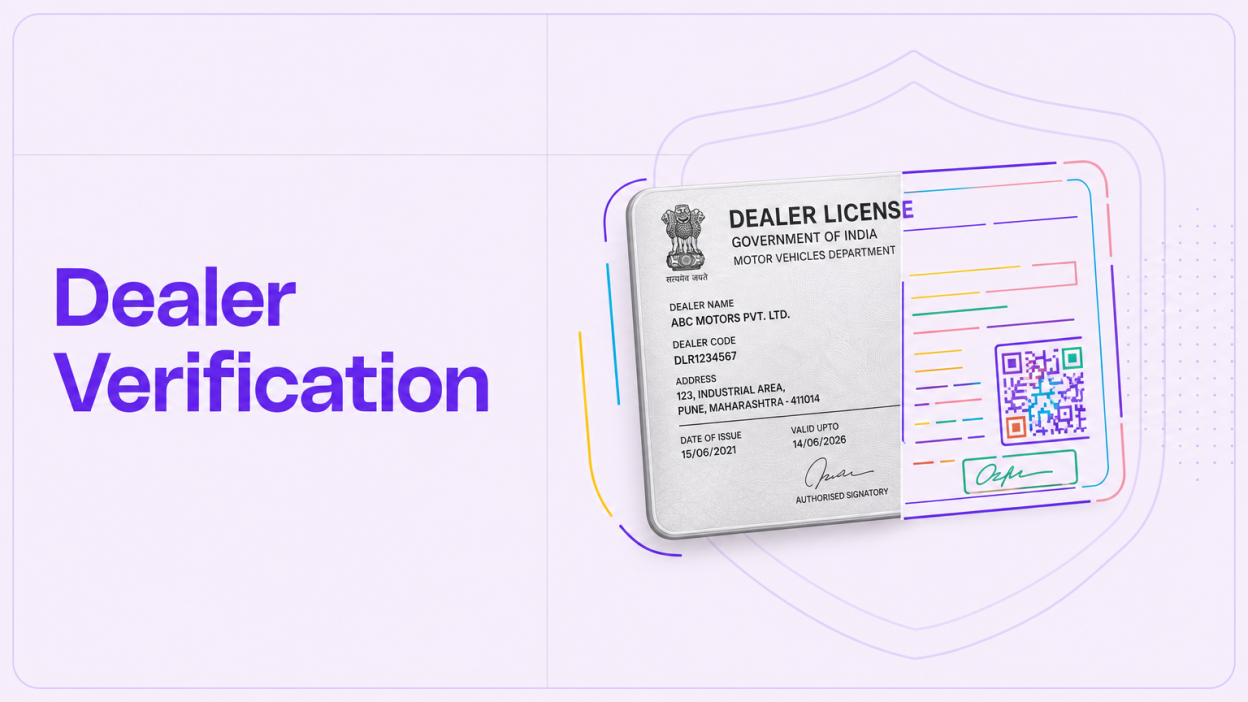
Dealer verification is the process of confirming that a dealer or distributor is a real, active business run by the people it names, before it receives stock on credit, financing or platform access. In India it typically covers GST status and filings, MCA or Udyam records, PAN, bank account ownership, promoter KYC and physical footprint.
A dealer network is a credit portfolio in disguise. Every distributor that receives goods on 30 or 60 day terms, or invoices discounted by a lender, is an unsecured exposure to a business the brand may know only through a sales rep.
That exposure has a fraud dimension. Since 2023, GST authorities have run sustained drives against networks of fake registrations used to generate invoices with no underlying supply. This guide covers what to verify, the fraud patterns that slip through, a step-by-step onboarding flow and a risk tiering model.
Who needs dealer verification
Four groups carry the risk, in different forms:
- Manufacturers and brands (FMCG, auto, pharma, consumer durables) extending trade credit and channel incentives.
- B2B marketplaces onboarding sellers and buyers, where a fake dealer can route goods or payments.
- Banks and NBFCs running dealer financing or supply chain finance programmes, where the anchor’s referral is not a substitute for due diligence.
- TReDS financiers and platforms discounting MSME receivables.
TReDS has a specific regulatory angle. The Reserve Bank of India (Trade Receivables Discounting System) Directions, 2026, issued on 23 June 2026, require platforms to have validation mechanisms to ensure the seller is an MSME, to credit funds only to the seller’s bank account, to carry out customer due diligence of buyers, and to establish the genuineness of uploaded invoices. RBI’s June 2023 circular had already widened the system to insurers and to a secondary market in factoring units.
For brands, no regulator mandates dealer verification. The case rests on credit loss, tax exposure and brand misuse.
What to verify in a dealer or distributor
A full dealer verification answers six questions. The checks below map each question to a source.
| Question | Check | Source |
|---|---|---|
| Does the entity exist? | Legal name, constitution, registration status | GST, MCA (companies and LLPs), Udyam |
| Is it tax compliant? | GSTIN status, return filing history, cancellation date | GST records |
| Who runs it? | Directors, partners or proprietor; promoter KYC | MCA, partnership deed, PAN and OVD |
| Is the bank account its own? | Account holder name match | Penny drop or reverse penny drop |
| Does it operate where it says? | Principal and additional places of business | GST address, site visit, digital footprint |
| Is it linked to known bad actors? | Shared PAN, address, phone or directors | Internal data, public records |
Signals that matter more for dealers than for other businesses
- Registration age: a GSTIN created weeks before a large first order deserves more scrutiny.
- Filing continuity: gaps in return filing often precede cancellation.
- Address type: a residential address for a distributor claiming warehouse-scale volume is a mismatch.
- Promoter overlap: the same person behind several new dealers in one territory.
Fraud patterns in dealer networks
The scale of fake GST registrations shows why GST data cannot be taken on trust:
- PIB reported on 7 January 2024 that GST formations had detected 29,273 bogus firms involved in suspected ITC evasion of ₹44,015 crore in a drive running since May 2023, with 121 arrests.
- In September 2024, CBIC member Shashank Priya said officers in the fake registration drive had detected 10,700 bogus firms with evasion of over ₹10,000 crore.
- In a written Lok Sabha reply on 15 December 2025, the government reported 3,977 fake registrations using forged PAN and Aadhaar in FY 2024-25, involving ₹13,109 crore of evasion.
These schemes surface in dealer networks in four main forms:
- Shell dealers: a registered entity with no premises, staff or stock, created to receive goods on credit and disappear.
- Fake invoices: invoices for supplies that never happened, used to claim input tax credit or to raise invoice finance.
- Circular trading: goods or invoices rotate between related entities to inflate turnover and qualify for higher credit limits.
- Borrowed identities: GST registrations created with someone else’s PAN and Aadhaar, so the named promoter has no knowledge of the business.
Our analysis of covers the ITC mechanics. For financiers, the most damaging case is a dealer whose invoices are real documents describing fictitious trade.
A step-by-step dealer onboarding flow
Run dealer verification as a fixed sequence, with the cheapest automated checks first and manual effort reserved for exceptions.
- Capture PAN, GSTIN and, where relevant, CIN, LLPIN or Udyam number at application, not later.
- Check GST status, legal and trade name, constitution, registration date and return filing history.
- Confirm MCA status and directors for companies and LLPs, or Udyam details for MSMEs.
- Verify promoter identity: PAN and an officially valid document for the proprietor, partners or directors who will sign.
- Confirm bank account ownership through matching the account name to the legal or trade name.
- Review digital footprint and, for higher tiers, run a physical or video site check of the stated premises.
- Search for links to existing or rejected dealers by PAN, address, phone, email and promoter.
- Assign a risk tier, set credit limit and payment terms, and schedule re-verification.
Illustrative example: a pharma distributor applies in a new district. GST shows registration three weeks old, the address is a flat, and the proprietor’s mobile number matches a dealer terminated last year. Each signal alone is weak; together they justify cash-and-carry terms until a trading history builds.
The that payment companies use are a useful extension of step 7.
Where BeFiSc fits: BizCheck produces a business risk report in about 60 seconds from GST, MCA, Udyam and digital footprint data, which covers steps 2, 3 and part of step 6 in a single call. Sales and credit teams see GST status and filing history, MCA or Udyam details and online presence before a credit limit is set. Run a free BizCheck report on a dealer in your current pipeline to see the output.
Risk tiering for dealer onboarding
Not every dealer needs the same depth. A tiered model keeps onboarding fast for low exposure and thorough where losses would hurt.
| Tier | Typical profile | Checks | Commercial terms |
|---|---|---|---|
| Low | Small order value, advance or cash-and-carry | GST status, PAN, bank account | Standard onboarding |
| Medium | Trade credit within a modest limit | Low tier plus filing history, MCA or Udyam, promoter KYC | Limit reviewed after first cycles |
| High | Large credit line, dealer finance or invoice discounting | Medium tier plus site visit, related-party search, bank statement review | Credit committee sign-off, periodic re-verification |
Tier thresholds are a commercial decision. The principle is that verification depth should rise with credit exposure, not with the dealer’s sales potential.
Re-verification
Dealer verification is not a one-time event. GST registrations get cancelled, directors change and filing lapses. Re-check high-tier dealers on a fixed cycle and whenever orders spike sharply or payment behaviour shifts.
Key Takeaways
- Dealer verification confirms that a distributor exists, is tax compliant, is run by the named people and owns the bank account it gives you.
- Government drives found tens of thousands of bogus GST firms between 2023 and 2025, so an “Active” GSTIN alone proves little.
- Shell dealers, fake invoices, circular trading and borrowed identities are the main fraud patterns in dealer networks.
- TReDS platforms now carry explicit duties under the 2026 Directions to validate MSME sellers and invoice genuineness.
- Tier verification depth by credit exposure and re-verify high-exposure dealers regularly.
Frequently Asked Questions
How often should dealers be re-verified?
High-exposure dealers should be re-checked on a fixed cycle and on trigger events such as large order spikes, payment delays or changes in GST status.
What is the difference between dealer verification and dealer financing due diligence?
Dealer verification confirms identity and legitimacy. Dealer financing adds credit assessment, such as cash flow, bank statement analysis and the anchor relationship, on top of verification.
How do I check if a dealer’s GST number is genuine?
Search the GSTIN on the GST portal and confirm status, legal name, trade name, address and filing history match the application. A genuine but recently created or non-filing GSTIN still needs scrutiny.
What documents are needed for dealer verification?
Typically PAN, GST certificate or GSTIN, incorporation or Udyam details where applicable, promoter PAN and identity documents, a cancelled cheque or bank details, and address proof for the business premises.
Conclusion
Dealer networks extend credit to businesses that often receive less scrutiny than a retail borrower. The GST enforcement record from 2023 to 2025 shows how easily a registered entity can be a front.
Brands and lenders that treat dealer verification as structured KYB, tiered by exposure and repeated over time, reduce bad debt and tax exposure without slowing good dealers down. That discipline matters more now that TReDS rules spell out seller validation and invoice genuineness.