
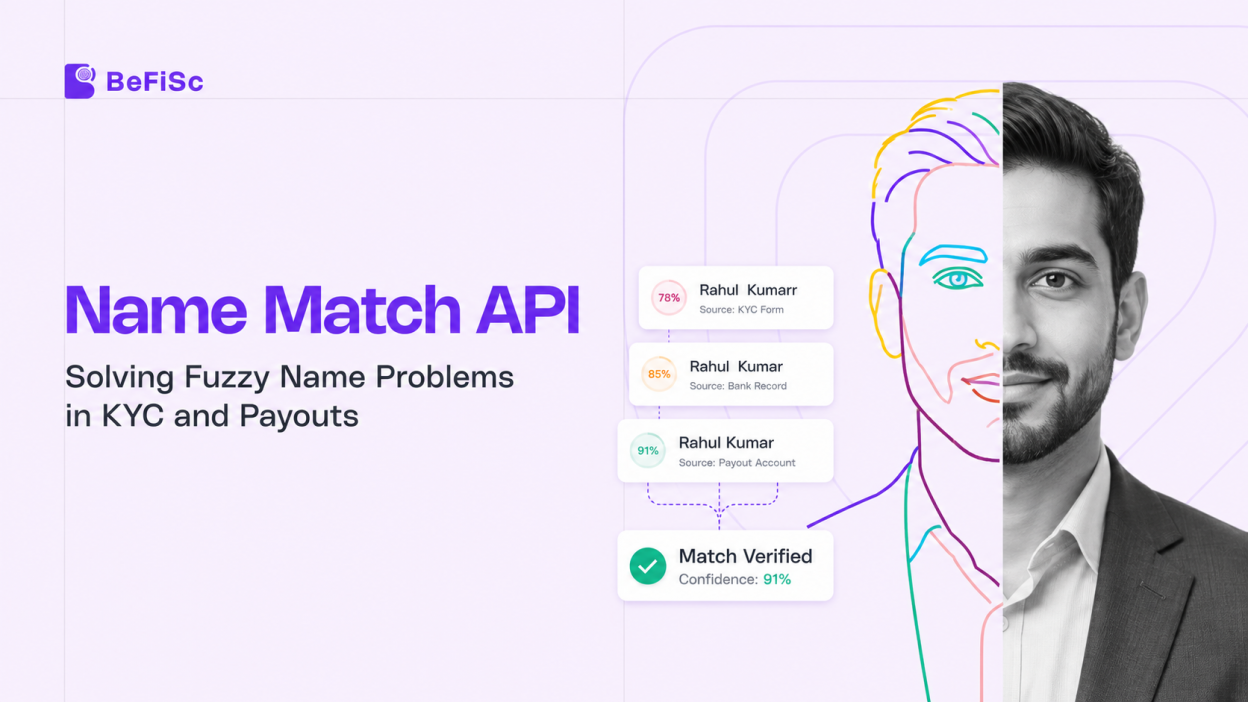
“MOHAMMED IRFAN K” and “Md. Irfan Khan” are probably the same person. “Sunita Sharma” and “Sunil Sharma” are probably not. Every verification pipeline in Indian fintech eventually hits this problem: two names, from two systems, that must be compared and no exact-match rule that survives contact with reality.
Names in India arrive with initials expanded or compressed, tokens reordered, honorifics attached, and the same name transliterated three different ways from the same script. Exact matching rejects legitimate customers at scale; careless leniency waves fraud through. A name match API is the specialised layer that resolves this, scoring the likelihood that two name strings refer to the same person, consistently, explainably, and at pipeline speed. This guide covers how the matching actually works, where it plugs into verification flows, and how to govern thresholds like the risk policy they are.
What Is a Name Match API?
A name match API takes two name strings and optionally supporting fields such as date of birth and returns a similarity score with a match classification: match, possible match, or no match. Behind the single call sits a stack of normalisation, linguistic, and statistical techniques tuned for personal names rather than generic strings.
The distinction from generic string comparison matters. Edit distance treats “Sunita” versus “Sunil” (two character changes, different people) as more similar than “Mohammed” versus “Mohd.” (six character changes, same person). Names have structure tokens, initials, honorifics, patronymics, transliteration families and a purpose-built matcher exploits that structure.
The output must also be explainable. A payout blocked or a sanctions alert raised on a name score will eventually be questioned by an auditor, a customer, or a regulator. “The API said 0.62” is not an answer; “the given names matched phonetically, the family names conflicted” is.
Why Names Fail to Match: The Indian Context
Five patterns generate most mismatches in Indian data.
Transliteration variance. Names written natively in Devanagari, Tamil, Telugu, Bengali, or Urdu scripts map to the Latin script in many valid ways: Srinivasan/Shrinivasan, Lakshmi/Laxmi, Mohammed/Muhammad/Mohd. Each source system froze a different choice.
Initials and expansions. South Indian naming conventions in particular produce “R. Karthik” in one system and “Ramaswamy Karthik” in another, for the same person, structurally different strings.
Token ordering. “Sharma Priyanka” versus “Priyanka Sharma”: bank CBS records, government databases, and application forms disagree on ordering conventions.
Truncation and honorifics. Bank records truncate to field lengths (“PRIYANKA SHARM”), and Shri/Smt/Dr prefixes attach inconsistently.
Life events and data entry. Post-marriage name changes, single-name individuals, and plain typos complete the picture.
None of these variants indicates fraud, and all of them defeat exact matching. That is the operational case for a dedicated matcher: the cost of false rejection is a lost customer per instance.
How Name Matching Algorithms Work
Production name matching layers four technique families.
Normalisation
Case folding, punctuation and honorific stripping, whitespace collapse, and known-abbreviation expansion (Md. → Mohammed) bring both strings to a canonical form before any comparison runs.
Token-Level Comparison
Names split into tokens are compared pairwise with order tolerance, so “Priyanka Sharma” and “Sharma Priyanka” align perfectly. Initial-aware logic lets “R.” match “Ramaswamy” at partial confidence rather than zero.
Phonetic and Transliteration Matching
Phonetic algorithms map tokens to sound-based representations so Lakshmi and Laxmi collide as intended. For Indian names specifically, matchers trained on Indic transliteration families outperform classic Western phonetic schemes (Soundex-era algorithms), which were designed for Anglophone names and miss Indic patterns.
Composite Scoring
Token, phonetic, and string-similarity signals combine increasingly via models trained on labelled Indian name pairs into a single score, with the contributing evidence retained for explainability. Supporting fields like date of birth act as tiebreakers on borderline scores.
The design goal is a score distribution that cleanly separates same-person pairs from different-person pairs, with a narrow, honest uncertainty band between them because that band is what your manual-review queue will breathe.
Where a Name Match API Fits in the Verification Stack
Name matching is rarely the product; it is the connective tissue inside five workflows.
Bank account verification. The name returned by a penny drop or reverse penny drop must match the applicant. This is the highest-volume name-match surface in fintech, and the mechanics sit inside every [bank account verification API] decision.
Cross-document KYC consistency. Aadhaar, PAN, and application names must reconcile. Hard-matching them destroys conversion; scored matching with review bands preserves it.
CKYC search and deduplication. Locating a customer’s existing record and preventing duplicate or synthetic identities from fragmenting across records.
Sanctions and PEP screening. Screening is name matching under adversarial conditions, with list-name variants and deliberate obfuscation. False-positive economics dominate here, as we discussed in our [PEP screening guide].
Payout and beneficiary controls. Vendor masters, insurance payouts, refunds — anywhere a registered name gates money movement.
Thresholds Are Risk Policy: Governing Match Scores
The most common name-matching failure is organisational, not algorithmic: thresholds set once by an engineer and never revisited.
Treat thresholds as governed risk parameters. Set them per use case: a loan disbursal name check deserves a stricter bar than a refund; sanctions screening deserves a recall-heavy bar with human review absorbing the false positives. Define three zones, not two: auto-pass, review, auto-fail, and staff the review band honestly.
Then back-test. Quarterly, sample auto-passed pairs for missed fraud and auto-failed pairs for false rejections; recalibrate against confirmed outcomes. Track the review band’s volume and hit rate as standing metrics. A threshold that was right at launch drifts wrong as your customer mix, fraud pressure, and upstream data sources change.
Finally, log every decision with its evidence. When a regulator asks why a sanctioned-adjacent name auto-passed, the answer must be a reasoned policy with an audit trail, not an archaeological dig through configuration history.
Evaluating a Name Match API
Five criteria separate contenders.
Indic-name performance. Demand benchmark results on Indian name pairs transliteration families, initials, ordering, not generic accuracy claims. Test with your own labelled pairs, including your historical false rejections.
Explainability. Scores must come with evidence breakdowns usable in audit and dispute contexts.
Latency and scale. Matching sits in line in onboarding and payout paths; sub-100ms response at your peak volume is the practical bar.
Configurability. Per-use-case thresholds, review bands, and field weighting should be configuration, not code changes.
Data handling. Names are personal data. Processing locality, retention behaviour, and logging practices must fit your [DPDP obligations].
Key Takeaways
- A name match API scores whether two name strings refer to the same person, using normalisation, token, phonetic, and model-based techniques built for personal names.
- Indian data guarantees mismatch pressure: transliteration variants, initials, token reordering, truncation, and honorifics are normal, not suspicious.
- Matching is connective tissue across bank verification, KYC consistency, CKYC dedup, sanctions screening, and payouts.
- Thresholds are risk policy: set per use case with three zones, back-test quarterly, and log decisions with evidence.
- Evaluate providers on Indic-name benchmarks, explainability, inline latency, configurability, and DPDP-grade data handling.
Frequently Asked Questions
Where does a name match API fit in a KYC stack?
A name match API runs wherever two names must reconcile: bank account verification responses against applications, Aadhaar against PAN, CKYC search and deduplication, sanctions and PEP screening, and beneficiary checks before payouts.
What score threshold should a name match API use?
There is no universal number. Set thresholds per use case — stricter for disbursals, recall-heavy for sanctions screening — with an explicit manual-review band between auto-pass and auto-fail, and back-test them quarterly against confirmed outcomes.
How accurate is a name match API for Indian names?
Accuracy depends on Indic-specific handling. A name match API trained on Indian transliteration families and naming conventions substantially outperforms generic string or Western phonetic matching; always benchmark on labelled Indian name pairs before adopting one.
Why do banks and fintechs need a name match API?
Because names for the same person legitimately differ across systems — initials, spelling variants, reordered tokens. A name match API lets verification flows accept those variants while still catching genuine mismatches that indicate error or fraud.
What is a name match API?
A name match API compares two name strings and returns a similarity score and classification match, possible match, or no match using techniques tuned for personal names, such as token alignment, phonetic matching, and transliteration handling.
Conclusion
Name matching is the quietest component in the verification stack and one of the most consequential: it silently decides who onboards smoothly, which payouts pause, and which screening alerts exist at all. Institutions that treat it as a solved string problem inherit its failures as customer complaints and audit findings; institutions that treat it as governed risk infrastructure turn it into conversion and control simultaneously.
The field is moving toward learned matchers trained on Indic data and multilingual embeddings, which will keep compressing the uncertainty band. What will not change is the governance requirement, because however good the score gets, someone will still have to explain it.
[…] to the borrower’s account. A bank account verification API confirms the account is real and name-matched to the borrower before disbursal- the control point that blocks mule-routed […]
[…] name: the registered name, for name-matching against the application or […]
[…] is valid and active (so a payment won’t simply fail), and whose account it maps to (so you can name-match the beneficiary against your records). That second part beneficiary name confirmation is what turns […]
[…] a lender, the immediately actionable signals are registration status and name-match. A GSTIN that returns as cancelled or suspended is an immediate red flag: either the business has […]