Salaried borrowers leave income trails everywhere: payslips, EPFO contributions, salary credits. Self-employed borrowers leave one that matters most: the income tax return. For business owners, professionals, and freelancers, the ITR is frequently the only structured, government-filed statement of income that exists. It is also the document most often submitted as a doctored PDF.
An ITR verification API resolves the contradiction. Instead of trusting an uploaded acknowledgement, the lender validates the return’s existence and key figures against Income Tax Department records through consent-based data fetches or acknowledgement-number verification. This guide explains what ITR verification actually confirms, how the flows work, how ITR data feeds underwriting for the self-employed, and the misreadings that trip up credit teams.
What Is an ITR Verification API?
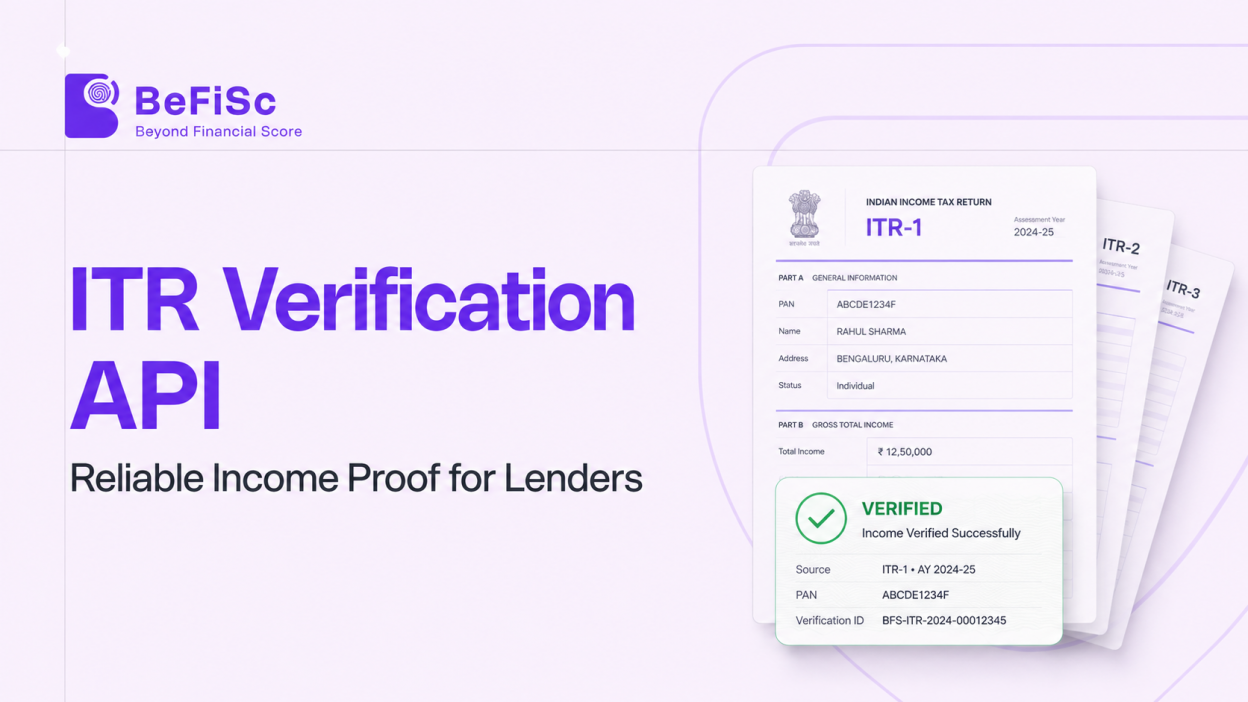
An ITR verification KYC API Integration Guide against Income Tax Department records rather than accepting borrower-supplied documents at face value. Depending on the integration mode, it confirms that a return was actually filed for a given PAN and assessment year, retrieves the return’s key financial figures with the taxpayer’s consent, and cross-references related records such as Form 26AS (tax credits) and the Annual Information Statement (AIS).
The distinction the API enforces runs through all modern verification: a PDF of an ITR acknowledgement is a claim; the department’s record is the fact. ITR forms are structured, well-understood documents, which makes them easy to forge convincingly. Template kits for ITR-V acknowledgements circulate exactly as bank statement templates do, a supply chain we documented in our [document forgery detection guide].
For lenders, the API converts the most important self-employed income document from a forensic problem into a data problem, verified figures, machine-readable, ready for underwriting logic.
What Gets Verified: Returns, Acknowledgements, and Linked Records
ITR verification operates at three depths, and choosing the right one is a policy decision.
Filing verification. The lightest check: confirming that a return exists for the PAN and assessment year, matching the acknowledgement number the borrower provided. This defeats wholesale fabrication of the “return” that was never filed with minimal friction.
Return data retrieval. With the borrower’s consent, the flow retrieves the filed return’s substantive figures: gross total income, income heads (business/profession, salary, capital gains, house property), deductions, and tax paid. This is the underwriting-grade depth, because it verifies the numbers, not just the filing.
Corroboration via 26AS and AIS. Form 26AS shows tax deducted and collected against the PAN; TDS entries from clients and employers are third-party evidence of real revenue. The AIS aggregates reported financial transactions. Together, they let underwriters test whether the return’s claimed income is consistent with what payers independently reported triangulation of the same kind we advocate with [bank statement analysis].
The PAN Verification API verifies everything, so ITR verification presumes a verified PAN and identity. The ITR rail extends an identity-verified journey; it does not begin one.
How ITR Verification Flows Work
A production ITR verification journey runs in four steps.
Step 1: Consent and Credential-Free Access
The borrower consents to income verification, and the flow initiates a consent-bound fetch. Modern implementations avoid collecting the borrower’s income tax portal credentials; credential-sharing patterns are a security anti-pattern and increasingly a regulatory one. Data Fiduciary under the DPDP Act to the taxpayer’s registered mobile is the clean design.
Step 2: Return Retrieval or Acknowledgement Check
Per policy depth, the flow either verifies the acknowledgement number and filing status or retrieves the return’s key figures for the required assessment years, typically the latest two or three for underwriting.
Step 3: Cross-Verification
Retrieved figures reconcile against the borrower’s stated income, uploaded financials, 26AS/AIS entries, and bank-statement cash flows. Discrepancies are routed by size and pattern: rounding gaps pass; structural contradictions go to review.
Step 4: Feature Extraction and Decision
Verified figures become underwriting features: income levels, growth trends, income mix, and tax-payment behaviour feed the credit policy, with the raw evidence archived. The journey adds seconds to onboarding, not days, which is what makes verified-ITR underwriting viable at digital-lending speed.
Underwriting the Self-Employed: From ITR Data to Credit Decisions
Verified ITR data changes self-employed underwriting in four concrete ways.
Multi-year income with trend. Two to three years of verified returns establish income level and trajectory. A profession showing steady field income across years is a different risk from one whose income doubled in the year before the loan application the classic pre-application inflation pattern.
Income quality decomposition. The return separates business income from capital gains, rent, and other heads. FOIR and serviceability calculations should weight recurring operating income differently from one-off gains, a distinction a single “annual income” number hides.
Consistency scoring. ITR versus 26AS versus bank credits: three independent views of the same economic reality. High-coherence borrowers earn faster approvals and better pricing; incoherent files earn scrutiny. This is the practical machinery behind the risk signals we mapped in [credit risk assessment: hidden signals lenders miss].
Segment expansion. Verified tax data lets lenders serve professionals and MSME owners who fail pay-slip-based policies, entirely widening the addressable market without widening the risk appetite, in line with the cash-flow-lending direction the [account aggregator framework] is driving.
ITR Fraud Patterns and How Verification Defeats Them
Four patterns dominate ITR-linked fraud.
Fabricated acknowledgements. A return that was never filed, presented as a polished ITR-V PDF. Filing verification kills it in one call.
Altered figures. A genuine filing whose PDF is edited to inflate income before upload. Return data retrieval makes the PDF irrelevant; the department’s figures are the figures.
Belated strategic filing. Returns filed just before the loan application, sometimes for multiple back years simultaneously, showing convenient income. Verification cannot make this income false; the return is real, but filing dates in the verified record expose the pattern, and policy should treat freshly filed multi-year backlogs as a review trigger.
Revised return games. Filing high, applying for the loan, then revising downward. Checking the latest return status and revision history for the relevant years closes the window.
The residual risk is honest-looking dishonesty: real filings on inflated declared income (paying some extra tax as the cost of fraud). This is where 26AS/AIS corroboration and bank-flow reconciliation earn their place: third parties did not report the income, and the accounts do not show it, however genuine the filing is. The layering logic matches our broader [first-party fraud] doctrine: no single artefact, however verified, decides alone.
Reading ITR Data Correctly: Common Misinterpretations
Credit teams new to verified ITR data make four recurring errors.
Confusing gross with taxable income. Deductions and exemptions make taxable income a poor proxy for cash income capacity. Serviceability should build from gross income and cash-flow reality, not the tax-optimised bottom line.
Penalising legitimate tax planning. Presumptive taxation schemes (such as those used by small businesses and professionals) report income on a deemed basis. Low declared margins under a presumptive scheme are a regime feature, not automatically an income-hiding signal; policy must read the scheme context.
Ignoring seasonality and lumpiness. Business income is uneven. A single weak year inside a healthy multi-year pattern is noise; underwriting on the worst year alone systematically misprices seasonal businesses.
Treating filing gaps as disqualification. Genuine reasons for missing years exist (income below thresholds, new businesses). Gaps warrant routing to an alternate income evidence bank that flows via AA and GST data rather than reflexive decline.
The discipline is the same one that governs every rail in this series: verified data deserves informed interpretation, and thresholds deserve governance.
Key Takeaways
- An ITR verification API validates tax return existence and figures against Income Tax Department records, replacing forgeable PDFs with source truth.
- Three depths filing verification, consented return retrieval, and 26AS/AIS corroboration map to escalating assurance needs.
- For self-employed underwriting, verified multi-year returns enable trend analysis, income-quality decomposition, and consistency scoring against bank flows.
- Verification defeats fabricated and altered returns; filing-date and revision-history checks expose strategic filing; corroboration catches inflated-but-real filings.
- Interpretation discipline matters: gross versus taxable, presumptive-scheme context, seasonality, and gap-routing keep verified data from being misread.
Frequently Asked Questions
What are the limits of an ITR verification API?
An ITR verification API verifies what was filed, not whether declared income is economically real. Strategically inflated filings require corroboration through 26AS/AIS and bank-flow analysis, and interpretation must account for presumptive schemes and business seasonality.
Does an ITR verification API require the borrower’s tax portal password?
No, and it should not. Well-designed ITR verification API flows use consent-based, OTP-bound access rather than credential sharing, keeping the borrower’s tax account secure and the lender’s process compliant.
Can an ITR verification API detect a fake ITR document?
Yes. Because an ITR verification API checks department records rather than the uploaded PDF, fabricated acknowledgements fail the filing check, and altered figures are overridden by the retrieved return data.
How does an ITR verification API help in loan underwriting?
An ITR verification API gives lenders verified, multi-year income figures for self-employed and professional borrowers, supporting trend analysis, FOIR calculations on real numbers, and consistency checks against bank statements and TDS records.
What is an ITR verification API?
An ITR verification API validates income tax return information against Income Tax Department records, confirming a return was filed, retrieving its key figures with the taxpayer’s consent, and enabling cross-checks against Form 26AS and AIS data.
Conclusion
The ITR sat for years in an awkward position: the most authoritative income document for the self-employed, handled through the least reliable channel: borrower-uploaded PDFs. Verification at source resolves the awkwardness, and with it, one of the structural reasons self-employed credit stayed expensive and slow.
The direction from here is convergence: tax records, GST data, RBI Governor: ULI and Account Aggregators to Boost Credit Access, and EPFO signals fusing into a composite income layer that underwrites people by what their economic footprint shows rather than what their documents claim. Lenders wiring the ITR rail in now are building toward that layer, not just closing a fraud gap.