India processes identity verification at a scale no other market attempts: over 1.3 billion Aadhaar numbers issued, more than 99 crore e-KYC transactions run through UIDAI’s Aadhaar Authentication ecosystem in recent years, and a lending and payments industry that onboards new customers almost entirely online. A KYC API is the piece of infrastructure that makes this possible; it lets a bank, NBFC, or fintech verify a customer’s identity in seconds instead of routing paperwork through a branch.
For a compliance or engineering team evaluating this category for the first time, the confusion isn’t about whether to use a KYC API. It’s about which one, integrated how, and against which regulatory obligations. This guide covers how KYC APIs actually work under the hood, what RBI’s KYC Master Directions require of a regulated entity regardless of which vendor it uses, and the specific criteria that separate a production-ready provider from a demo that breaks under real transaction volume.
What a KYC API Actually Does
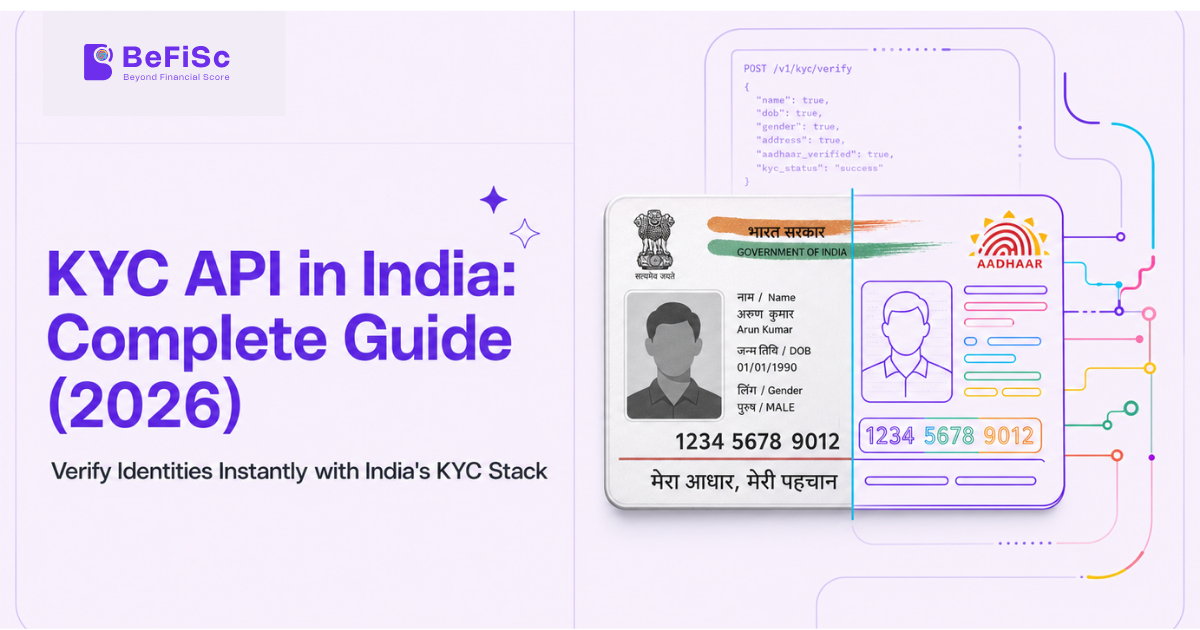
A KYC API is a programmatic interface that lets a business verify a customer’s identity against an authoritative source, typically UIDAI (Aadhaar), the Income Tax Department (PAN), the Election Commission (Voter ID), or a state transport authority (driving licence), and receive a structured, machine-readable response within the same session as account opening.
The distinction that matters operationally is between verification and authentication. Verification confirms that a document or number exists and its stated details are internally consistent (a PAN format check, for instance). Authentication confirms that the person presenting the document is the person the document belongs to, usually through an OTP sent to a registered mobile number, a biometric match, or a face-liveness check against the photograph on file.
Most production KYC flows in Indian fintech combine both: a document-level verification call followed by a real-time authentication step, because verifying that a PAN number is valid says nothing about who is holding it.
The Technical Building Blocks: OTP-Based, Biometric, and Offline eKYC
Three distinct mechanisms sit under the umbrella term “Aadhaar-based KYC,” and they carry different compliance weight.
OTP-based eKYC authenticates a customer by sending a one-time password to the mobile number linked with their Aadhaar and matching the response against UIDAI’s records. It is fast and low-friction, but RBI does not treat it as equivalent to biometric authentication for all use cases; its 2022 KYC amendment restricts OTP-based e-KYC to specific account categories and caps balances or requires additional verification within a defined window for accounts opened this way.
Biometric-based eKYC uses fingerprint or iris capture matched live against UIDAI’s database. This carries the fullest regulatory weight and is typically required for high-value accounts, though it requires either a physical biometric device or a video-based equivalent.
Offline Aadhaar eKYC (XML/QR) lets a customer download a signed, UIDAI-issued XML file or share-code-protected QR from the UIDAI portal or mAadhaar app, which the business then verifies cryptographically without ever calling UIDAI’s live servers or handling the Aadhaar number itself. This is the mechanism privacy-conscious implementations increasingly favor, because it avoids storing or transmitting the raw Aadhaar number, a meaningful distinction under both UIDAI’s data-minimization guidance and the Digital Personal Data Protection Act, 2023.
A capable KYC API provider supports all three and lets the integrating business choose based on the account type, not just whichever method is cheapest to implement.
Where RBI’s KYC Master Directions Fit In
RBI’s Master Direction on KYC (updated periodically, most recently with amendments addressing the Video-based Customer Identification Process, or V-CIP) sets the actual compliance bar; the API is only the delivery mechanism. Three provisions matter most for a team building on top of a KYC API:
Risk categorization. Regulated entities must classify customers into risk categories (low, medium, high) and apply proportionate due diligence. A KYC API that returns only a pass/fail result without supporting the data points needed for risk scoring, address consistency, PEP screening flags, and document authenticity signals forces the integrating business to build that layer separately.
Central KYC Registry (CKYCRR) reporting. Once a customer’s KYC is completed, the regulated entity is required to upload the KYC records to CERSAI’s Central KYC Records Registry within the prescribed timeline, so other regulated entities can retrieve an existing KYC record (a CKYC number) instead of re-verifying the same customer from scratch. A KYC API that doesn’t support CKYC search-and-fetch, or that can’t format records for CKYCRR upload, pushes that integration work back onto the client.
Periodic updates. KYC isn’t a one-time event. RBI mandates periodic re-verification cycles that vary by risk category (typically every two years for high-risk customers, eight for low-risk, though entities should confirm current cycles against the latest Master Direction). An API relationship that only handles onboarding, not periodic re-KYC, leaves a compliance gap that surfaces during an RBI inspection, not during initial due diligence.
CKYC, CERSAI, and the Record-Sharing Layer
CKYCRR deserves its own explanation because it’s frequently confused with Aadhaar eKYC. CERSAI (Central Registry of Securitisation Asset Reconstruction and Security Interest) operates the CKYC Records Registry as a shared utility: once any regulated entity completes and uploads a customer’s KYC, that customer receives a 14-digit CKYC number. Any other regulated entity can then retrieve the existing record using that number, avoiding duplicate verification.
For a lender running high onboarding volumes, a KYC API that checks CKYCRR first before triggering a fresh Aadhaar or PAN verification call meaningfully reduces both cost and customer friction, since a large share of digitally active Indian consumers already have a CKYC record from a previous bank, NBFC, or mutual fund relationship.
Evaluating a KYC API Provider: What Actually Matters
Most vendor comparisons focus on the wrong variables. Per-transaction pricing and a polished dashboard are visible; uptime under load and audit-readiness are not, and the second category is what causes production incidents.
A structured evaluation should weigh:
- UIDAI/NSDL/ECI source connectivity, not a reseller layer. Ask whether the provider holds a direct AUA/KUA (Authentication User Agency/e-KYC User Agency) licence from UIDAI or operates through an intermediary; this affects both latency and accountability during an outage.
- CKYCRR integration depth: search-and-fetch before triggering fresh verification, and automated formatting for CKYC upload, not just raw verification.
- Audit trail completeness: every verification call should generate a retrievable, timestamped record (consent captured, source queried, response received) because RBI inspections and internal audits both require this evidence months or years after the fact.
- Fallback handling: UIDAI’s servers do experience downtime; a provider without a documented fallback path (offline XML, alternate document type) turns a UIDAI outage into an onboarding outage.
- Data residency and retention practice: under the DPDP Act, 2023, how long the provider retains verification artifacts, and where, is now a question compliance teams are expected to ask and document, not assume.
Common Mistakes in KYC API Implementation
The most frequent gap is not technical but categorical: teams treat KYC as a one-time onboarding gate rather than a lifecycle obligation, and build integration accordingly, wiring the API into the signup flow and nowhere else. Periodic re-KYC, address-change triggers, and risk-category upgrades then become manual processes bolted on later, usually after an audit finding.
A second common mistake is over-relying on a single verification method. OTP-based eKYC alone, for instance, is vulnerable to SIM-swap fraud; pairing it with a document-level check and, for higher-risk accounts, a liveness or biometric step closes that gap at a marginal cost that is small relative to the fraud exposure it removes.
Key Takeaways
- A KYC API is the delivery layer for verification; RBI’s KYC Master Directions, not the vendor, set the actual compliance requirements a regulated entity must meet.
- Offline Aadhaar XML/QR verification avoids handling the raw Aadhaar number and aligns better with DPDP Act data-minimization expectations than always calling UIDAI’s live servers.
- CKYCRR search-and-fetch before triggering a fresh verification reduces both cost and friction, since many customers already hold a CKYC record.
- Evaluate providers on source connectivity, audit-trail completeness, and fallback handling, not only per-transaction price.
- Periodic re-KYC and risk-category updates are compliance obligations, not optional extras; build them into the integration from day one.
Frequently Asked Questions
Does a KYC API cover business (KYB) verification as well as individual KYC?
Not always. Individual KYC (Aadhaar, PAN, biometric) and business verification (GST, MCA/CIN, Udyam) are frequently built on separate underlying data sources and, on many platforms, separate API products confirm both are supported if the business onboards both individual and business customers.
How often does RBI require re-verification of an existing customer’s KYC?
RBI’s Master Direction sets periodic updation cycles based on customer risk category; high-risk customers are re-verified more frequently than low-risk ones. Regulated entities should confirm exact cycle lengths against the current Master Direction, as amendments periodically adjust these timelines.
Can DigiLocker be used instead of a KYC API?
DigiLocker can serve as a source for offline, user-consented document retrieval (including Aadhaar’s e-Aadhaar and other government-issued documents), and is increasingly integrated as one verification pathway within a broader KYC API rather than a full replacement for one, since it doesn’t independently provide biometric authentication or CKYC integration.
What is the difference between Aadhaar verification and Aadhaar authentication?
Verification confirms a document or number is internally valid and consistent; authentication confirms the person presenting it is the person it belongs to, typically via OTP or biometric match against UIDAI’s live database.
Is the UIDAI Aadhaar API free to use?
UIDAI does not charge individuals to verify their own Aadhaar, but businesses accessing Aadhaar authentication or e-KYC services commercially do so through licensed AUA/KUA entities or their sub-agents, which charge per-transaction fees. There is no free, unlimited commercial route to Aadhaar verification.
Conclusion
The KYC API market in India has matured past the point where basic Aadhaar OTP verification is a differentiator; every credible provider offers it. What separates a production-grade partner from a demo-stage one is depth: CKYCRR integration that actually reduces redundant verification, audit trails that survive an RBI inspection, and support for the full lifecycle of a customer relationship rather than just its first five minutes.
Teams evaluating this category should treat the regulatory requirement as the specification and the API as the implementation, not the other way around. A vendor that understands the difference between verification and authentication, supports offline eKYC for data-minimization reasons, and can demonstrate CKYCRR search-and-fetch in a live demo has usually done the compliance homework that a pricing sheet alone won’t reveal.