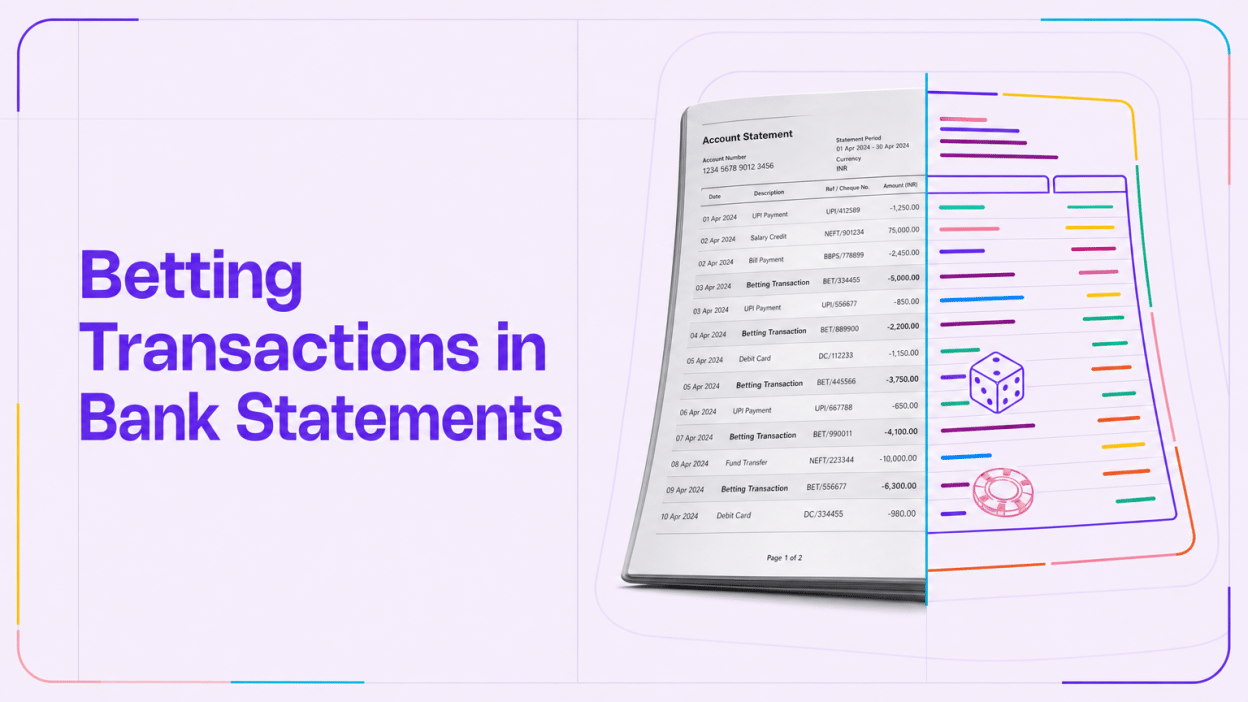
Betting transactions in a bank statement are debits to, and credits from, gambling or online money gaming platforms, often disguised as payments to unrelated merchants or individuals. Since India banned online money games in 2025, these flows have moved to offshore apps and mule accounts, so lenders must identify them through patterns rather than merchant names.
Before August 2025, a credit analyst could often spot gaming spend by name: a regulated real-money gaming app appeared clearly in UPI narrations. That visibility has largely gone.
The Promotion and Regulation of Online Gaming Act, 2025 prohibited online money games, and domestic platforms withdrew their money-game offerings. Demand did not disappear. It moved to offshore platforms that collect money through personal accounts, payment gateway merchants with unrelated business names, and rotating UPI handles.
This guide explains the legal position, why betting debits still show up, how to identify them in a statement, and what underwriting and AML policy options lenders have.
What the Online Gaming Act, 2025 changed
The Promotion and Regulation of Online Gaming Act, 2025 passed the Lok Sabha on 20 August 2025 and the Rajya Sabha on 21 August 2025, and received presidential assent on 22 August 2025. MeitY released draft rules in October 2025, and the rules were notified in April 2026.
Key provisions relevant to lenders:
- Online money games, where users deposit money expecting winnings, are prohibited, along with their advertisement and promotion.
- Section 7 provides that no bank, financial institution or other person facilitating financial transactions shall engage in, permit or facilitate transactions or authorisation of funds towards payment for an online money gaming service.
- E-sports and online social games are to be promoted and regulated, not banned.
Challenges to the Act were transferred to the Supreme Court in September 2025, so its final contours could still change. Lenders should treat the prohibition as the operating position while tracking that litigation.
Why lenders still see betting transactions
Enforcement figures show both the scale of offshore activity and the methods used to collect money:
- In March 2025, before the Act, PTI reported that DGGI had blocked 357 illegal offshore gaming websites and attached about 2,400 bank accounts.
- In March 2026, IANS, citing official sources, reported that about 8,400 illegal betting and gambling websites and apps had been blocked in total, roughly 4,900 of them after the new law.
- In its 6 November 2025 press release in the 1xBet case, the Enforcement Directorate said it had identified over 6,000 mule accounts used to collect user deposits, routed through multiple payment gateways, with merchants onboarded without proper KYC and transaction patterns that did not match the declared business.
The pattern is consistent. Money leaves a user’s account to a personal account, a small merchant with an unrelated name, or a wallet. It is then layered onward. For a lender reading a borrower’s statement, the debit rarely says “betting”.
How to identify betting transactions in a bank statement
Identification relies on combining narration clues with behaviour.
Narration and counterparty clues
- UPI handles or merchant names that change frequently but receive similar amounts.
- Payments to individuals, often in other states, with no apparent relationship to the borrower.
- Merchant names suggesting generic services (“traders”, “enterprises”, “digital services”) that receive repeated round-value payments.
- Wallet top-ups followed by no visible spending.
- Narrations containing known platform names, sport or match references, or terms like “deposit”, “recharge” or “add cash”.
Behavioural patterns
- Many small or medium debits in quick succession, especially late at night or during live sports events.
- Round amounts (Rs 500, Rs 1,000, Rs 5,000) repeated across different payees.
- Irregular credits from unrelated individuals or merchants, consistent with winnings or withdrawals.
- Spending that rises after salary or business credits and depletes balances quickly.
- Loan disbursal followed by rapid outflows to these counterparties.
A practical review sequence
- Structure the statement into normalised transactions with counterparty, mode, and timestamp.
- Flag known gaming and betting keywords in narrations.
- Identify counterparties receiving repeated round-value debits that do not match the borrower’s spending profile.
- Look for credits from those same or similar counterparties (bidirectional flows).
- Measure the share of monthly outflows going to flagged counterparties and its trend.
- Review timing against sports calendars and late-night clustering.
- Escalate to manual review where flagged outflows cross a policy threshold.
Underwriting policy options
Lenders handle gaming and betting exposure differently. The table below shows illustrative policy options; thresholds are examples, not recommendations.
| Policy approach | Illustrative trigger | Action | Trade-off |
|---|---|---|---|
| Hard decline | Any confirmed betting debit in the last 3 months | Reject | Simple, but may reject borrowers with minor or historic activity |
| Threshold-based | Flagged outflows above 10% of monthly income | Decline or refer | Balances risk and reach; needs reliable flagging |
| Trend-based | Flagged outflows rising for 3 consecutive months | Refer to manual review | Catches escalation; more analyst effort |
| Adjust eligibility | Flagged outflows treated as fixed obligations | Reduce loan amount | Keeps customer, controls affordability |
| Post-disbursal monitoring | Disbursal followed by flagged outflows within 7 days | Investigate for misuse or fraud | Detects diversion; requires ongoing data access |
Whatever approach is chosen, record the rationale and evidence, and apply it consistently.
The AML and transaction laundering link
For banks and payment aggregators, betting flows are also an AML issue. Offshore operators need accounts and merchants to collect and move funds, which creates two risks:
- Customer accounts used as mules. A borrower’s account receiving many small credits from strangers and sending them onward may be collecting deposits for a platform.
- Merchants used as fronts. A merchant whose declared business is unrelated to its transaction patterns may be processing gaming payments.
Section 7’s broad wording means institutions that facilitate such flows, even unknowingly, face regulatory risk. Suspicious patterns should go through the institution’s STR process under PMLA.
Use cases
These scenarios are illustrative.
Salaried personal loan applicant
A borrower earning Rs 80,000 a month shows 45 UPI debits of Rs 1,000 to Rs 5,000 to rotating individual payees over two months, clustered on evenings with cricket matches, plus occasional credits from similar payees. Flagged outflows equal 30% of income. The lender declines under its threshold policy.
MSME owner with diverted disbursal
A business loan is disbursed and, within five days, a large share moves to a wallet and then to multiple merchants with generic names. Post-disbursal monitoring flags possible diversion and triggers a review.
Payment aggregator merchant
A newly onboarded “digital services” merchant receives thousands of round-value UPI payments late at night from many unrelated payers. The PA suspends settlement pending investigation.
Where BeFiSc fits
Where BeFiSc fits: Finnalyzer analyses bank statements across 100+ formats and converts them into structured transactions with counterparties and narrations, giving credit teams the base data to flag suspected betting and gaming flows under their own policy. Try it with a free Finnalyzer trial.
Key Takeaways
- The Online Gaming Act, 2025 (assent 22 August 2025) prohibits online money games and, under section 7, bars financial institutions from facilitating payments for them.
- Betting flows have moved to offshore platforms, mule accounts and merchant fronts, so narrations rarely show the platform name.
- Enforcement actions point to thousands of mule accounts and blocked sites, confirming the scale of hidden flows.
- Identification combines keyword flags with behaviour: round amounts, rotating payees, late-night and match-day clustering.
- Lenders should choose a documented policy (decline, threshold, trend, eligibility adjustment, monitoring) and apply it consistently.
- For banks and PAs, these patterns are also AML and transaction laundering signals.
Frequently Asked Questions
How are betting platforms linked to mule accounts?
Enforcement agencies have reported platforms collecting deposits through large networks of mule accounts and payment gateway merchants, then layering funds onward to hide their origin.
Is gaming spend always a credit risk?
Not every transaction is. Spending on permitted social or e-sports games differs from money gaming. The risk lies in scale, trend, and impact on repayment capacity, as well as AML exposure.
Should lenders reject applicants with betting transactions?
It depends on policy. Some lenders decline on any confirmed activity; others use thresholds relative to income, trends, or adjustments to eligibility. The key is a documented, consistent approach.
How do betting transactions appear in a bank statement?
They often appear as UPI payments to individuals or merchants with unrelated names, wallet top-ups, or repeated round-value debits, sometimes with credits from similar counterparties. Platform names are frequently absent.
Are online betting transactions legal in India after 2025?
The Promotion and Regulation of Online Gaming Act, 2025 prohibits online money games and their promotion, and bars financial institutions from facilitating payments for them. Challenges are pending before the Supreme Court, but the prohibition is the operating position.
Conclusion
The 2025 ban removed regulated real-money gaming from Indian payment rails, but it did not remove betting transactions from bank statements. It made them harder to see. Flows now hide behind personal accounts, generic merchant names and rotating UPI handles, the same infrastructure used for mule activity and transaction laundering.
Lenders that structure statements, flag behaviour and not just names, and apply a clear policy will protect both credit quality and their compliance position under section 7. Treat it as part of standard underwriting rather than an occasional manual check.