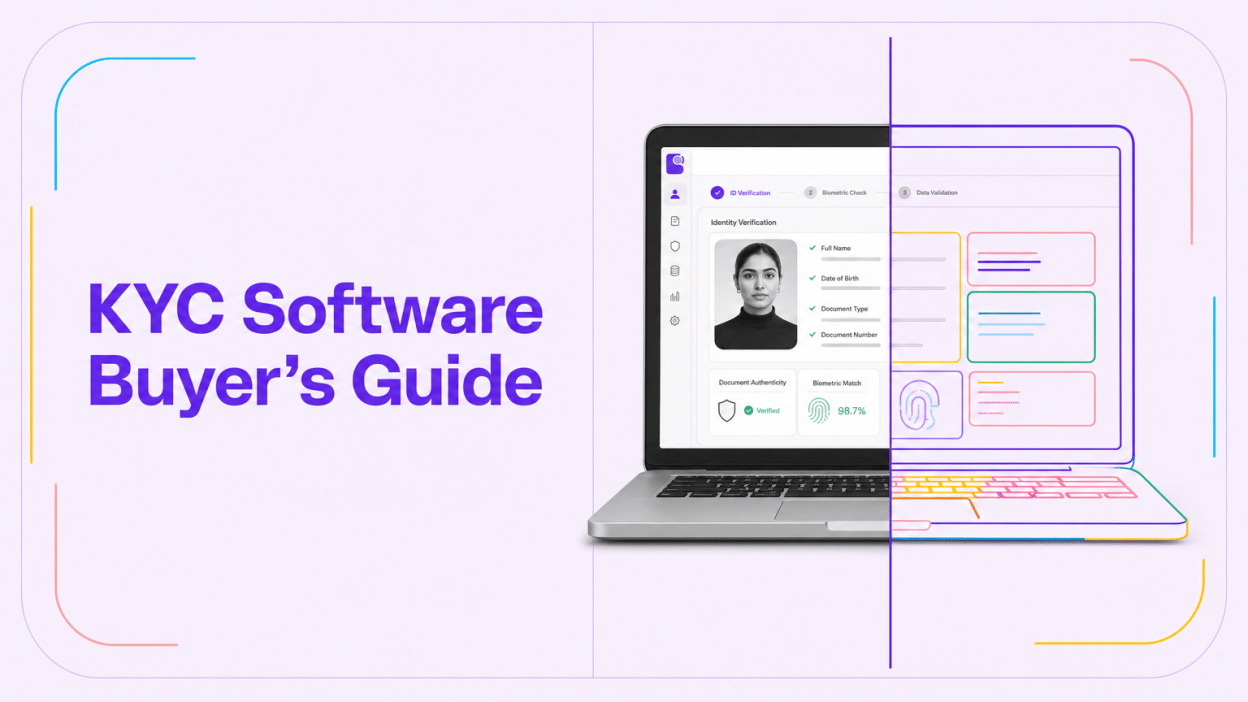
Buy KYC software that covers every route your KYC Directions allow (PAN, Aadhaar offline or DigiLocker, CKYC, V-CIP), verifies at source, and logs evidence per check. Choose an API when you own the journey, a platform when you need workflow too, and build only the orchestration. Decide with a two-week POC on your own cases.
Most KYC software decisions in India are made backwards. Teams compare vendor logos and per-call prices, sign, and only discover in production that pass rates on their own customer mix are ten points lower than the demo suggested.
The cost of that mistake is not the licence. It is drop-off, manual review hours, and an audit trail that cannot answer an inspector’s question. This guide sets out the three buying models, what the software must cover under the 2025 KYC Directions, an evaluation table, a two-week POC plan with metrics, and a build versus buy cost comparison.
KYC API vs KYC platform vs in-house build
The phrase “KYC software” covers three different purchases. Mixing them up is the most common reason a shortlist goes wrong.
KYC API
A KYC API exposes individual checks (PAN verification, Aadhaar offline XML or DigiLocker fetch, face match, liveness, name match, bank account verification) as calls your own application makes. You own the screens, the decision rules, and the case file.
It suits lenders and fintechs with an engineering team and an existing onboarding app. Integration effort is real but bounded;
KYC platform
A KYC platform adds hosted journeys, a rules engine, a review console, and reporting on top of the checks. It is closer to a finished KYC solution, and suits teams that need operations tooling more than raw calls. The trade-off is less control over UX and a higher, often seat- or journey-based, price.
In-house build
Here the institution integrates directly with each source (NSDL or Protean for PAN, UIDAI through a KUA, DigiLocker, CKYCR, NPCI rails) and writes its own matching models. Very few institutions should do all of it. Direct source access carries licensing, audit, and security obligations, and face match and liveness models need continuous retraining.
The practical answer for most buyers is hybrid: buy the checks, build the orchestration and decision layer that encodes your risk policy.
What KYC software must cover under the KYC Directions 2025
RBI repealed the 2016 KYC Master Direction on 28 November 2025 and replaced it with entity-specific KYC Directions. Paragraph numbers below are from the Commercial Banks Directions (RBI/DOR/2025-26/169); NBFC and co-operative bank versions number them differently.
| Route or check | What the software must do | Directions anchor (Commercial Banks) |
|---|---|---|
| PAN verification | Validate PAN and return name and status from the source, not from OCR | PAN is a core CDD document |
| Aadhaar OTP e-KYC | Support the route and enforce its limits for non-face-to-face accounts | Para 25 |
| Aadhaar offline XML or DigiLocker | Verify the digital signature and capture a live photo for equivalent e-documents | Paras 5(1)(x), 23 |
| CKYCR | Download only with explicit consent; upload within timelines | Paras 23(4), 65 |
| V-CIP | Liveness or spoof detection plus face matching, live GPS, audit trail | Para 27(1)(v) |
| Face match and liveness | 1:1 match of selfie to reference photo; reject replays and printed photos | Supports paras 24 and 27 |
| Name match | Score names across PAN, Aadhaar, and bank records with transliteration tolerance | Data consistency for CDD |
| Bank account verification | Confirm the account exists and is in the customer’s name | Para 44 (first credit from own KYC-compliant account as a non-face-to-face safeguard) |
| Record keeping | Keep evidence of each check for at least five years after the relationship ends | Para 50 |
Two points get missed in demos. First, CKYCR and V-CIP are often delivered by separate vendors; your KYC software must orchestrate them even if it does not supply them. Second, under the DPDP Act,, every verification vendor is your data processor, so consent capture and deletion are part of the software, not the contract alone. The DPDP Rules were notified in November 2025, with the main duties applying from May 2027.
What weak KYC software costs
The losses from poor identity verification rarely appear on a single line. They show up in four places.
- Fraud loss: RBI data released with its Annual Report 2025-26 show banks reported 10,114 fraud cases worth Rs 48,021 crore in FY26, of which advances frauds were 8,640 cases and Rs 40,774 crore (Outlook Business, 29 May 2026). Impersonation and synthetic identities enter through onboarding.
- Regulatory exposure: RBI fined a West Bengal co-operative bank Rs 3 lakh (25 June 2026) and a Bihar central co-operative bank Rs 5 lakh (8 October 2026) for not uploading KYC records to CKYCR within the prescribed timeline. Small sums, but each one follows an inspection finding that took months to remediate.
- Operations hours: every false reject becomes a manual review or a lost customer.
- Drop-off: each retry at the selfie or document step costs conversion.
Illustrative: a lender onboarding 50,000 customers a month with a 6% false reject rate sends 3,000 genuine customers to manual review. At 12 minutes a case, that is 600 analyst hours a month. Cutting false rejects to 3% halves that, before counting the customers who never came back.
Scale makes small error rates expensive. UIDAI recorded 47.19 crore Aadhaar e-KYC transactions in November 2025 alone; at that volume, a one-point difference in pass rate is a material number of people.
Evaluation table: how to compare KYC software
Use this table to score each KYC vendor
| Criterion | Why it matters | What to ask the vendor |
|---|---|---|
| Route coverage | Gaps force a second vendor and a second integration | Which of PAN, Aadhaar OTP, offline XML, DigiLocker, face match, liveness, name match and bank account checks are native? Which are partner-delivered? |
| Source-level verification | OCR reads a document; source checks confirm it | For each check, is the result from the issuing source or from extraction? |
| Uptime and latency | Source outages stop onboarding | Uptime by check over the last 6 months; p50 and p95 latency; behaviour when a source is down |
| Audit trail | Inspectors ask what was checked, when, and against what | Is every request and response stored with timestamp, source and version? Exportable per customer? |
| Consent and DPDP | You remain liable for processors | Where is consent captured? Retention defaults? Deletion on request? Sub-processor list? |
| Data location | Regulated entities expect clarity on storage | Where is data stored, processed and backed up? |
| Pricing model | Per-call, per-verified-customer and platform fees produce different totals | Are failed and retried calls billed? Minimum commitments? |
| Integration effort | Determines time to value | SDKs, sandbox, webhooks, sample code, typical go-live time |
Pricing deserves its own analysis. Our guide breakdown shows why per-call price is the wrong unit; the right one is cost per verified customer.
A two-week POC plan with success metrics
A proof of concept on your own data is the only reliable way to compare KYC software. Two weeks is enough if you prepare the sample first.
- Days 1 to 2: sample build (owner: risk analytics). Pull 500 to 1,000 anonymised past applications across channels, including known fraud, known genuine edge cases (old ID photos, name variants, regional scripts) and recent rejects.
- Days 2 to 3: legal and data setup (owner: compliance and legal). Sign an NDA and a data processing addendum; agree on retention and deletion of POC data.
- Days 3 to 6, sandbox integration (owner: engineering). Wire the same checks for each shortlisted vendor behind one internal interface so results are comparable.
- Days 6 to 10, run (owner: product). Process the sample through each vendor; log every response and latency.
- Days 10 to 12, review (owner: operations). Manually adjudicate disagreements between vendors and your historical decision.
- Days 13 to 14, score and decide (owner: steering group). Apply the metrics below and the evaluation table.
| Metric | Definition | How to read it |
|---|---|---|
| Pass rate | Share of genuine cases verified without manual review | Higher is better, but only alongside false accepts |
| False reject rate | Genuine cases wrongly failed | Drives review cost and drop-off |
| False accept rate | Known fraud cases passed | The risk number; must be near zero on your known fraud set |
| Turnaround time | Median and p95 time from submission to decision | Watch the p95; it is what customers feel |
| Cost per verified customer | Total billed cost divided by customers verified | Includes retries, failed calls, and review time |
What to bring to the demo: 50 anonymised past cases, your current pass rate by channel, the checks you run today, and your target monthly volume.
Build vs buy: total cost of ownership
The build option looks cheap in year one because licences are zero. The cost sits in people, source agreements, and model maintenance.
| Cost line (Illustrative, 3-year view) | In-house build | Buy (API or platform) |
|---|---|---|
| Source access and licensing | Direct agreements, audits and security reviews for each source | Included in vendor pricing |
| Engineering | Integration for each source, plus maintenance as source APIs change | One integration; orchestration layer only |
| Face match and liveness models | Data, training, spoof testing and retraining | Included; test on your data during POC |
| Uptime engineering | Fallbacks and monitoring for every source | Vendor SLA; you monitor the vendor |
| Compliance evidence | Build logging and export yourself | Check the audit trail during evaluation |
| Time to go live | Typically months | Typically weeks, subject to your integration |
| Variable cost | Source fees plus infrastructure | Per check or per verified customer |
The honest conclusion: build where your differentiation lives (decision rules, risk tiers, UX), and buy the verification checks. If you insist on building, run the POC anyway; it gives you the benchmark your own system has to beat.
Where BeFiSc fits: IDProof gives banks, NBFCs and fintechs one API for PAN verification, Aadhaar routes including DigiLocker, face match, liveness, name match, and bank account verification. BeFiSc runs 150+ APIs for 250+ businesses, handles 20M+ API calls a month at a reported 99.99% uptime and about 3 seconds average response, and holds ISO 27001:2022. CKYCR and V-CIP remain with your own processes or their providers. Book a demo and walk through how your past cases would route.
Key Takeaways
- KYC software means three different purchases: an API, a platform, or an in-house build. Most buyers should buy the checks and build the orchestration.
- Under the KYC Directions 2025, coverage must span PAN, Aadhaar OTP, offline XML or DigiLocker, CKYCR, V-CIP, face match, live presence, and record keeping for five years.
- Compare vendors on source-level verification, uptime by check, audit trail, DPDP terms, and cost per verified customer, not per-call price.
- A two-week POC on 500 to 1,000 of your own cases, scored on pass rate, false rejects, false accepts, TAT, and cost per verified customer, beats any demo.
- In-house builds carry hidden costs in source agreements, model maintenance, and evidence logging.
Frequently Asked Questions
What is a fair price for KYC software?
An API integration for core checks typically takes a few weeks of engineering, depending on how many routes you add and how your journey is built. A platform can be faster to launch but slower to customise. Ask each vendor for a sandbox on day one of the POC.
Will RBI accept checks done through a vendor’s KYC software?
RBI regulates the outcome, not the vendor: the regulated entity remains responsible for KYC under its Directions and outsourcing rules. Checks must follow the permitted routes and leave an auditable record, which is why audit trail export belongs in your evaluation.
How accurate is automated KYC verification?
It depends on your customer mix, reference photos, and the checks used. That is why accuracy should be measured on your own sample: pass rate, false reject rate, and false accept rate on known fraud. Vendor-wide figures rarely transfer.
Is using a third-party KYC vendor compliant with the DPDP Act?
Yes, if the vendor acts as your data processor under a valid contract with security safeguards, purpose limits, and deletion terms. You remain responsible for its processing, so collect written answers on retention, data location, and sub-processors before go-live.
How long does it take to integrate KYC software?
An API integration for core checks typically takes a few weeks of engineering, depending on how many routes you add and how your journey is built. A platform can be faster to launch but slower to customise. Ask each vendor for a sandbox on day one of the POC.
Conclusion
Buying KYC software is a risk decision with a procurement wrapper. The vendor that wins the slide comparison is not always the one that verifies your customers, at your volumes, with evidence an inspector will accept.
Fix the order of work: map the routes your Directions require, score vendors on the evaluation table, and run a two-week POC on your own cases. Then make the build versus buy call with real numbers. The institutions that onboard fastest in 2027 will be the ones that measured before they signed.