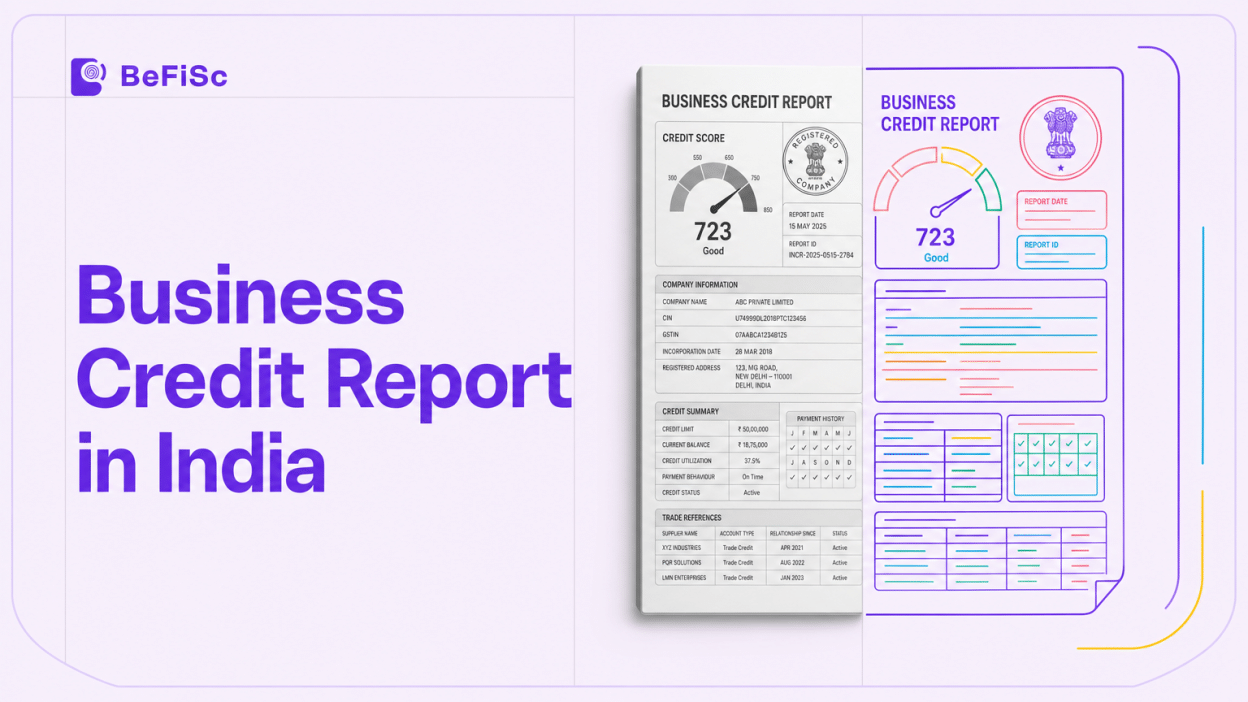
A business credit report in India is a commercial report issued by a credit information company (TransUnion CIBIL, Experian, Equifax, or CRIF High Mark) that summarises a business’s loans, repayment behaviour, defaults, and enquiries, often with a risk rank. It covers businesses with formal borrowing history, so new-to-credit firms need other data.
Every MSME loan decision in India starts with a bureau pull. For a company with a decade of borrowing, the commercial report says most of what a lender needs about repayment.
For a two-year-old proprietorship billing Rs 3 crore through GST with no prior loan, the same pull returns little or nothing. That is not a bureau failure. It reflects what bureaus are designed to record.
This guide explains what a business credit report contains, how to read it, where it falls short, and how a business risk report built from GST, MCA, Udyam, and footprint data fills the gaps.
What a business credit report is
A business credit report is a record of an entity’s credit relationships with regulated lenders, compiled by a credit information company licensed by RBI under the Credit Information Companies (Regulation) Act, 2005.
India has four CICs: TransUnion CIBIL, Experian, Equifax and CRIF High Mark. Each maintains consumer and commercial databases. Banks, NBFCs and other credit institutions submit borrower data to them, and since 1 January 2025, RBI has required that this data be updated at least fortnightly (on the 15th and the last day of each month), under its circular of 8 August 2024.
Commercial reports cover companies, LLPs, partnerships and, in some cases, proprietorships where borrowing is reported under the business. Proprietors are often assessed through their individual consumer report as well.
What a commercial credit report contains
While layouts differ by bureau, most commercial reports include:
- Entity details: name, constitution, PAN, CIN or registration, addresses.
- Credit facilities: lender, facility type, sanctioned amount, outstanding, overdue, asset classification.
- Repayment history: days past due by month.
- Derogatory information: suit-filed accounts, wilful default tags, written-off or settled accounts.
- Enquiries: recent credit enquiries by lenders.
- Related parties: directors, partners or guarantors, where reported.
- Risk rank or score: for example, TransUnion CIBIL’s CIBIL MSME Rank (CMR).
About the CIBIL MSME Rank
According to TransUnion CIBIL’s April 2020 announcement, CMR ranks MSMEs from CMR-1 (lowest risk) to CMR-10 (highest), estimating the probability of an entity becoming NPA in the next 12 months. It covers entities with aggregate commercial exposure up to Rs 50 crore and uses 24 months of bureau history. Other bureaus offer their own commercial scores with different scales.
How to read a business credit report
A disciplined reading follows a sequence:
- Confirm identity: match PAN, legal name and address with KYB documents.
- Review total exposure across lenders, compared with declared turnover.
- Scan DPD history for the last 12 to 24 months, noting recency and frequency.
- Check for suit-filed, written-off, settled, or restructured facilities.
- Look at enquiry velocity: many enquiries in a short span may indicate credit hunger.
- Read the director and guarantor section and pull individual reports where needed.
- Note the risk rank, but treat it as one input, not the decision.
What a business credit report misses
A bureau report records credit. It does not record business activity. That creates predictable blind spots.
New-to-credit and thin-file businesses
A business with no formal loan has no commercial file. CMR requires 24 months of credit history. This matters at scale: the government reported in May 2026 that over 7.9 crore enterprises had registered through Udyam and Udyam Assist, a population far larger than the set of MSMEs with commercial bureau histories. A May 2025 SIDBI survey reported by Business Standard found that 17% of surveyed MSMEs had not availed any credit.
Proprietorships
A proprietorship has no separate legal identity. Its business loans may be reported against the proprietor, or as unsecured personal credit, so the commercial file can be thin even when the owner has an active consumer file.
Operating reality
Bureau data says nothing about:
- Whether GST returns are filed regularly and turnover is growing or shrinking.
- Whether the company is active on MCA, with filings up to date, or has charges registered by non-reporting creditors.
- Whether the business has a real operating presence, website, domain age, or verified contact points.
- Whether the declared Udyam category matches the scale claimed.
Lag and coverage
Fortnightly reporting has reduced lag, but the report still reflects what lenders have reported. Trade credit, supplier dues, and informal borrowing do not appear.
Business credit report vs business risk report
A business risk report assembles public and registry data to describe whether a business exists, operates, and complies, independent of whether it has borrowed before.
| Dimension | Business credit report (bureau) | Business risk report (registry and footprint data) |
|---|---|---|
| Core question | How has this entity repaid credit? | Is this a real, active, compliant business? |
| Data sources | Lender submissions to CICs | GST, MCA, Udyam, digital footprint |
| Coverage | Entities with formal credit history | Any business with registrations |
| New-to-credit firms | Little or no data | Full registration and filing picture |
| Turnover signals | Indirect, via exposure | GST filing history and declared category |
| Governance | Directors or guarantors if reported | Directors, charges, company status from MCA |
| Fraud signals | Defaults, settlements, enquiries | Cancelled GSTINs, name mismatches, new registrations, weak footprint |
| Regulatory basis | CIC Act 2005, consent-based pull | Public registry data and consented checks |
| Best use | Repayment risk | Existence, legitimacy and operating risk |
The two answer different questions. Lenders get the clearest view when they read both.
Verifying businesses at scale for your lending or onboarding workflow
For lenders, NBFCs, payment aggregators and B2B marketplaces, a practical stack looks like this:
- Pull the commercial bureau report for repayment history where it exists.
- Verify GSTIN status, filing frequency, and legal name.
- Check company or LLP status, directors, and charges.
- Confirm Udyam registration and category.
- Assess online presence.
- Reconcile all of the above with bank statement turnover.
Where the bureau file is empty, steps 2 to 6 become the primary evidence. Where it is rich, they act as fraud and consistency checks.
Use cases
These scenarios are illustrative.
New-to-credit manufacturer
A small manufacturer applying for its first working capital loan has no commercial file. GST shows 30 months of regular filing and steady turnover, MCA shows an active private limited company with no charges, and the Udyam category is consistent with declared sales. The lender proceeds with a smaller initial limit.
Clean bureau, weak operations
A trading entity has a clean commercial report with one closed loan. Its GSTIN, however, was cancelled six months ago and its website domain was registered last month. The bureau report alone would have missed the problem.
Where BeFiSc fits
Where BeFiSc fits: BizCheck produces a business risk report in about 60 seconds using GST, MCA, Udyam, and digital footprint data. It complements the bureau report by showing whether a business exists, operates, and files, including for new-to-credit firms. Request a free BizCheck report on a business you are evaluating.
Key Takeaways
- A business credit report from a CIC shows repayment history, exposure, defaults, and enquiries for entities with formal credit.
- RBI has required fortnightly credit data updates to CICs since 1 January 2025.
- CMR ranks MSMEs from 1 to 10 for exposures up to Rs 50 crore, using 24 months of history.
- New-to-credit firms and proprietorships often have thin or no commercial files.
- A business risk report built from GST, MCA, Udyam, and footprint data answers whether the business is real and active.
- Reading both together gives a more complete MSME credit assessment than either alone.
Frequently Asked Questions
Is a business risk report a substitute for a credit bureau report?
No. A business risk report does not show repayment history. It complements the bureau report by verifying the business’s legitimacy and operating activity.
Can lenders assess a business without a bureau history?
Yes. Lenders use GST filings, MCA records, Udyam registration, bank statements, and digital footprint to assess existence, activity, and turnover when bureau data is thin.
Why does my business have no credit report?
If the business has never borrowed from a reporting lender, there is no commercial history to report. Proprietorships may also have credit recorded against the owner personally.
What is a CMR score?
CMR, or CIBIL MSME Rank, is TransUnion CIBIL’s rank for MSMEs from 1 (lowest risk) to 10 (highest risk), estimating the probability of becoming NPA within 12 months for entities with commercial exposure up to Rs 50 crore.
What is a business credit report in India?
It is a commercial report from a credit information company such as TransUnion CIBIL, Experian, Equifax or CRIF High Mark, showing a business’s credit facilities, repayment history, defaults, enquiries and often a risk rank.
Conclusion
The business credit report remains the best single source on how an entity has repaid formal credit. Its limits come from its design: it records lending relationships, so it says little about businesses that have not borrowed and nothing about whether a business is actually operating.
As MSME credit reaches deeper into new-to-credit segments, lenders need a second view built on registry and footprint data. Teams that pair bureau pulls with structured business risk checks make faster decisions on thin files and catch problems that a clean bureau record would hide.