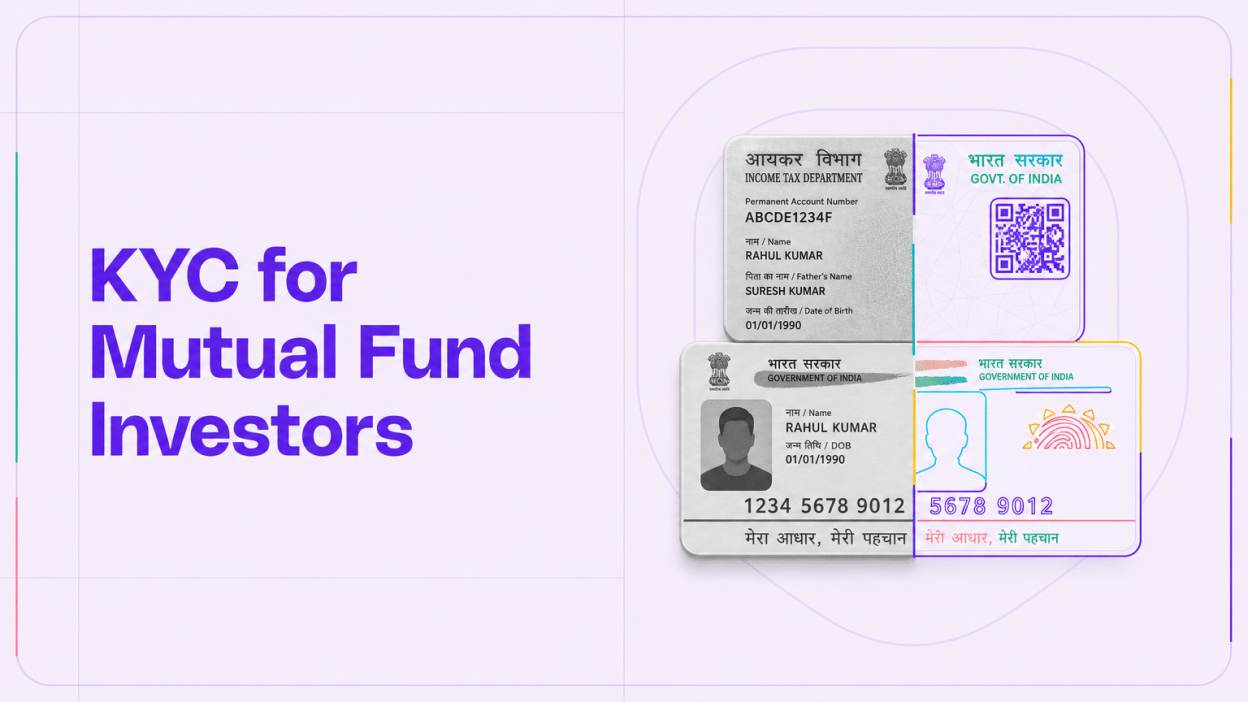
KYC for mutual fund investing is done once and recorded with a KYC Registration Agency (KRA). Investors need PAN, an Aadhaar-based or document-based KYC and verified contact details. For platforms, the decision is where to catch failures: verify PAN, Aadhaar, selfie, names and bank account before the record reaches the KRA.
Mutual fund folios reached about 27.86 crore in June 2026, up from 26.13 crore in December 2025, according to AMFI data reported by Cafemutual. Every new folio starts with KYC for mutual fund investment, and every failed check is an investor who did not start an SIP.
For MFDs, RIAs, wealthtech apps and brokers, the hard part is no longer the form. It is the gap between what the investor enters and what official databases say: names that differ between PAN and bank, PANs not linked to Aadhaar, contact details that cannot be validated. This guide gives investors the short answer, then sets out the SEBI framework, where onboarding fails, and how platforms automate the checks.
The investor’s quick answer
To complete KYC for mutual fund investment, you need:
- A PAN, linked with Aadhaar unless you fall in an exempt category.
- Identity and address proof, usually through Aadhaar-based e-KYC or DigiLocker
- other officially valid documents are accepted.
- A mobile number and email that can be validated by OTP.
- A selfie or in-person verification, depending on the route.
- A bank account in your own name for redemptions.
You do KYC once. The record sits with a KRA and any SEBI-registered intermediary can rely on it.
How SEBI’s KYC framework works
SEBI’s Master Circular on KYC norms for the securities market (12 October 2023) sets the base: intermediaries collect KYC, upload it to a KRA, and other intermediaries can rely on that record instead of repeating the process.
The 14 May 2024 circular (SEBI/HO/MIRSD/SECFATF/P/CIR/2024/41) narrowed and sharpened KRA validation:
- KRAs verify three attributes (PAN, name and address) within two days of receiving the record.
- A record is a Validated Record only if those attributes are verified against official databases, such as the Income Tax Department’s PAN database, Aadhaar XML, DigiLocker or mAadhaar.
- PAN-Aadhaar linkage must also be verified under Rule 114AAA of the Income-tax Rules.
- Systems were to change by 31 May 2024.
KYC also feeds CKYC, the central registry run by CERSAI
KRA KYC statuses and what they mean
As explained in KRA and fund-house communication from 2024 (for example FundsIndia and Business Today), the main statuses are:
| Status | What it indicates | Practical effect |
|---|---|---|
| KYC Validated | PAN, name and address verified against official sources; PAN-Aadhaar linked or exempt; email and mobile validated | Portable: invest with any fund house or intermediary |
| KYC Registered | Identity checks passed but source validation of the address document not done, or PAN not linked, or only one contact validated | Continue with existing fund houses; validate before a new one |
| On Hold | Neither email nor mobile validated, or other deficiency | Transactions blocked until fixed |
| Rejected | Record failed checks | Fresh KYC needed |
The move from Registered to Validated usually means redoing KYC with Aadhaar or DigiLocker and validating contact details. For platforms, a Registered investor who wants to invest in a new AMC is a conversion problem, not only a compliance one.
The rules are still moving. SEBI’s circular of 4 November 2026 on clients resident outside India says KRAs tag individual attributes as validated against source databases and that KYC records are portable regardless of whether all attributes are validated. That applies to PROI clients from 3 December 2026; check KRA guidance on how statuses apply to your investor base.
Aadhaar e-KYC, CKYC and in-person verification
Three routes carry most onboarding volume:
- Aadhaar-based e-KYC: run through UIDAI-authorised entities, with intermediaries using sub-KUA arrangements where permitted. It returns name, address and photo from source.
- DigiLocker: issuer-signed documents, including Aadhaar, fetched with consent. The signature makes them verifiable without a physical original.
- Document upload with in-person verification: OVD images plus IPV, which SEBI has allowed through video since April 2020.
Each route needs a photo or live capture tied to the person. That is where face match and liveness sit in a digital journey.
Minors and NRIs: brief notes
- Minors: investments are made through a guardian, whose KYC is required; on the minor turning 18, the investor completes their own KYC before transacting further. Confirm documentation with your RTA.
- NRIs, OCI holders and foreign nationals: from 3 December 2026, SEBI permits digital onboarding of PROI clients in FATF-compliant countries, with passport-based KYC, an overseas address, and video IPV safeguards including liveness, geo-tagging and VPN blocking. Clients in non-compliant countries stay under the existing process.
Where mutual fund onboarding fails
Most failures in KYC for mutual fund journeys are data mismatches between sources, not missing documents.
- Name mismatch between PAN and bank: “Priya S” on the bank account, “Priya Sharma” on PAN, “Sharma Priya” in Aadhaar. Redemption to an account not in the investor’s name is not permitted, so the mismatch blocks payouts later. Our guide explains scored matching.
- PAN not linked with Aadhaar: the record cannot reach Validated. Point investors to the check.
- Bank account validation: an incorrect IFSC, a closed account or a joint account where the investor is second holder. Verify the account and the holder name before the first SIP debit.
- Selfie and IPV failures: poor lighting, old Aadhaar photos, or someone else completing the journey on the investor’s phone.
- Contact details: a family member’s mobile or an email that bounces leaves the record On Hold or Registered.
What onboarding failures cost a platform
When KYC for mutual fund onboarding fails, the cost is drop-off and rework, and it compounds with scale.
- Acquisition spend wasted: an investor acquired through marketing who stalls at KYC costs the full acquisition price for nothing.
- Rework: a record rejected by the KRA, or stuck at Registered, sends the investor back through the journey, often days later.
- Failed redemptions and SIP debits: bank or name issues found after the first transaction create service tickets and complaints.
- Compliance exposure: intermediaries rely on KRA records but remain responsible for their own KYC; SEBI’s 4 November 2026 circular restates that the intermediary remains ultimately responsible when relying on another’s KYC.
Illustrative: a wealthtech app starts 40,000 KYC journeys a month. If 12% fail or stall on name and bank issues, and half are recovered after manual follow-up, 2,400 investors a month are lost and another 2,400 cost a support interaction each.
Pre-KRA verification checklist
Use this to evaluate your KYC for mutual fund journey, or a vendor, before records go to the KRA.
| Check | Why it matters | What to ask the vendor or team |
|---|---|---|
| PAN at source | Wrong or inoperative PAN blocks validation | Returns status and name from source? Flags inoperative? |
| Aadhaar via DigiLocker or offline XML | Source-verified name, address and photo | Signature verified? Number masked in storage? |
| Face match | Ties the live investor to the ID photo | Reference photo source and threshold? |
| Liveness | Stops someone else completing the journey | Passive or active? Retry handling? |
| Name match | PAN, Aadhaar and bank names differ in format | Scored with transliteration and initials? |
| Bank account verification | Redemptions go only to the investor’s account | Holder name returned and matched? |
| Contact validation | Needed for Validated status | OTP on both mobile and email? |
| Audit trail | Intermediary remains responsible | Timestamped results exportable per investor? |
Manual vs automated onboarding
| Factor (Illustrative) | Manual review | Automated pre-KRA checks |
|---|---|---|
| Name mismatch handling | Found by RTA or KRA days later | Caught in-session with a prompt |
| Bank validation | Cancelled cheque upload | Verified account with holder name |
| Selfie or IPV | Reviewed by staff | Face match and liveness scored instantly |
| Time to first SIP | Days | Same session, subject to KRA processing |
| Evidence | Scattered uploads | Result per check with timestamps |
An automated onboarding flow
- Investor enters PAN; verify at source and flag inoperative status early.
- Fetch Aadhaar through DigiLocker or offline XML; verify the signature and extract the photo.
- Capture a selfie with liveness; match it to the Aadhaar photo.
- Score names across PAN, Aadhaar and the declared name; prompt the investor on low scores.
- Verify the bank account and match the holder name to PAN.
- Validate mobile and email by OTP.
- Submit the record through your KRA route, attaching the verification evidence.
- Monitor KRA status and trigger re-KYC prompts for Registered or On Hold investors.
What to bring to the demo: your current funnel drop-off by step, top KRA rejection reasons, and a few anonymised failed cases.
Where BeFiSc fits: IDProof runs the pre-KRA checks in one API: PAN verification, Aadhaar via DigiLocker, face match, liveness, name match and bank account verification. It does not look up or upload KRA records; your KRA route stays as it is, with cleaner data reaching it. Book a demo to see the flow on your journey.
Key Takeaways
- KYC for mutual fund investing is done once and held by a KRA; Validated status needs PAN, name and address verified at source, PAN-Aadhaar linkage and validated contacts.
- SEBI’s 14 May 2024 circular set the validation attributes; its 4 November 2026 circular eased digital onboarding for clients resident outside India from 3 December 2026.
- Most onboarding failures are mismatches: names across PAN and bank, unlinked PANs, bank account errors, selfie failures and unvalidated contacts.
- Catching these before the KRA cuts drop-off, rework and failed redemptions.
- Intermediaries stay responsible for KYC they rely on, so keep per-check evidence.
Frequently Asked Questions
Does automated verification satisfy SEBI’s IPV requirement?
Face match and liveness support digital identity checks, but IPV and VIPV have specific SEBI requirements. Map your route to the current master circular with compliance.
Is it safe to share investor data with a verification provider?
Under the DPDP Act, the platform is the data fiduciary and the provider its processor. Use a data processing agreement, mask Aadhaar numbers and limit retention.
How hard is it to add pre-KRA checks to an existing app?
The checks are API calls placed before submission to the KRA, so the KRA route does not change. Most effort goes into in-session prompts for mismatches.
What does KYC Registered mean, and can I still invest?
It means some checks passed but the record is not fully validated, often because PAN is not linked with Aadhaar or address was not source-verified. You can usually continue with existing fund houses; a new fund house needs validation first.
What documents are needed for KYC for mutual fund investment?
PAN, identity and address proof (usually Aadhaar e-KYC or DigiLocker), a validated mobile and email, a selfie or in-person verification, and a bank account in your name for redemptions.
Conclusion
KYC for mutual fund onboarding has moved from paperwork to data quality. SEBI’s validation rules mean the KRA will test PAN, name and address against source; platforms that send inconsistent data get Registered or On Hold records and lose investors in the gap.
The fix is to run the same tests first, inside your own journey, while the investor is still there to correct a name or link a PAN. That turns KYC from a back-office queue into a conversion lever, with evidence to show you did your part.
Book a 30-minute IDProof demo and test it on your onboarding funnel