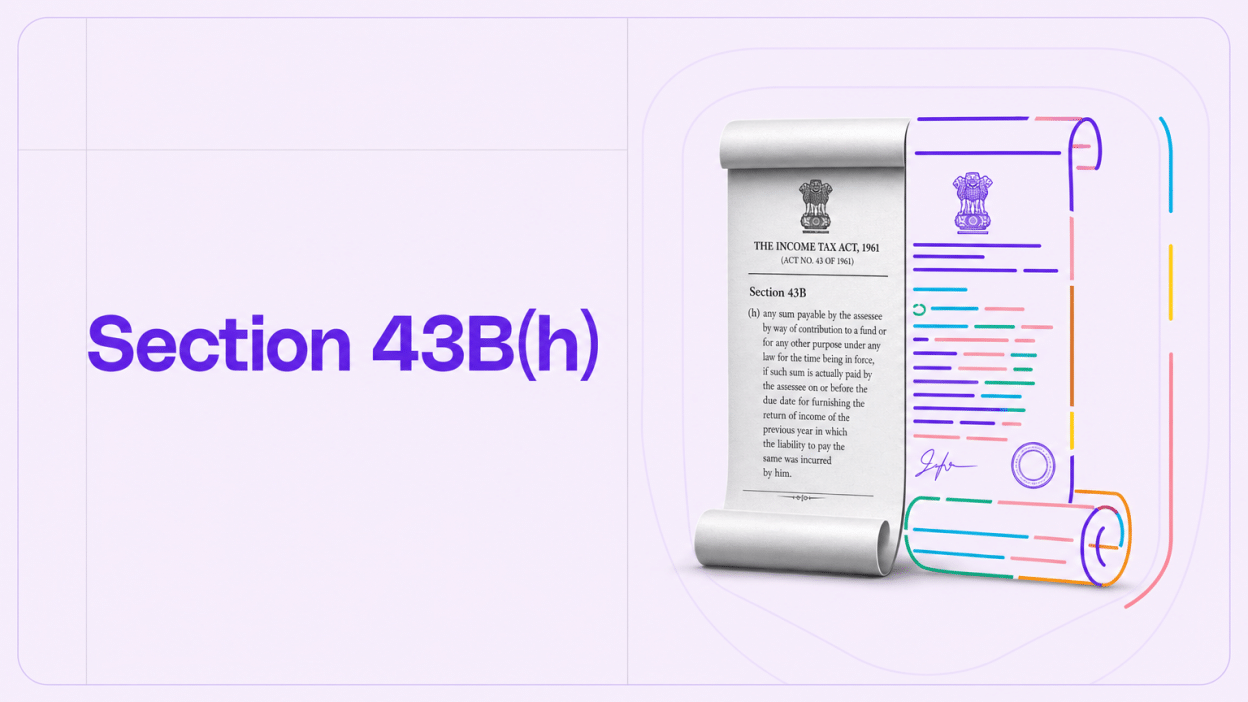
Section 43B(h) of the Income-tax Act, 1961 allows a buyer to deduct amounts owed to a micro or small enterprise only when paid, if payment is made after the time limit in Section 15 of the MSMED Act: 15 days without a written agreement, or up to 45 days with one. It applies from AY 2024-25.
For most finance teams, the hard part of 43B(h) is not the rule. It is knowing, for every vendor on the payables ledger, whether that vendor is a registered micro or small enterprise, and whether it is a manufacturer or service provider rather than a trader.
Get that classification wrong, and a year-end creditor balance can turn into a disallowance. This guide covers what the provision says, which suppliers qualify, what changed under the Income-tax Act, 2025, and how to verify vendor status systematically.
What Section 43B(h) says
Section 43B(h) is a clause, inserted by the Finance Act, 2023, that makes deduction of sums payable to micro and small enterprises conditional on actual payment when the payment is made beyond the MSMED Act time limit.
Clause (h) added MSME dues to the list of expenses deductible only on payment, with effect from 1 April 2024, so it applies from assessment year 2024-25 (financial year 2023-24).
In a written reply to the Rajya Sabha on 21 July 2026, the Ministry of Finance stated that such sums “shall be allowed as deduction only on actual payment basis and not when liability to pay such expense has incurred”, and that the policy aim is to improve the cash flow and working capital of micro and small enterprises.
MSMED Act section 15: the 15-day and 45-day timelines
Section 15 of the Micro, Small and Medium Enterprises Development Act, 2006 fixes when a buyer must pay a supplier:
- No written agreement: payment is due within 15 days of acceptance (or deemed acceptance) of the goods or services.
- Written agreement: payment is due on the agreed date, which cannot exceed 45 days from acceptance.
If the buyer pays late, section 16 of the MSMED Act requires compound interest at three times the bank rate notified by RBI, and section 23 provides that this interest is not deductible for income-tax purposes.
The MSMED Act sets the deadline and interest; the Income-tax Act decides when the expense is deductible.
Which suppliers qualify under 43B(h)
The provision covers sums payable to micro and small enterprises as defined under the MSMED Act. Three filters decide whether a particular vendor is in scope.
1. Enterprise category
Only micro and small enterprises are covered. Medium enterprises are outside 43B(h). From 1 April 2025, the revised classification thresholds reported by the government are:
| Category | Investment in plant, machinery or equipment | Turnover |
|---|---|---|
| Micro | Up to Rs 2.5 crore | Up to Rs 10 crore |
| Small | Up to Rs 25 crore | Up to Rs 100 crore |
| Medium | Up to Rs 125 crore | Up to Rs 500 crore |
A vendor’s category can change year to year as its turnover changes, so a one-time classification on the vendor master goes stale.
2. Registration
The MSMED Act’s payment protections are generally understood to attach to a “supplier” that has registered (now through Udyam). Common practice, reflected in professional commentary, is to treat Udyam registration of the supplier as the practical test. The buyer does not need to be registered.
3. Activity: manufacturing or services, not trading
In July 2021, the Ministry of MSME allowed retail and wholesale traders to register on Udyam, but only for priority sector lending benefits. Professional commentary generally reads this to mean that dues to pure traders are outside the delayed payment provisions and therefore outside 43B(h). Because this rests on interpretation, finance teams should confirm their position with their tax advisers.
Other interpretive points
- Timing of status: practice varies on whether status is tested at the date of purchase or later. Record the vendor’s Udyam details as on the transaction date.
- Unpaid at year-end: the disallowance bites when the amount remains unpaid beyond the permitted period; payment in the following year makes it deductible in that year.
Section 43B(h) under the Income-tax Act, 2025
The Income-tax Act, 2025 replaces the 1961 Act from 1 April 2026. In its 21 July 2026 Rajya Sabha reply, the Ministry of Finance stated that section 43B(h) corresponds to section 37(2)(g) of the Income-tax Act, 2025.
The reply describes the same rule: deduction on an actual payment basis where payment to a micro or small enterprise is beyond the MSMED Act time limit. We have not seen any official statement of a substantive change in scope. Until a line-by-line comparison is available from your tax adviser, treat the new section as a renumbering and continue the same controls.
Practical implications:
- Update internal checklists, tax audit working papers and ERP labels that reference “43B(h)”.
- Retain vendor classification evidence under both references for transition years.
How 43B(h) affects your tax computation
Consider an illustrative example. A manufacturer buys components worth Rs 12 lakh from a Udyam-registered small enterprise on 1 March under a 45-day written agreement. The due date falls in mid-April, in the next financial year.
- If the buyer pays within 45 days of acceptance, even after 31 March, the expense is deductible in the year of purchase.
- If the buyer pays on, say, 20 May, beyond the agreed period, the Rs 12 lakh is deductible only in the year of payment.
- Interest payable under section 16 of the MSMED Act is not deductible at all.
Tax auditors report MSME dues in Form 3CD, so weak vendor classification becomes visible at audit time.
Verifying vendor status at scale for your business
For a company with a few dozen vendors, a manual check on the Udyam portal is workable. For a buyer with thousands of suppliers, it is not. A repeatable process looks like this:
- Extract the vendor master with PAN, GSTIN, and any Udyam number on file.
- Verify each Udyam number to confirm it is valid and belongs to the vendor’s PAN.
- Record the enterprise category (micro, small, medium) and major activity (manufacturing, services, trading).
- Check the GSTIN status and legal name for consistency.
- Flag vendors with no Udyam registration but small turnover for a declaration request.
- Tag in-scope vendors in the ERP with payment terms of 15 or 45 days and set ageing alerts.
- Re-verify the full list at least annually, and before year-end close.
For developers integrating this into procurement or AP systems, our guide explains the data fields involved.
Use cases: how finance teams apply this
These scenarios are illustrative.
Mid-size FMCG company
The AP team found that 18% of vendors had a Udyam number captured at onboarding years earlier, but several had since moved from micro to small or medium. Re-verification removed medium vendors from the 45-day tracker and added newly registered small suppliers.
Distributor buying from traders
A distributor’s top suppliers were wholesale traders registered on Udyam. After tax advice, the company treated these as outside 43B(h) but documented the trading activity shown in each registration as evidence.
Where BeFiSc fits
Where BeFiSc fits: BizCheck produces a business risk report in about 60 seconds, drawing on GST, MCA, Udyam and digital footprint data, so procurement and finance teams can confirm a vendor’s registration and profile before payment terms are set. Send us your vendor list for a free BizCheck report.
Vendor verification also supports wider goals: catching inactive GSTINs, mismatched names, and shell suppliers.
Key Takeaways
- Section 43B(h) allows deduction of dues to micro and small enterprises only on payment if paid beyond 15 days (no agreement) or the agreed period, up to 45 days.
- It applies from AY 2024-25; under the Income-tax Act, 2025, the Ministry of Finance has mapped it to section 37(2)(g).
- Medium enterprises are outside the provision, and pure traders are generally treated as outside it.
- Vendor categories change with turnover, so classification must be re-verified, not captured once.
- A structured Udyam and GST check across the vendor master is the most reliable control.
Frequently Asked Questions
How do I check if a vendor is a micro or small enterprise?
Verify the vendor’s Udyam registration number against its PAN and review the enterprise type and major activity. For large vendor lists, an API or bulk report is more practical than manual portal lookups.
What is the equivalent of 43B(h) in the Income-tax Act, 2025?
According to a Ministry of Finance reply in the Rajya Sabha on 21 July 2026, section 43B(h) corresponds to section 37(2)(g) of the Income-tax Act, 2025.
Does 43B(h) apply to purchases from traders?
Retail and wholesale traders can register on Udyam, but the Ministry of MSME allowed this for priority sector lending purposes. Most professional commentary treats dues to pure traders as outside 43B(h). Confirm your position with a tax adviser.
What is the 45-day rule under Section 43B(h)?
If a buyer has a written agreement with a micro or small supplier, payment must be made within the agreed period, not exceeding 45 days from acceptance. If paid later, the expense is deductible only in the year of actual payment. Without an agreement, the limit is 15 days.
Conclusion
Section 43B(h) turned MSME payment discipline into a tax computation issue, and the Income-tax Act, 2025 carries it forward under section 37(2)(g). The provision is simple to state, but compliance depends on vendor data most companies have never maintained carefully: current Udyam category, activity type, and registration validity.
Finance teams that verify the vendor master annually, tag in-scope suppliers, and monitor ageing against 15– and 45 day limits will avoid surprises at tax audit, and will pay their smallest suppl15–rs on time, which is the purpose of the rule.