Every driver a platform onboards is a standing bet: that the person behind the wheel is licensed, that the licence is valid today, and that it covers the vehicle they will drive. However, when the bet fails through an expired licence, a two-wheeler licence behind a commercial van, or a forged card, the downside can quickly escalate. Consequently, the consequences can include accidents, insurance repudiation, regulatory exposure, and damaging headlines. Ultimately, what begins as a verification failure can become a much larger operational and reputational risk.
Automated Identity Verification. A driving licence verification API can: it validates the licence against the national Sarathi database in real time, returning the holder’s details, validity dates, and authorised vehicle classes. This guide covers what the API verifies, the onboarding architectures it powers, the fraud it defeats, and the compliance context around driver data.
What Is a Driving Licence Verification API?
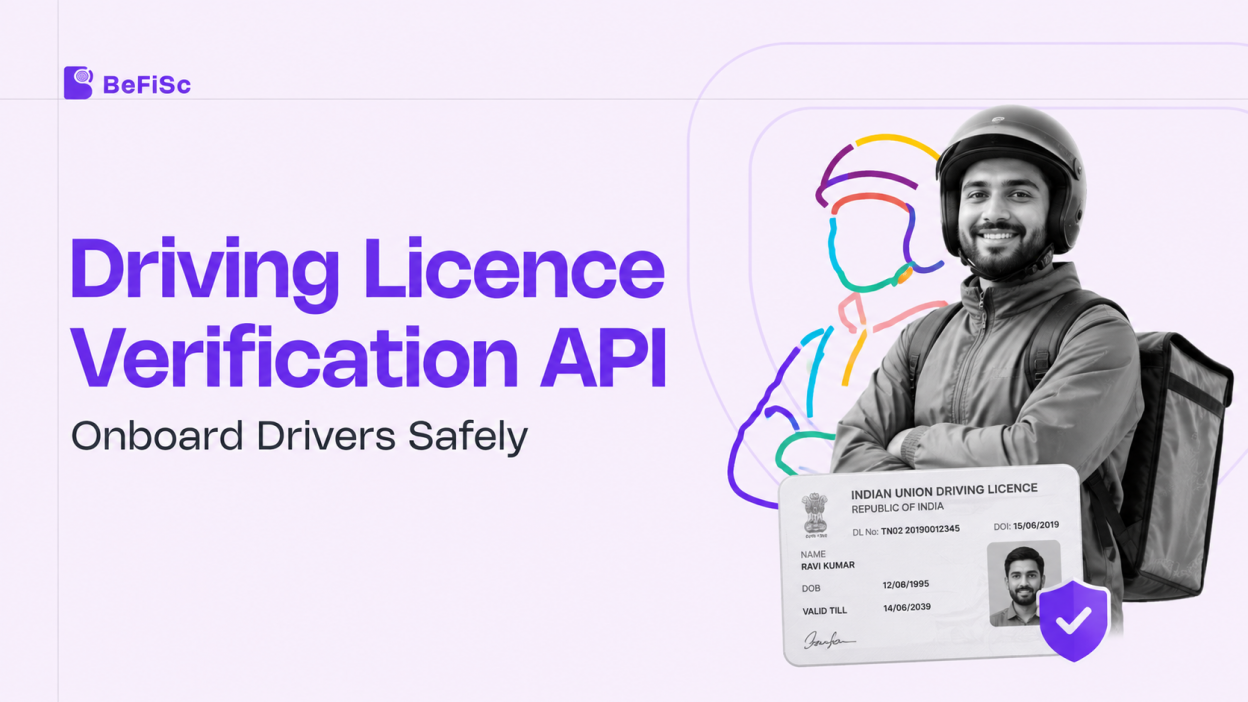
A driving licence verification API validates a DL against government transport records in the Sarathi system under the Ministry of Road Transport and Highways, which consolidates licence data issued by RTOs across states. Given a DL number and typically the holder’s date of birth, the API returns the official record: holder name, licence status, issue and expiry dates, issuing RTO, and the classes of vehicle the holder may drive.
The document-versus-source distinction does the heavy lifting, as it does across this entire category. A laminated card or a photo of one proves nothing durable; the Sarathi record is the current legal fact. Moreover, the licence functions as an officially valid document (OVD) in KYC contexts. Therefore, the API serves a dual purpose: it verifies driving eligibility and provides identity input in the same call.
For platforms, the API converts a days-long manual verification queue into a sub-minute automated gate with an audit trail that manual eyeballing never produced.
What Gets Verified: Fields and What They Decide
Each response field maps to a concrete decision.
Holder name and date of birth. Matched against the applicant’s identity using fuzzy logic to confirm the licence belongs to the person onboarding, not a borrowed credential.
Licence status and validity dates. The licence status can be active, expired, suspended, or revoked. Additionally, expiry dates feed directly into both the onboarding gate and the re-verification calendar discussed below. As a result, businesses can track eligibility continuously rather than relying on a one-time check.
Class of vehicle (COV). The decisive field for platform risk. A licence valid for motorcycles (MCWG) does not authorise a light motor vehicle; transport-category authorisation matters for commercial operations. Policy must match the COV to the actual vehicle the worker will operate, which is why DL verification pairs naturally with in-fleet flows.
Issuing RTOs and issue dates. Useful for tenure signals (a freshly issued licence for a “ten-year experienced” driver invites questions) and for routing edge-case manual reviews.
The Onboarding Architecture: OCR, Source Check, Face Bind
Production driver onboarding runs a three-layer pipeline.
Layer one: capture and extraction. The applicant photographs their DL; an [OCR extraction service] reads the number, name, and dates. However, OCR is only an input mechanism here, not the verification itself. Instead, it helps applicants avoid mistyping their licence number, while the actual verification is performed by the underlying licence data.
Layer two: source verification. The driving licence verification API validates the extracted number against Sarathi, returning the authoritative record. Extracted-versus-returned discrepancies (name variants, date conflicts) route through scored matching to pass, review, or fail.
Layer three: person binding. Source verification proves the licence is real and current; it does not prove the applicant is the holder. A live selfie with [liveness detection, face-matching] against the identity anchor closes the loop- the same binding logic that runs through every credential-based verification we cover.
The pipeline’s output is a composite decision plus an evidence bundle: images, extracted data, API responses, match scores, timestamps. That bundle is what an insurer, a court, or a regulator will one day ask for.
Use Cases Beyond Ride-Hailing
For example, ride-hailing and delivery platforms represent the high-volume use case. In these environments, the licence serves as both a KYC document and an operating credential. As a result, COV mismatches can directly increase insurance, compliance, and safety exposure.
Logistics and trucking verify transport-category licences at driver intake and pair them with vehicle and permit checks; a fleet is only as compliant as its least-verified driver-vehicle pair.
Background verification programmes include DL checks for any role involving driving, field sales, service technicians, and corporate drivers inside the broader stack our [background verification API guide] describes.
Vehicle rental and car-sharing platforms verify licences at booking, where an invalid licence voids insurance and the platform absorbs the accident.
Moreover, insurers use DL verification during motor-policy issuance and claims processing. For example, if a driver is unlicensed or incorrectly licensed at the time of a loss, the claim may face repudiation. Therefore, verifying the licence early helps prevent both mispriced risk and difficult claim disputes.
Lenders verify licences as supporting KYC and, for commercial-vehicle loans, as evidence the borrower can lawfully operate the income-producing asset being financed.
Fraud Patterns in Driver Onboarding
Four patterns dominate, and the API-plus-binding architecture addresses each.
Forged licences. Fake DL cards are cheap and visually convincing. In contrast, source verification makes visual quality largely irrelevant. Instead, the licence number either resolves to a valid record or it does not. Furthermore, the record’s contents must match the submitted details; otherwise, the verification fails.
Borrowed credentials. A valid licence belonging to someone else: a relative, a friend, a rented identity. Name matching narrows it; face binding against a live selfie closes it. Platforms that skip the selfie layer are verifying documents, not drivers.
Account sharing post-onboarding. The verified driver onboards; someone else drives. Therefore, this is an operations problem more than an onboarding one. Instead, periodic in-app face rechecks before each shift provide the countermeasure, while also reusing the same face-match infrastructure.
Suspension concealment. Initially, a licence may be valid at onboarding. However, it can later be suspended, often because of the very conduct that platforms are designed to monitor. Therefore, ongoing licence verification becomes essential.
The pattern family will be familiar from our [mule and identity-fraud work]: credentials are real more often than fake; the fraud lives in who is using them.
Ongoing Validity: Verification Is Not a One-Time Event
Licences expire, and drivers get suspended, on their own schedules, not on your onboarding date. A driver base verified once decays silently.
Three practices keep it current. In addition, expiry-driven re-verification uses the API response’s expiry date to trigger scheduled checks. As the date approaches, the system re-checks the licence and, where necessary, off-boards the driver before validity lapses. Meanwhile, advance notifications give drivers time to renew and avoid disruption. Periodic status sweeps: batch re-verification of the active driver base at a policy-defined cadence, catching suspensions and revocations between expiry events. Event-triggered checks: incidents, complaints, and insurance claims each warrant a fresh pull, because the record at the moment of the event is what liability turns on.
Driver data across all of these licence numbers, names, and face images is personal data under the DPDP Act: collected for verification purposes, retained under policy, access-controlled, and deletable. Platforms holding years of stale driver documents “just in case” are accumulating liability, not safety.
Key Takeaways
- A driving licence verification API validates DL authenticity, status, validity, and vehicle-class authorisation against the Sarathi registry in real time.
- Class of vehicle is the decisive risk field: policy must match COV to the vehicle actually operated, pairing DL checks with RC verification in fleet flows.
- Source verification alone verifies documents; face binding with liveness verifies drivers. Production onboarding needs both.
- The dominant fraud is borrowed and shared credentials, not forged cards, countered by binding at onboarding and periodic in-app re-checks.
- Validity decays: run expiry-driven re-verification, periodic sweeps, and event-triggered pulls, and handle driver data under DPDP discipline.
Frequently Asked Questions
What is a driving licence verification API?
A driving licence verification API validates a DL number against government transport records (Sarathi), returning the holder’s name, licence status, issue and expiry dates, issuing RTO, and authorised vehicle classes in real time.
How often should platforms re-run a driving licence verification API check?
At minimum, on every licence’s expiry date, plus periodic status sweeps of the active driver base and event-triggered checks after incidents or claims. Licences expire, and suspensions occur continuously, so one-time verification decays.
What is a driving licence verification API?
A driving licence verification API validates a DL number against government transport records (Sarathi), returning the holder’s name, licence status, issue and expiry dates, issuing RTO, and authorised vehicle classes in real time.
Is a driving licence verification API enough to onboard a driver?
No. A driving licence verification API proves the licence; it does not prove the applicant is its holder. Pair it with face match and liveness detection at onboarding, and with periodic re-checks, to bind the credential to the person actually driving.
Can a driving licence verification API detect fake licences?
Yes. Because a driving licence verification API queries the source registry, a forged card fails structurally: either the number resolves to no record, or the record’s details do not match the applicant. No visual document forensics are needed for that question.
Conclusion
Driver verification is where identity infrastructure meets physical-world consequences: the gap between a verified record and an unverified person is measured in accidents and repudiated claims, not just fraud losses.Ultimately, platforms that internalise this approach treat verification as a continuous lifecycle. First, they capture and check the source, then bind the verified record to the user, and finally re-verify it as circumstances change. As a result, verification becomes an ongoing control rather than a one-time onboarding checkbox.
The direction of the ecosystem favours them. Transport registries are digitising deeper, face-binding is becoming routine, and insurers increasingly price platform risk on verification rigour. A driving licence verification API is the entry point; the durable asset is the lifecycle discipline built around it.