
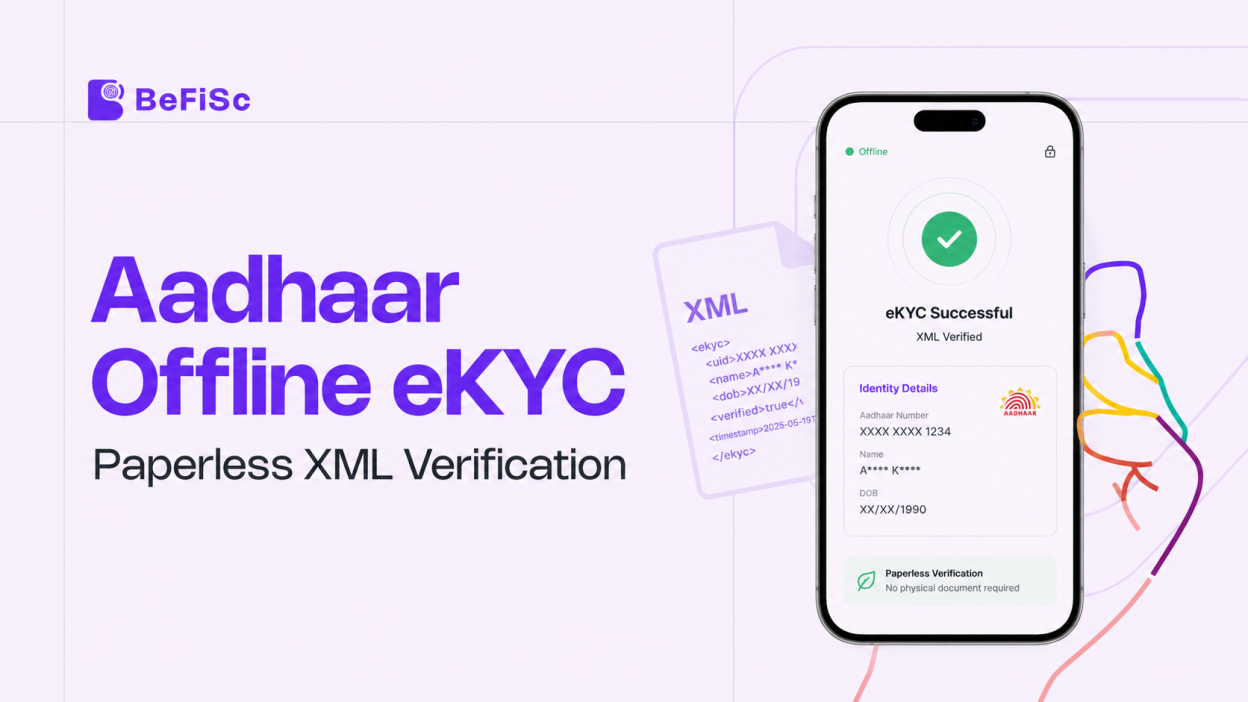
Not every business can or should hit the Aadhaar database. Online Aadhaar authentication is restricted to specific categories of entities, and the Supreme Court’s Puttaswamy judgment sharply limited private-sector access. Yet millions of onboarding journeys still need Aadhaar-grade identity assurance. Aadhaar offline eKYC exists precisely for this gap.
The mechanism is elegant: the customer downloads a digitally signed XML file from UIDAI and shares it, along with a share code, with the verifying business. The business validates UIDAI’s signature and reads the data without any live connection to the Aadhaar database, without the full Aadhaar number, and without UIDAI ever learning where the customer applied. This guide covers how Aadhaar offline eKYC works, why it is privacy-preserving by design, and how to run it in production.
What Is Aadhaar Offline eKYC?
Aadhaar offline eKYC, formally Aadhaar Paperless Offline e-KYC, is a UIDAI mechanism that lets an Aadhaar holder prove identity by sharing a digitally signed data file instead of undergoing live authentication against the Aadhaar database.
The customer generates the file from the UIDAI portal, protecting it with a four-digit share code of their choosing. The file is a ZIP containing XML data signed by UIDAI. Any verifier can validate that signature using UIDAI’s published public certificate. If the signature validates, the data inside is authentic; no API call to UIDAI is required.
Because verification is cryptographic and local, Aadhaar offline eKYC is available to a far wider set of businesses than online authentication, and it works even where connectivity to UIDAI systems is unavailable or impermissible. UIDAI’s QR code on e-Aadhaar and PVC cards operates on the same signed-data principle in a compact form.
Why Offline eKYC Exists: The Legal and Privacy Background
Two forces produced Aadhaar offline eKYC.
The first is legal. After Puttaswamy (2018), private entities lost broad access to online Aadhaar authentication. The Aadhaar Act’s amended framework confines online eKYC largely to banking, telecom, and entities specifically permitted under law. Everyone else needed a lawful alternative that did not query the central database.
The second is privacy architecture. Online authentication creates a record at UIDAI every time it runs, which builds a trail of where a citizen transacted. Offline eKYC breaks that trail. UIDAI signs the data once, when the citizen downloads it. Subsequent sharing happens entirely between the citizen and the verifier. UIDAI cannot see who verified the file, when, or why.
The design also enforces data minimisation. The file carries a reference ID ending in the last four digits of the Aadhaar number, never the full number. The verifier gets identity assurance without acquiring the persistent identifier, which aligns cleanly with the [Aadhaar masking obligations]that govern storage.
What the Aadhaar XML Contains
The signed XML delivers the fields most KYC policies need.
- Reference ID containing the last four digits of the Aadhaar number and a timestamp.
- Name, date of birth, and gender of the holder.
- Full address as recorded with UIDAI.
- Photograph of the holder, embedded in the file.
- Hashed mobile number and hashed email, which the verifier can confirm against customer-provided values by hashing and comparing again without learning the underlying data unless the customer supplies it.
Everything is covered by UIDAI’s digital signature. Alter one byte and validation fails. This is the property that makes the artefact stronger than any photographed document: authenticity is mathematical, not forensic the same shift in trust model we described for [DigiLocker KYC].
The Aadhaar Offline eKYC Workflow, Step by Step
A production Aadhaar offline eKYC journey runs in five stages.
Step 1: File Generation by the Customer
The customer visits the UIDAI resident portal, authenticates with an OTP to their Aadhaar-linked mobile, sets a four-digit share code, and downloads the ZIP. Well-designed onboarding flows guide this in-line with clear instructions, since the step happens on UIDAI’s property, not yours.
Step 2: Upload and Share Code Entry
The customer uploads the ZIP into your flow and enters the share code, which decrypts the archive. The share code travels from the customer to the verifier directly; UIDAI never knows it.
Step 3: Signature Validation
Your backend validates the XML against UIDAI’s public certificate. This is the security core of the process. Skip it, and you are trusting an unverified file. Also check the generation timestamp against your policy’s freshness window.
Step 4: Data Extraction and Cross-Checks
Extract name, DOB, gender, address, and photograph. Run a name match against the application, verify mobile/email hashes if collected, and perform a face match between the embedded photograph and a live selfie with liveness detection; the binding layer is covered in our [liveness detection and face match guide].
Step 5: Record Creation
Store the verification outcome, the signature validation result, and the artefact per your retention policy with the reference ID, not a full Aadhaar number, as the identifier. The record then feeds your CKYC obligations like any other completed KYC.
Offline eKYC vs Online eKYC vs DigiLocker: Choosing the Right Rail
The three Aadhaar-anchored rails differ on access, freshness, and friction.
Online eKYC (OTP or biometric) returns live data from UIDAI at the moment of verification. It is the freshest source but is legally available only to permitted entities, and every transaction is logged centrally.
Aadhaar offline eKYC is available broadly, is privacy-preserving, and carries UIDAI-signed assurance. Its data is as fresh as the file’s generation date, and its friction point is real: the customer must navigate the UIDAI portal and manage a share code mid-journey.
DigiLocker fetches a masked Aadhaar artefact through a consent flow that many users find smoother, and it extends beyond Aadhaar to 70+ document types. Its dependency is a DigiLocker account.
The pragmatic architecture is a waterfall keyed to your entitlement and your users. Entities permitted to run online eKYC lead with it. Everyone else leads with DigiLocker or offline eKYC and keeps OCR-plus-forgery-detection as the last resort. Whichever rail wins, the downstream face-match and screening layers stay identical.
Integration and Production Considerations
Four issues decide whether Aadhaar offline eKYC performs in the field.
Drop-off at the UIDAI step. Sending users to an external portal costs conversions. Mitigate with in-flow instructions, deep links, and a visible fallback. Measure this segment separately; it is where most abandonment concentrates.
Share code errors. Users forget or mistype the code they set minutes earlier. Allow retries gracefully and explain that the code is user-chosen, not an OTP.
Stale files. A file generated long ago may carry an outdated address. Enforce a freshness window appropriate to your risk policy, and request regeneration rather than rejecting the customer outright.
Signature validation discipline. Treat certificate management as production infrastructure: pin UIDAI’s certificate, monitor for rotation, and fail closed. An integration that “validates” against a stale or missing certificate is theatre.
Handled well, offline eKYC delivers Aadhaar-grade assurance at low cost, with the least regulatory surface area of any Aadhaar rail, which is why it remains the workhorse for entities outside the online-authentication perimeter.
Key Takeaways
- Aadhaar offline eKYC verifies identity through a UIDAI-signed XML file and share code, with no live query to the Aadhaar database.
- It exists because the post-Puttaswamy law restricts online authentication; offline verification is available to a much broader set of businesses.
- The file carries name, DOB, gender, address, photograph, and hashed contact fields anchored to the last four Aadhaar digits, never the full number.
- Signature validation against UIDAI’s public certificate is the non-negotiable security core; pair it with face match and liveness to bind the file to a live person.
- Manage the real-world friction of UIDAI portal navigation, share codes, and stale files with in-flow guidance and a fallback waterfall.
Frequently Asked Questions
What are the common failure points in Aadhaar offline eKYC journeys?
The usual failures are customer drop-off at the UIDAI portal step, mistyped share codes, stale XML files with outdated addresses, and integrations that skip strict signature validation. In-flow guidance, retry handling, freshness windows, and certificate discipline resolve them.
How is Aadhaar offline eKYC different from online eKYC?
Online eKYC authenticates against UIDAI’s database in real time and is restricted to permitted entities, with each transaction logged centrally. Aadhaar offline eKYC validates a pre-signed file locally, is available to a wider range of businesses, and leaves no trail at UIDAI.
Does Aadhaar offline eKYC expose the full Aadhaar number?
No. The XML carries a reference ID ending in the last four digits only. This makes Aadhaar offline eKYC privacy-preserving by design and keeps verifiers clear of full-number storage obligations like the Aadhaar Data Vault.
Is Aadhaar offline eKYC legally valid for KYC?
Yes. Aadhaar offline eKYC is a UIDAI-recognised verification mode, and regulated frameworks including the RBI’s KYC directions accept offline verification of Aadhaar as a permitted method. Its validity rests on successful validation of UIDAI’s digital signature
What is Aadhaar offline eKYC?
Aadhaar offline eKYC is a UIDAI mechanism where the customer shares a digitally signed XML file, protected by a share code, to prove identity. The verifier validates UIDAI’s signature locally, gaining Aadhaar-grade assurance without querying the Aadhaar database.
Conclusion
Aadhaar offline eKYC is the quiet workhorse of Indian identity verification: less discussed than video KYC, less glamorous than DigiLocker, and yet the rail that gives the broadest set of businesses lawful, cryptographic identity assurance. Its design signed once, verified anywhere- was anticipated, minimised by default, where Indian data law was heading before the DPDP Act arrived.
As CKYC 2.0 and consent-based infrastructure mature, expect offline artefacts to matter more, not less. Verification is consolidating around signed, source-issued data that citizens carry and control. Teams that build clean offline eKYC pipelines today strict validation, graceful fallbacks, minimal retention are already operating on that model.

[…] of verifying a customer’s identity remotely through a real-time video interaction. Unlike basic eKYC (which verifies identity through documents and databases), V-CIP confirms both the customer’s […]
[…] address through Aadhaar offline XML or DigiLocker is stronger evidence than any uploaded […]