
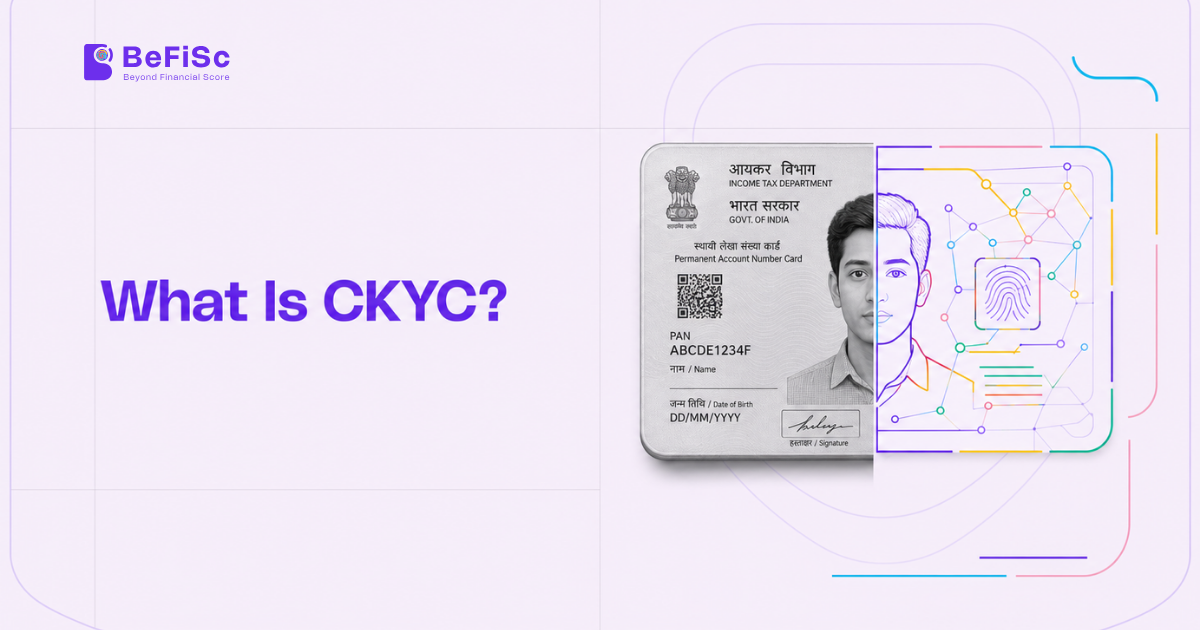
Before Central KYC, every financial relationship in India started from zero. Open a bank account, buy an insurance policy, start a SIP and take a loan, and you would submit the same documents four times to four institutions, each storing its own copy.
CKYC was designed to end that duplication. One verified record, one identifier, reusable across the financial sector.
This guide explains the CKYC framework, the role CERSAI plays, how CKYC compares with e-KYC and KRA KYC, and what the 2025 reforms mean for institutions and customers. For a detailed walkthrough of CKYCRR messages and identifier handling, see our companion guide on CKYCRR.
What CKYC Means
CKYC stands for Central Know Your Customer. It is the framework under which regulated financial institutions upload a customer’s verified KYC data to a single national registry, the Central KYC Records Registry (CKYCRR), and retrieve it when the same customer approaches them later.
Each customer receives a 14-digit KYC Identifier on first upload. That number, not the documents, becomes the portable proof that KYC has been done.
Why India Built a Central KYC System
The policy logic has three parts.
- Customer friction: Repeated document submission slowed onboarding and excluded people with limited paperwork.
- Cost: Each institution paid separately to collect, verify, store and refresh the same data.
- Risk and inconsistency: Different institutions held different versions of the same customer, making it harder to spot identity misuse.
The framework draws its authority from the Prevention of Money-Laundering Act, 2002 and the PML (Maintenance of Records) Rules, 2005, which require regulated entities to file KYC records with the central registry.
CERSAI: The Institution Behind the Registry
CERSAI, the Central Registry of Securitisation Asset Reconstruction and Security Interest of India, was originally set up under the SARFAESI Act to maintain a national register of security interests, such as mortgages on property. That is why many people know it from property and loan searches.
The Government later authorised CERSAI to also act as the Central KYC Records Registry. It became operational for regulated entities in 2016, with banks uploading records for new individual accounts from early 2017 and other sectors following.
CERSAI’s KYC role is custodial: it stores, de-duplicates and distributes records and notifications. It does not verify customers itself. The accuracy of a record remains the responsibility of the entity that collected and uploaded it.
How CKYC Differs from e-KYC, V-CIP and KRA KYC
These terms are often mixed up because they describe different layers.
| Term | What it is | Role in onboarding |
|---|---|---|
| CKYC | Central registry framework for sharing verified KYC records | Reuse of an existing record |
| e-KYC | Aadhaar-based electronic authentication with UIDAI | Fresh verification of identity and address |
| Offline verification | UIDAI-signed XML, Secure QR or DigiLocker | Fresh verification without a live UIDAI query |
| V-CIP (video KYC) | RBI-approved live video process with an official | Remote customer due diligence |
| KRA KYC | SEBI’s KYC Registration Agencies for the securities market | Reuse within capital markets |
A typical modern journey combines them: try CKYC first, and if no usable record exists, verify afresh through e-KYC, offline verification or V-CIP, then upload the new record to CKYCRR.
Individual and Legal-Entity CKYC
CKYC began with individuals. RBI later extended upload obligations to legal entities such as companies, partnerships and trusts, for accounts opened from April 2021, with older accounts uploaded at periodic updation.
Legal-entity records are more complex. They include constitutional documents, beneficial owner details and authorised signatories. They also go stale faster, because directors, signatories and ownership change. Institutions relying on a legal-entity CKYC record should re-check current company data from MCA filings and GST registration before relying on it.
What Changed in 2025
Three developments reshaped CKYC during 2025.
- Budget announcement: The Union Budget on 1 February 2025 announced a revamped Central KYC Registry with a streamlined system for periodic updating.
- Simplified periodic updation: RBI’s June 2025 amendments made it easier to update KYC for low-risk individuals, including through self-declaration, business correspondents and digital channels, and required institutions to act on updates notified by CKYCRR.
- New Directions: On 28 November 2025, RBI replaced the Master Direction on KYC, 2016 with separate KYC Directions for each category of regulated entity. The CKYC obligations continue under the new structure.
Together with the late-2024 rule that the KYC Identifier is the first reference point for onboarding, the direction is clear: CKYC is expected to be the default, not an afterthought.
Benefits and Limits
Benefits
- Faster onboarding with fewer document requests
- Lower cost of verification and storage
- A consistent record that updates across institutions
- Better customer experience for repeat financial relationships
Limits
- Legacy quality: Early uploads can have poor images or outdated addresses.
- Coverage: Customers who have never dealt with a regulated entity have no record.
- Not proof of presence: A record proves KYC was once done, not that the applicant today is the same person.
- Legal-entity drift: Company records can be out of date quickly.
The practical rule: use CKYC to speed things up, and live checks to stay safe.
Use Cases
Mutual fund distributor: A distributor pulls the investor’s CKYC record at onboarding, confirms PAN status and bank account, and completes the account without asking for documents.
Gold loan company: Branch staff retrieve CKYC for walk-in customers, capture a live photo for face match, and use biometric or offline Aadhaar only where no usable record exists.
Corporate account opening: A bank retrieves a company’s legal-entity CKYC, then verifies current directors and beneficial owners against MCA data before activating the account.
Key Takeaways
- CKYC is India’s framework for reusing verified KYC across banks, NBFCs, insurers, brokers and pension providers.
- CERSAI operates the registry but does not verify customers; uploading entities own record accuracy.
- CKYC is a reuse layer; e-KYC, offline verification and V-CIP are fresh-verification methods.
- 2025 brought a Budget-announced revamp, simpler periodic updation and new entity-wise KYC Directions.
- Retrieved records still need live checks for identity, presence and current data.
Frequently Asked Questions
Is CERSAI a government body?
CERSAI is a Government of India company that operates both the security-interest registry and the Central KYC Records Registry.
How can I find my CKYC number?
It is usually communicated by SMS or email after your first upload. You can also ask any bank, insurer or broker you have completed KYC with.
Is CKYC mandatory?
Uploading and using CKYC records is mandatory for regulated entities. For customers, completing KYC is required; CKYC simply lets that KYC be reused.
What is a CKYC number?
The 14-digit KYC Identifier assigned by the Central KYC Records Registry when your KYC is first uploaded.
What is the full form of CKYC?
Central Know Your Customer.
Conclusion
CKYC is one of India’s quieter pieces of financial infrastructure, but it now shapes almost every onboarding journey. The 2025 reforms push institutions to treat the KYC Identifier as the starting point, keep records synchronised, and re-collect documents only when there is a reason.
The institutions that get the most from CKYC pair it with live verification, so that speed does not come at the cost of accuracy.
BeFiSc’s verification APIs provide those live checks, from PAN and bank account verification to company data and face match, so CKYC-first onboarding stays both fast and defensible. Talk to the BeFiSc team to design your flow.
[…] January 2020: RBI introduced V-CIP through an amendment to its KYC framework. […]